
Content Removal › Internet Defamation Removal
Internet Defamation Removal Service
We remove false, defamatory, and harassing content about people and businesses from websites, complaint and review sites, forums, social media, and Google, Bing, and AI search results. Pay after removal is available on eligible cases, and every agreed removal is backed by a money-back guarantee.
- ✓ Pay after removal available
- ✓ Free, confidential review
- ✓ Firm quote before any work starts
- ✓ Money-back guarantee on agreed removals
- ✓ 10+ years, 4,000+ clients served
Reviewed by Joe Chierotti, Defamation Defenders · Updated October 2026
Tell us what was posted and where. A removal specialist reviews the links confidentially, tells you which removal routes apply, and gives you a firm quote before any work starts.
Free Expert Consultation
Can defamatory content be removed from the internet?
Short answer: Yes, in most cases. Defamatory posts are removed by (1) reporting violations of the hosting site’s own policies, (2) asking the publisher or webmaster to take the content down, (3) sending a legal demand through a partner attorney, or (4) obtaining a court order and submitting it to the site and to Google. When the original page can’t be deleted, it can often be deindexed from Google and Bing or pushed off page one with suppression. You don’t have to prove a full defamation case to get most content removed.
Defamation Defenders has spent more than ten years removing false and damaging content for over 4,000 individuals and businesses. We are an online reputation and content removal company that works with partner attorneys when a legal route is needed. We prepare and submit every request on your behalf, follow up, and confirm the result in search.
Key facts about internet defamation removal
| Question | Answer |
|---|---|
| What can be removed | False statements of fact, fake reviews, impersonation, harassment, doxxing, and posts that break a site’s terms of service |
| Where it can be removed from | The source website, Google, Bing, and the AI search tools that draw on them |
| Do you need a lawsuit? | Usually not. Most removals are won through platform policy and publisher outreach. Court orders are a last resort |
| How long it takes | Most removals resolve within a few days to a few weeks. Cases that need a court order take longer |
| What it costs | A firm per-link quote after a free review. Pay after removal and payment plans are available |
| If removal fails | Money back on any agreed removal we can’t complete |
What counts as online defamation?
Defamation is a false statement of fact, communicated to someone else, that harms another person’s or business’s reputation. Written or published defamation, which includes nearly everything posted online, is libel. Spoken defamation is slander. A post about you online is usually libel, even though many people call it “internet slander.”
The elements of a defamation claim
Laws vary by state, but a plaintiff generally has to show:
- A false statement of fact. Opinions (“the worst service ever”) are usually protected. Provably false claims (“he stole client money”) are not.
- Publication to a third party. Posting it on a website, review site, forum, or social network counts.
- Identification. A reasonable reader can tell the post is about you, even without your full name.
- Fault. Private people usually have to show negligence. Public figures must show “actual malice,” meaning the poster knew it was false or recklessly ignored the truth.
- Harm. Lost clients, jobs, income, or reputation. Some statements, such as false accusations of a crime, are treated as harmful on their own.
Defamation vs. negative content that isn’t defamation
| Type of content | Defamatory? | Can it still be removed? |
|---|---|---|
| False accusation of a crime, fraud, or cheating | Usually yes | Yes, through policy, outreach, legal demand, or court order |
| Fake review from someone who was never a customer | Often | Yes, most review platforms ban fake and conflict-of-interest reviews |
| Harsh opinion or bad review from a real customer | Usually no | Sometimes, if it breaks the platform’s rules |
| True but outdated or embarrassing information | No | Often, through deindexing, outreach, or suppression |
| Personal information or doxxing | No, but it may violate privacy policies | Yes, Google and most platforms remove doxxing on request |
Even when content isn’t legally defamatory, there is usually still a path. See our negative content removal and personal information removal services.
Types of defamatory content we remove
We handle defamation wherever it shows up, from one fake review to a coordinated harassment campaign across dozens of sites.
Complaint and gripe sites
Fake and defamatory reviews
Cheater and gossip sites
Forums and Reddit
Social media posts
Blogs and attack sites
News articles
Deepfakes and images
Why online defamation does so much damage
It ranks for your name
AI answers repeat it
It costs real money
It spreads and gets copied
How we remove defamatory content
Every case gets the fastest route that will actually work. We usually run more than one at the same time.
1. Platform policy and terms-of-service reports
Most sites prohibit fake reviews, harassment, impersonation, threats, hate speech, and posting private information. A well-documented report that cites the exact rule is the fastest way to get a post taken down, often in days.
2. Publisher and webmaster outreach
Many site owners, bloggers, and editors will remove, correct, or anonymize a post when they are shown it is false or violates their policies. We handle the contact so you never have to deal with the poster directly.
3. Legal demand through a partner attorney
When a site or poster won’t cooperate, one of our partner attorneys can send a formal demand or cease-and-desist letter. This route works especially well against identifiable posters and businesses.
4. Court orders
If the poster can be sued, a court can rule the content defamatory and order it removed. We then submit the order to the hosting site, to Google, and to Bing. Google reviews court orders case by case, so a clear, URL-specific order matters.
5. Google, Bing, and AI search removal
When the source page is gone or changed, we file outdated-content requests so the old title and snippet drop out of search. We also use Google’s own policies on personal information, doxxing, and sites with exploitative removal practices. Learn more about our Google deindexing service.
6. Suppression when removal isn’t possible
For content that is protected opinion or can’t be removed at the source, we push it off page one with positive, accurate content. See search result suppression.
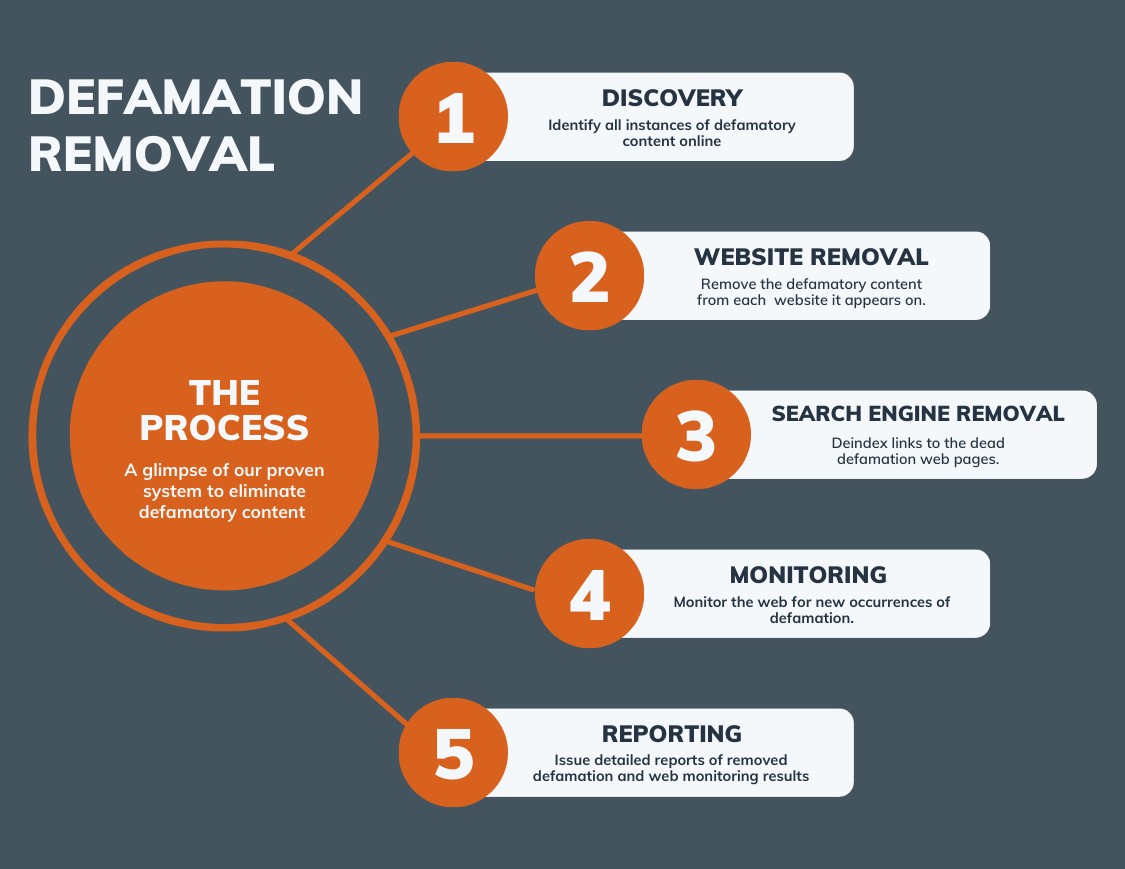
Our internet defamation removal process
Free confidential review
Send us the links. We check every URL, the site’s policies, copies on other sites, and what shows in Google, Bing, and AI answers for your name.
Firm quote and plan
You get a written per-link price and the removal routes we’ll use. No work starts until you approve it.
We file and follow up
We prepare and submit every request, report, and demand on your behalf and push each one to a decision.
Search cleanup
Once a page is removed or changed, we clear the cached result from Google and Bing so it stops showing for your name.
Confirmation and monitoring
We confirm each removal with you and watch for reposts and copies. Ongoing monitoring is available.
How long does defamation removal take?
Most removals resolve within a few days to a few weeks. Timing depends mostly on which route works for the site involved.
| Removal route | Typical timing | What affects it |
|---|---|---|
| Platform policy report | A few days to a few weeks | How clearly the post breaks the rules and how fast the platform reviews reports |
| Publisher or webmaster outreach | A few days to a few weeks | Whether the owner responds and agrees to remove or correct the post |
| Partner attorney demand | A few weeks | Whether the poster or site is identifiable and responsive |
| Court order | Several months or longer | Court schedules, finding anonymous posters, and whether the defendant contests |
| Google and Bing cleanup | Days to a few weeks after the source changes | Search engine review queues and recrawl timing |
Every quote includes a realistic timeline for your specific links, so you know what to expect before you pay anything.
Why websites refuse to remove defamation (Section 230)
Section 230 of the Communications Decency Act generally shields websites from liability for what their users post. That means a site usually can’t be forced to pay damages for a defamatory comment, and many complaint sites use that protection to refuse removal requests outright.
Section 230 does not protect the person who wrote the post, and it does not stop a site from removing content voluntarily. That’s why the strongest strategies focus on the site’s own policies, the original poster, court orders, and search engines rather than threatening the website.
Watch out for removal scams. Some complaint sites sell paid “arbitration” or “advocacy” programs that only add a rebuttal while the post keeps ranking. Ask any removal company exactly what will be removed, from where, and what happens if it comes back.
Can you remove defamatory content yourself?
Sometimes. If a post clearly breaks a platform’s rules, you can report it yourself for free. Here’s how to start:
- Screenshot the post, the URL, the date, and the poster’s profile before you do anything else.
- Find the site’s terms of service or content policy and identify the exact rule the post breaks.
- Use the site’s report or legal form (see the platform links below) and cite that rule.
- Don’t reply publicly or contact the poster. It often makes things worse and creates more search results.
- Once the post is gone, use Google’s outdated content tool to remove the old result.
Where DIY removal goes wrong
Most self-filed requests fail because they argue the post is “unfair” instead of showing a specific policy violation or provable falsehood. Copies on other sites are missed, Google keeps showing cached results, and a public fight can spread the post further.
| Doing it yourself | Defamation Defenders | |
|---|---|---|
| Cost | Free, apart from your time | Firm per-link quote; pay after removal available |
| Knowing which route works | Trial and error | Matched to each site’s policies and track record |
| Copies and scraper sites | Often missed | Found and removed together |
| Legal demands | You’d hire and manage a lawyer | Handled through partner attorneys when needed |
| Google and Bing cleanup | Separate requests you file | Included |
| If it fails | You start over | Money back on agreed removals |
Should you sue for internet defamation?
A lawsuit is sometimes the right move, especially against an identifiable poster or a competitor. But it’s rarely the fastest or cheapest way to get content off the internet.
| Defamation lawsuit | Content removal | |
|---|---|---|
| Goal | Damages and a court ruling | Getting the content off the site and out of search |
| Typical time | Months to years | Days to weeks for most cases |
| Cost | Attorney fees can be substantial | Firm quote up front |
| Anonymous posters | Need subpoenas to identify them | Often unnecessary |
| Risk | Public filings and anti-SLAPP motions can backfire | Confidential |
| Deadlines | Statutes of limitation are short, often one to two years from posting depending on the state | No filing deadline |
If you’re considering legal action, talk to a defamation attorney about your state’s rules. We can work alongside your lawyer, or bring in a partner attorney, so removal happens while the legal side plays out.
Internet defamation law: common questions
Defamation law applies online much as it does in print, but the speed and reach of the internet raise their own questions. This is general information, not legal advice; rules vary by state.
Are bloggers considered journalists in defamation cases?
For defamation purposes, U.S. courts generally give bloggers the same protections and responsibilities as traditional media. The First Amendment protects opinion and true statements, not false statements of fact, so bloggers can be sued like anyone else.
Are bloggers or people who comment on local politics public figures?
Usually not just for having a blog. But someone who voluntarily enters a public controversy can become a “limited-purpose public figure” for that topic and would then have to prove actual malice. Public figures face a much higher bar than private individuals.
Are businesses treated as public figures?
It depends on the facts. Large, well-known companies are often treated like public figures, while small private businesses are usually treated like private individuals. Businesses can bring defamation claims over false statements that harm their reputation.
Can a post be defamatory if it says “in my opinion” or leaves out names?
Yes. Adding “IMO” doesn’t protect a statement that implies false facts, and leaving out a name doesn’t help if readers can still tell who the post is about. Courts look at how a reasonable reader would understand it.
Is it illegal to link to defamatory content?
A bare link is usually not treated as republishing the defamation, but repeating, endorsing, or adding to the false claims around the link can create liability. When in doubt, don’t share or link to it.
Am I liable if someone posts something defamatory on my website?
Generally no. Section 230 protects site owners from liability for user posts. That protection can be lost if you write or materially contribute to the defamatory content yourself.
Are fake reviews defamatory or illegal?
Fake reviews can be defamatory when they make false factual claims about a business. Separately, the FTC’s rule on fake reviews prohibits writing, buying, or selling fake consumer reviews and allows civil penalties. Competitors who post fake reviews may also face false-advertising claims under the Lanham Act.
Will defamatory content come back?
It can. Posters repost, complaint sites copy each other, and Google can surface a duplicate once the top result is gone. We reduce that risk by removing every copy we can find together, clearing search caches, and monitoring your name after the work is done.
- Fake and defamatory reviews: if the same reviewer reposts within 30 days, we handle it at no extra cost.
- Court records and mugshot pages: free re-removal if the page is re-posted on the same site.
- Other content: your written quote spells out exactly what is covered if a post returns, before you pay.
Ask any removal company what happens if the post comes back. We put our answer in writing. See our removal guarantee below.
Defamation Defenders vs. other removal options
| Defamation Defenders | Typical removal companies | Hiring a lawyer only | |
|---|---|---|---|
| Free confidential review | Yes | Varies | Often a paid consultation |
| Firm price before work starts | Yes, per link | Varies | Hourly or retainer |
| Pay after removal | Available on eligible cases | Rare | No |
| Money-back guarantee | On every agreed removal | Varies | No |
| Policy, outreach, legal, and search routes | All, in one plan | Often just one | Mostly legal |
| Google, Bing, and AI search cleanup | Included | Sometimes extra | Usually not included |
| Payment plans | Available | Varies | Varies |
Pay after removal. Money back if we can’t remove it.
Most defamation removal services ask you to trust them. We put our terms in writing before any work starts.
Pay after removal
Available on eligible cases, with no upfront fee. We’ll tell you during your free review if your case qualifies.
Money-back guarantee
If we can’t complete a removal we agreed to, you get your money back.
Firm, written price
A per-link quote before work starts. No hourly billing and no surprise fees.
Flexible payment
All major credit cards and Zelle, plus payment plans for larger projects.
Defamation removal reviews
Here’s what Defamation Defenders clients say about getting false and negative content removed. We’ve served more than 4,000 clients over the past ten-plus years.
Buddika R
The service was very helpful and I would really recommend it to anyone else. It has helped me maintain my name online and escape from cyber bully.
Tim R
I used Defamation Defenders to remove negative items about me from the internet and also help build me a more positive and professional reputation online so that I could find a suitable job in my industry. Today my online reputation is stellar and I’m happily employed, likely in part to the work Defamation Defenders did on my reputation.
John Wester
it is a great service, I suggest to everyone to use this service.thanks for this service
Toni P.
A very good business that offers the personal reputation management services that actually work. Great solution to clean personal information off the internet and scrub your reputation if you are unfairly included in a negative article or defamatory posting online.
N. Helaki
Where to report defamation on major platforms
If you want to try a report yourself first, these are the official forms. Cite the specific policy the post breaks and include the exact URL.
| Platform | Official reporting page |
|---|---|
| Google Search | Report content for legal reasons |
| Defamation reporting form | |
| YouTube | Defamation complaint requirements |
| SoundCloud | Reporting defamation |
| WordPress.com | Defamation policy |
Need help with a specific platform? See Facebook removal, YouTube video removal, Instagram removal, and TikTok removal.
Internet defamation removal FAQs
How do I remove defamatory content from the internet?
Start by documenting the post, then report it to the hosting site under the specific policy it breaks. If that fails, ask the publisher to remove it, send a legal demand, or obtain a court order. Once the page is removed or changed, request removal of the old result from Google and Bing. Defamation Defenders handles every step on your behalf.
Can you remove defamatory content from Google?
Yes. Google removes results when the source page is deleted or changed, when content violates its policies on personal information or doxxing, and in some cases when it receives a valid court order. Google reviews court orders case by case and generally does not remove content just because someone says it is false.
What is the difference between libel and slander?
Libel is written or published defamation, which includes posts, reviews, and articles online. Slander is spoken defamation. Most internet defamation is technically libel.
How do I prove a post is defamatory?
You generally need to show a false statement of fact, published to others, that identifies you, was made with the required level of fault, and caused harm. Documents, records, and screenshots that show the claim is false make the strongest case.
Do I need to sue to get defamation removed?
Usually not. Most defamatory content is removed through platform policy reports, publisher outreach, or legal demand letters. A lawsuit and court order is a last resort for content that cannot be removed any other way.
How much does internet defamation removal cost?
It depends on the website, the number of links, and the removal route. We give you a firm per-link quote after a free, confidential review. Pay after removal is available on eligible cases, and payment plans are available.
Do you offer pay after removal?
Yes. Pay after removal is available on eligible cases, with no upfront fee. We confirm whether your case qualifies during your free review.
What happens if you cannot remove the content?
If we cannot complete a removal we agreed to, you get your money back. If removal at the source is not possible, we can also discuss deindexing or search result suppression.
How long does defamation removal take?
Most removals resolve within a few days to a few weeks. Cases that require a court order or involve uncooperative sites can take several months.
What if the defamatory post comes back?
If the same reviewer reposts a removed review within 30 days, we handle it at no extra cost. Court records and mugshot pages re-posted on the same site are removed again free. Your written quote states exactly what is covered for other content.
Can you find out who posted anonymous defamation?
Sometimes. Identifying an anonymous poster usually requires a lawsuit and a subpoena to the website or internet provider. In many cases the content can be removed without ever identifying the poster.
Can you remove a negative review that is not defamatory?
Sometimes. A real customer’s honest opinion is usually protected, but reviews that are fake, posted by competitors or former employees, off-topic, or that break the platform’s rules can often be removed.
Can a website be sued for defamation posted by its users?
Usually not. Section 230 of the Communications Decency Act generally protects websites from liability for user posts. The person who wrote the post can still be held responsible.
Can you remove defamation from ChatGPT and AI search results?
AI tools draw on what is published and indexed online. Removing or deindexing the source pages is the most reliable way to stop AI answers from repeating false claims, and we monitor AI results as part of the cleanup.
How long do I have to sue for online defamation?
Statutes of limitation for defamation are short, often one to two years from the date of publication, depending on the state. Talk to a defamation attorney in your state as soon as possible if you are considering a lawsuit.
Is Defamation Defenders a law firm?
No. Defamation Defenders is an online reputation and content removal company. When a case needs legal action, we work with partner attorneys. Nothing on this page is legal advice.
Is the process confidential?
Yes. Your review, the links you send us, and the work we do are kept confidential. We submit requests on your behalf, so you do not have to contact the poster or the website yourself.
Do you remove defamation for businesses?
Yes. We remove defamatory reviews, complaint posts, forum threads, and articles for businesses, professionals, and executives, and can pair removal with business reputation management.
Related removal services
- Content removal services
- Negative content removal
- Review removal
- Complaint site removal
- Cheater website removal
- Reddit removal
- Social media removal
- News article removal
- Google deindexing service
- Search result suppression
- Business reputation management
- Personal reputation repair
- AI reputation management
- Reputation monitoring
Find out if your defamatory content can be removed
Send us the links. We’ll review them confidentially, tell you which removal routes apply, and give you a firm quote before any work starts. Pay after removal is available on eligible cases. Call 1-800-785-1749 or request your free review online.
Defamation Defenders is an online reputation and content removal company, not a law firm, and nothing on this page is legal advice. Defamation Defenders is not affiliated with Google, Facebook, YouTube, or the other platforms named on this page.
Published · Last updated by the Defamation Defenders team