
Content Removal › Court Records
Court Records Removal Service
We remove court cases, lawsuits, and criminal case records from Google, Bing, legal databases like Justia, UniCourt, Trellis, PlainSite, and PacerMonitor, people-search sites, and the AI tools that quote them, so the first thing people find about you is no longer a docket.
- ✓ Free, confidential case review
- ✓ Firm quote before any work starts
- ✓ Money-back guarantee on agreed removals
- ✓ 10+ years, 10,000+ records removed
Can court records be removed from the internet?
Yes, in most cases. The official file kept by the court usually stays on record unless a judge seals or expunges it. But the copies people actually find, on Google, legal databases such as Justia and UniCourt, people-search sites, and AI answers, are published by private companies that can remove, anonymize, or deindex a case. Defamation Defenders handles that work for you, site by site, and confirms each result is gone.
Key facts about court record removal
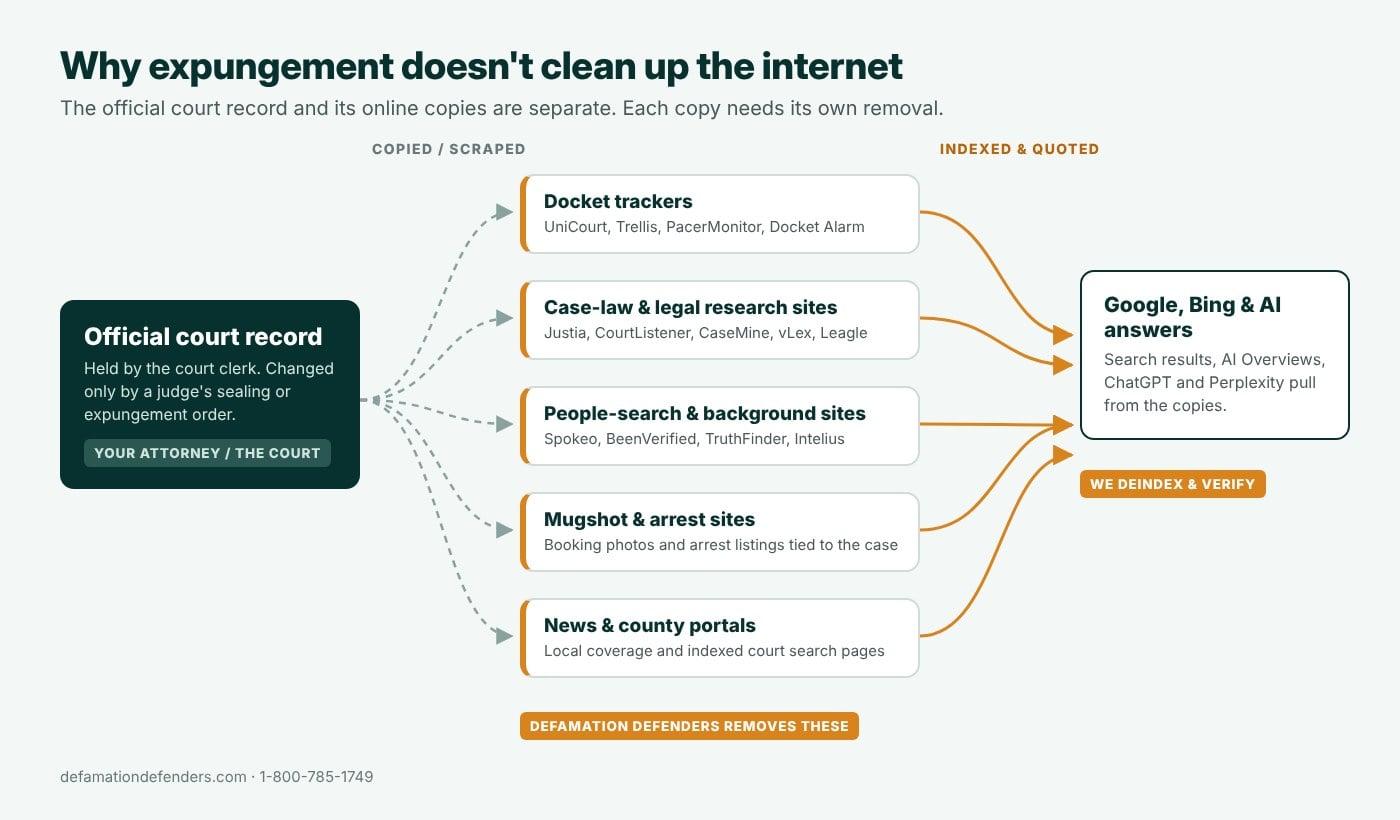
- Two different records exist. The court’s official record and the online copies are separate. Removing one does not remove the other.
- Expungement does not clean up the internet. A sealing or expungement order binds the court and government agencies. Third-party websites keep showing the case until someone sends them the order and asks for removal.
- Every site is its own project. Removing a case from Justia does not remove it from UniCourt, Trellis, or a people-search site. Each has its own policy and process.
- Google follows the source. Once a page is removed or your name is redacted, Google and Bing can be asked to drop or refresh the outdated result.
- Some cases are stronger than others. Dismissed, acquitted, sealed, expunged, juvenile, and older civil cases are the best candidates for full removal.
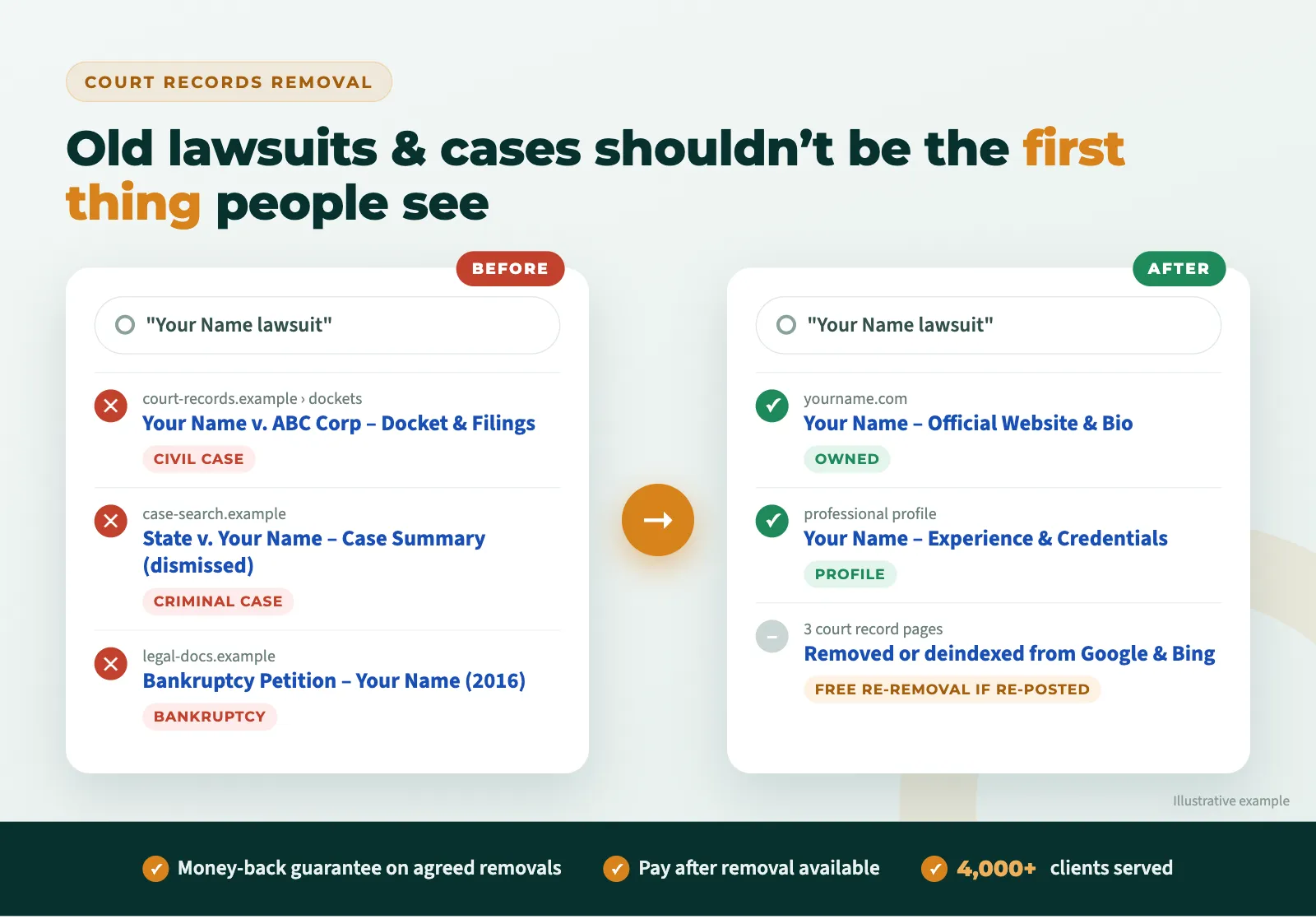
Why an online court record is a problem, even when you did nothing wrong
Court record aggregators publish millions of cases automatically, with no context about how the case ended. A lawsuit you won, a charge that was dismissed, or a divorce from a decade ago can rank on page one for your name and sit there indefinitely.
Outdated listings, no context
Housing and business
Clients, partners, and dates
AI answers repeat it
Where court records show up online, and what we can do about each
Before we quote anything, we search your name the way anyone looking you up would. These are the places court records usually surface:
| Where it appears | Common examples | What we do |
|---|---|---|
| Docket trackers and PACER scrapers | UniCourt, Trellis, PacerMonitor, Docket Alarm, DocketBird, PlainSite, Justia Dockets, CourtListener (RECAP) | Removal requests, name redaction, or noindexing of the case page |
| Case-law and legal research sites | Justia, CourtListener, CaseMine, vLex, Leagle, FindLaw, AnyLaw, OpenJurist | Anonymization of your name in published opinions, removal or noindexing where policy allows |
| People-search and background sites | Spokeo, BeenVerified, TruthFinder, Intelius, Instant Checkmate, Radaris, Whitepages | Opt-outs and accuracy disputes for sealed, expunged, or dismissed cases |
| County court and sheriff portals | Online case search pages and inmate or booking pages indexed by Google | Search engine deindexing requests, plus sealing-order enforcement where applicable |
| Mugshot and arrest sites | Arrest-record and booking-photo websites tied to the case | Full removal through our mugshot removal service |
| News and blogs | Local news coverage of the arrest, lawsuit, or trial | Updates, anonymization, or removal through our news article removal service |
| Search engines and AI | Google, Bing, Google AI Overviews, ChatGPT, Perplexity, Copilot | Deindexing and outdated-content refresh after source removal; Google deindexing when the page itself stays up |
Not sure where your case is listed? That is what the free review is for. We send you a list of every URL we find, at no cost.
Types of court records we remove
Criminal case records
- Dismissed or dropped charges including nolle prosequi and no-bill cases
- Not-guilty verdicts and acquittals
- Expunged and sealed cases that are still online
- Completed diversion or deferred judgment cases
- Arrests with no charges filed
- Dismissed or resolved traffic and misdemeanor cases
- Juvenile records that were published
Civil court records
- Lawsuits you won, settled, or were wrongly named in
- Divorce, custody, and family court cases
- Evictions and landlord-tenant cases
- Small claims and debt collection suits
- Bankruptcy filings on aggregator sites
- Protective and restraining orders that were dismissed or expired
Business and federal cases
- Business and contract disputes naming you or your company
- Employment and HR lawsuits
- Federal (PACER) cases republished by PacerMonitor, Justia, and others
- Appellate opinions that name you, through anonymization requests
- Professional licensing and administrative actions on aggregators
Which court records are easiest to remove?
We tell you up front what is realistic. Removal depends on the outcome of the case, its age, and who publishes it.
| Likelihood | Typical situations |
|---|---|
| Strong candidates | Sealed, expunged, or juvenile cases; dismissed charges; acquittals; cases where you were the victim or a minor party; outdated records on people-search sites; most docket aggregator listings |
| Case-by-case | Older civil lawsuits, divorces, evictions, and judgments that were paid or vacated; published appellate opinions (name redaction is often possible); county portals that are indexed by Google |
| Hardest | High-profile cases with ongoing news coverage and official government court websites. We do not take on active or pending cases. When a page cannot be removed, we can often deindex it or push it down with search result suppression. |
If we do not think we can remove a record, we will say so before you pay, not after.
How our court record removal process works
Free confidential audit
Send us your name, the case, or the links that worry you. We search Google, Bing, legal databases, people-search sites, and AI answers, and list every place the record appears.
Firm quote and guarantee
You get a link-by-link removal plan: what can be removed, the method for each site, the timeline, and a firm price. Nothing starts until you approve it.
Removal and deindexing
We file formal requests with each publisher, backed by your dismissal, sealing, or expungement paperwork where it helps, then ask Google and Bing to drop or refresh the outdated results.
Verification and monitoring
We confirm each record is gone from the source site and from search results, then send you a report. Optional monitoring alerts us if a database re-scrapes the case.
The removal methods we use
Source removal
The best result is deleting the page where it lives. Many legal databases and people-search sites will take down a case listing when the request cites the right policy and includes the right documentation. Once the source is gone, search engines and AI tools lose it too.
Name redaction and anonymization
Some sites keep published opinions online for legal research but will replace a private person’s name with initials. Your case stays in the law library, but it no longer shows up when someone searches your name.
Search engine deindexing
When a page is removed or changed, we use Google’s and Bing’s outdated-content processes so the old result and snippet disappear. When a page stays up but qualifies under a search engine policy, we request removal from search results directly. Learn more about our Google deindexing service.
People-search opt-outs and accuracy disputes
Background and people-search sites re-list data constantly. We handle opt-outs across the major brands and dispute listings that report sealed or expunged cases, which background check companies generally should not report. See our personal information removal service.
Suppression, when removal is not possible
For official government pages or high-profile cases, we build and promote accurate, positive content so the record moves off page one. How search result suppression works.
Why your record is still online after expungement or sealing
This is the most common reason people call us. An expungement or sealing order tells the court and government agencies to restrict the record. It does not reach the private websites that copied the case before the order, and those sites rarely check for updates on their own.
More states are passing “Clean Slate” laws that seal eligible records automatically, which means many people now have sealed records they never had to file for, while the old copies stay on Google. The same is true for dismissed and acquitted cases: the court record shows the outcome, but the aggregator page often shows only the charge.
Sealing vs. expungement: does it matter online?
Rules vary by state. Generally, sealing hides the record from the public while keeping it available to courts and some agencies, and expungement treats the record as erased or destroyed. For online removal, both are powerful because they show a publisher the record is no longer meant to be public.
Documents that strengthen a removal request
- Signed sealing or expungement order
- Dismissal order, nolle prosequi, or final judgment showing acquittal
- Proof of completed diversion or deferred judgment
- Satisfaction of judgment, vacated judgment, or stipulated dismissal (civil cases)
- Case number, court, and filing date
Don’t have a sealing order yet? Expungement is a court process, usually handled by a criminal defense or record-clearing attorney. Once you have the order, we use it to clean up every copy online.
Court records in ChatGPT, Google AI Overviews, and AI search
AI assistants answer questions about people by pulling from pages that are indexed and well-ranked. If a docket page or case summary ranks for your name, it can show up in a Google AI Overview or be cited in a ChatGPT, Perplexity, or Copilot answer.
There is no single “delete” button for AI answers. The reliable fix is removing or deindexing the sources the AI relies on, then giving it accurate, current information to cite instead. Every court record project we take on includes a check of major AI tools for your name, and we re-check after the sources are gone.
Can you remove court records yourself?
Sometimes. Many sites accept removal requests by email or web form, and you can use Google’s outdated-content tool once a page changes. Where people get stuck is volume and policy: a single case is often copied to 5 to 15 sites, each with different rules, and generic requests are frequently ignored or denied.
For a step-by-step overview of checking publishers, documenting each URL, and addressing search results, see our guide to removing court cases from Google.
| Doing it yourself | Defamation Defenders | |
|---|---|---|
| Finding every copy | Manual searches; easy to miss aggregators and people-search listings | Full audit of search engines, legal databases, people-search sites, and AI tools |
| Request quality | Generic forms, often denied | Policy-specific requests with the right documentation for each site |
| Google and Bing cleanup | Separate tools and follow-up | Handled for every removed URL and verified |
| If it comes back | Start over | Monitoring and re-removal support |
| Cost if it fails | Your time | Money back on any agreed removal we cannot complete |
Our court record removal guarantee
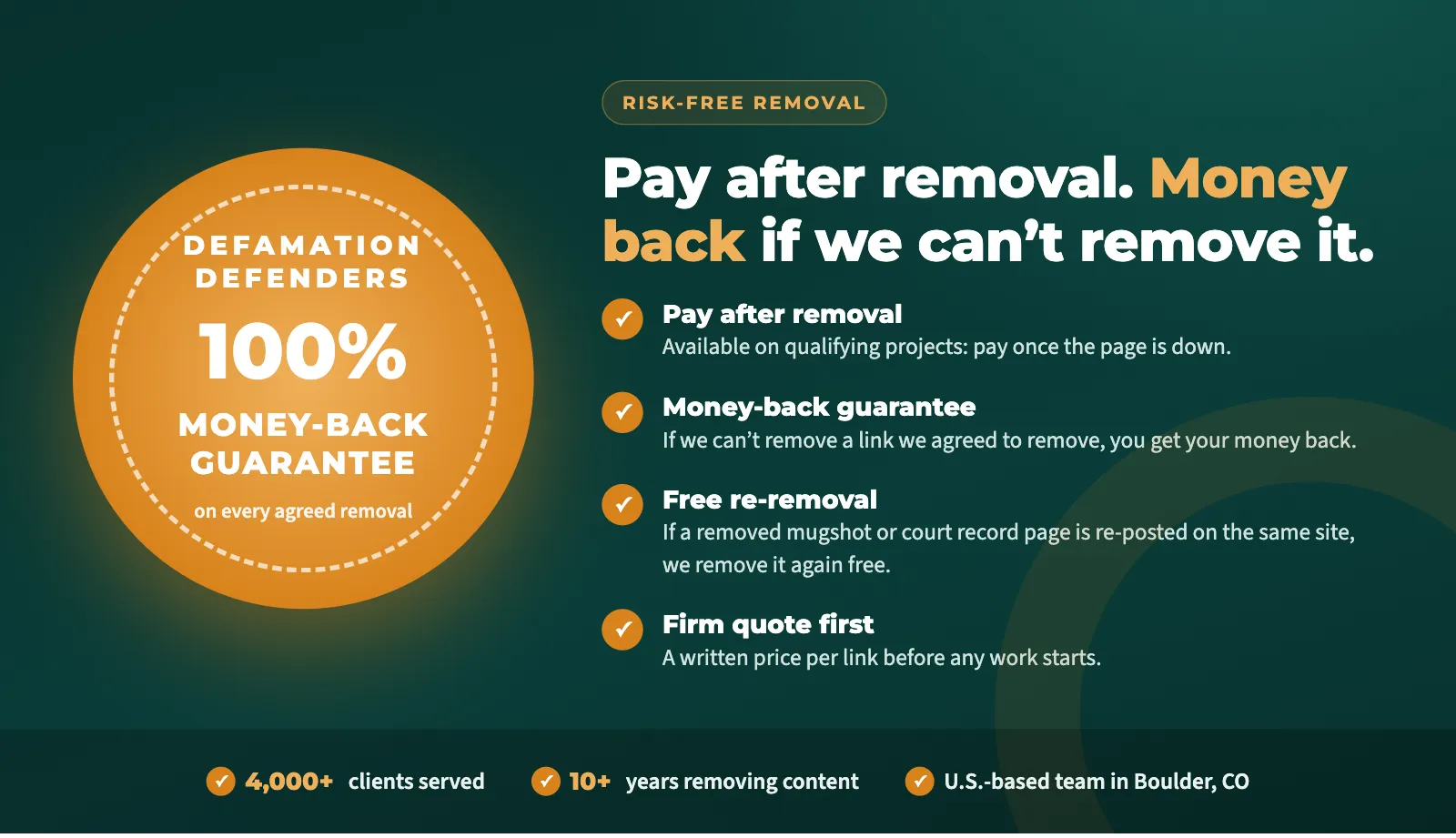
Money-back guarantee
If we agree to remove a record and cannot, you get a full refund for that removal.
Firm price up front
You see the exact price per link before work begins. Discounts apply when a case appears on multiple sites.
Re-removal at no extra cost
If a court record or related mugshot page we removed is re-posted on the same site, we remove it again at no additional charge.
Flexible payment
All major credit cards and Zelle, with payment arrangements available for multi-site projects.
Court record removal FAQs
Can court records be removed from Google?
Yes. Google generally removes a court record from search results once the page hosting it is deleted, changed, or redacted. We remove or anonymize the source first, then use Google’s outdated-content process to clear the result and snippet. When the source cannot be changed, some pages can still be deindexed or suppressed.
How do I remove my court case from Justia, UniCourt, or Trellis?
Each site has its own removal or privacy policy. Requests are strongest when they include your case details and a sealing order, expungement order, dismissal, or another reason the listing is outdated or harmful. We prepare and submit these requests for you, follow up, and confirm removal. Removing a case from one site does not remove it from the others. For Justia-specific policies and search visibility options, see our Justia removal services.
My record was expunged. Why is it still online?
An expungement order applies to the court and government agencies, not to private websites that copied the case earlier. Those sites keep showing it until someone sends them proof of the expungement and requests removal. This is one of the most successful types of removal we handle.
Can you remove a case that was dismissed?
Usually, yes. Dismissed charges, not-guilty verdicts, and cases where no charges were filed are strong candidates because the online listing often shows the accusation without the outcome.
Can civil lawsuits be removed from the internet?
Often. Civil cases, including lawsuits you won or settled, evictions, small claims, and debt collection suits, are commonly republished by docket aggregators. Many of those sites will remove or redact listings for private individuals, especially older or resolved cases.
Can you remove divorce or family court records?
In many cases, yes. Family court records frequently involve private details and minors, and many publishers will remove or redact them on request. We review each case before quoting.
Can federal (PACER) court records be removed?
The official PACER record stays with the federal court, but third-party sites that republish federal dockets, such as PacerMonitor, Justia Dockets, and CourtListener, have their own removal and redaction processes. We work with those sites and with search engines.
How long does court record removal take?
It depends on the site. Many removals are completed within a few weeks, and some sites act within days. Government pages and sites that require a document review can take longer. Your quote includes an estimated timeline for each link.
How much does court record removal cost?
Cost depends on how many sites list the record, the type of case, and whether a page is on a government website. We give you a free, firm quote per link before any work starts, with discounts when a case appears on multiple sites.
Will removing the record also remove it from ChatGPT and AI Overviews?
Over time, yes. AI tools rely on indexed web pages, so removing and deindexing the sources removes what they draw from. We check major AI tools for your name before and after the project.
What if the record comes back after it is removed?
Some databases re-scrape court systems. If a court record or related mugshot page we removed is re-posted on the same site, we remove it again at no additional cost. Optional monitoring helps catch new copies early.
Do I need a lawyer to remove court records online?
Not for removing third-party copies, which is what we do. You need a lawyer, or the court’s self-help process, if you want the official record sealed or expunged. Defamation Defenders is not a law firm and does not give legal advice.
Is court record removal legal?
Yes. We do not alter or delete official court files. We use each website’s own policies, search engine removal processes, and your lawful court orders to remove or limit private copies of your information.
Is my case kept confidential?
Yes. Your case review is free and confidential, and we never publish client names or case details.
Related removal services
Find out what can be removed, free
Send us your name or the links you want gone. We’ll show you every place your court record appears and give you a firm, guaranteed quote. Call 1-800-785-1749, Monday to Saturday, 8 AM to 6 PM.
Defamation Defenders is an online reputation and content removal company, not a law firm, and nothing on this page is legal advice. We do not alter official court records, and we do not help anyone conceal information from lawful background checks, courts, or government agencies. We focus on outdated, inaccurate, sealed, expunged, and resolved records published by private third-party websites. Results depend on each publisher’s policies and the facts of your case. Last updated October 2026.
Published · Last updated by the Defamation Defenders team