
Content Removal › Court Records › PlainSite
PlainSite Removal Service
Is a lawsuit, bankruptcy, divorce, or criminal case on PlainSite.org showing up when people search your name? We get the case suppressed from search engines under PlainSite’s own policy, deleted when you have a sealing or expungement order, removed from Google and Bing, and cleaned off the other court record sites and AI tools that copied it. Pay after removal is available, and if we can’t remove an agreed link, you get your money back.
- ✓ Pay after removal available
- ✓ Money-back guarantee on agreed removals
- ✓ Free, confidential PlainSite case review
- ✓ Firm quote before any work starts
- ✓ 10+ years, 10,000+ records removed
Reviewed by Joe Chierotti, Defamation Defenders · Updated October 2026

Get your free PlainSite removal quote
Confidential review. Firm price before any work starts.
Prefer to talk? Call 1-800-785-1749
Can you remove a case from PlainSite?
Often, yes, but PlainSite plays by its own rules. PlainSite is a legal transparency site run by Think Computer Corporation. It republishes federal cases from PACER, state court records, and data from agencies such as the IRS, FEC, and USPTO. It is not the court. PlainSite says it does not delete government-provided records without a court order, but it does keep some cases out of search engines, deletes cases that have been sealed or expunged, redacts Social Security numbers published in error, and on rare occasions shortens names to initials.
The catch is that PlainSite weighs every request against a long list of public-interest factors, takes about 30 days to reply, and does not control Google. The same case is usually also on PacerMonitor, CourtListener, Justia, UniCourt, and people-search sites. Defamation Defenders handles all of it: PlainSite first, then Google, Bing, and every other copy, and we confirm each result is gone.
Key facts about PlainSite case removal
- PlainSite covers a lot. Federal district, bankruptcy, and appellate dockets from PACER, plus records from state courts and agencies, along with the filed documents themselves.
- Removal usually means search engine suppression. PlainSite adds pages to a suppression list so search engines stop indexing them. Outright deletion requires a sealing, expungement, or other court order.
- Page views count against you. PlainSite says a record with roughly 100 or more hits signals strong public interest, and calls this one of the most important factors it weighs.
- One request per case, through the form. PlainSite no longer accepts removal requests by email. Requests go through its Contact Us form, one case at a time.
- Expect about 30 days. PlainSite says suppression and removal requests usually get a reply in 30 days, and that calls, letters, and repeat requests don’t speed it up.
- Google is a separate step. PlainSite does not control search engines. The old title and snippet can stay on Google until it recrawls the page or a removal request is approved.
What PlainSite will and won’t remove
PlainSite publishes one of the most detailed privacy policies of any court record site. It lists four things it can do, the factors that push it toward keeping a case public, and the factors that outweigh all of those. Here is how it plays out.
Sealed and expunged cases
This is the only route PlainSite names for full deletion. If a case was sealed or expunged after PlainSite first collected it and you provide the court order, PlainSite says it will delete the information according to the terms of the order. PlainSite itself recommends getting a record sealed or expunged first, then contacting it.
Individual, uncontested bankruptcy cases
PlainSite says the bankruptcy process is meant to help people start over, and it tries to honor requests to suppress individual bankruptcy cases. Repeat filers are the exception: PlainSite says someone with many bankruptcy filings should not get suppression, and even two cases of any kind can count against a request.
Family matters and cases involving minors
Divorces, custody disputes, and other family cases, along with matters involving minors, are factors PlainSite says outweigh its public-interest factors. These are among the strongest requests you can make.
Car crash lawsuits
PlainSite names lawsuits over vehicle accidents as a category it tends to keep out of search engines, because they often contain medical information.
Social Security numbers and account numbers
PlainSite will redact Social Security numbers and other sensitive data published by the government in error. On its own, though, that redaction does not lead PlainSite to suppress or remove the rest of the case.
Name abbreviation
In rare cases where a case has strong public interest but a person’s privacy is badly compromised, PlainSite may replace a name with initials so search engines no longer index it.
What PlainSite generally keeps public
- Records with about 100 or more hits on PlainSite’s view counter
- Cases involving government officials or agencies
- Cases involving $2,500 or more, and sometimes small claims over $1,000
- Serious criminal charges
- Recent or ongoing matters, generally those filed within the last five years
- Appealed or frequently cited cases, which PlainSite says it does not suppress as a rule
- Business, patent, and trademark matters, and cases involving lawyers or law firms
- Multiple cases or unusual filing activity by the same person
PlainSite also says it ignores what other websites have done, does not apply the California Consumer Privacy Act or the “right to be forgotten” to public records, and does not give weight to health conditions or personal attributes. It states plainly that it cannot guarantee any action on a given record ahead of time. If your case falls into the “keep public” group, we tell you before you pay, and we can often still push the Google result down with search result suppression.
Why a PlainSite listing hurts, even if you did nothing wrong
PlainSite is built as a transparency and legal research tool, but its case pages and document pages rank in Google for ordinary names. A result shows your name, the court, the case number, the docket, and often the full text of complaints and motions, with no context about how the case ended.
Employers and background checks
The documents are online too
Lenders, landlords, and partners
AI tools repeat it
What we remove from PlainSite
Civil and family cases
- Lawsuits you won, settled, or were wrongly named in
- Divorce, custody, and family law cases
- Car accident and personal injury suits
- Debt collection, eviction, and small claims cases
- Cases involving minors
Bankruptcy and federal cases
- Individual Chapter 7 and Chapter 13 bankruptcies
- Federal civil suits republished from PACER
- Dismissed or acquitted federal criminal cases
- Individual document pages (complaints, motions, exhibits)
Sealed cases and sensitive data
- Sealed and expunged cases still listed
- Dismissed or dropped charges
- Social Security and account numbers published in error
- Your name shortened to initials where full removal is not possible
How to remove PlainSite from Google
Even after PlainSite acts on a request, Google can keep showing the old title and snippet, with your name in it, until it recrawls the page. Here is how we clear it:
- Fix the source first. We get every PlainSite URL for the case suppressed, deleted under a court order, or changed to initials, so the page no longer exposes your information to search engines.
- Use Google’s and Bing’s removal tools. Where a page was deleted or changed, we file outdated-content requests so the cached title and snippet are dropped. Where it was suppressed, we track the recrawl until it falls out.
- Catch the document pages. PlainSite often has separate URLs for the docket and for individual filings. We find and clear each one, not just the main case page.
- Verify by name search. We search your name the way an employer would and confirm the PlainSite result is gone from Google, Bing, and AI answers.
Need the same process for other sites? See our Google deindexing service.
Which PlainSite cases are easiest to remove?
We tell you up front what is realistic, based on the factors PlainSite publishes.
| Likelihood | Typical situations |
|---|---|
| Strong candidates | Sealed or expunged cases with a court order, individual uncontested bankruptcies, divorce and custody cases, cases involving minors, car crash lawsuits, and Social Security or account numbers published in error |
| Case-by-case | Older civil suits where you were named as a private individual, dismissed charges, smaller-dollar disputes, and cases with low view counts on PlainSite |
| Hardest | Cases with about 100 or more hits, recent or ongoing cases, appealed cases, serious criminal charges, cases involving officials, lawyers, or businesses, and people with multiple cases. When PlainSite will not act, we can often still push the Google result down with search result suppression. |
If we do not think we can remove your PlainSite listing, we will say so before you pay, not after.
Our PlainSite removal process
Free confidential audit
Send us your name or the PlainSite link. We find every PlainSite URL tied to the case, including document pages, plus copies on PacerMonitor, CourtListener, Justia, UniCourt, people-search sites, and AI answers.
Firm quote and guarantee
You get a link-by-link plan: what can be removed, the method for each site, the timeline, and a firm price. Nothing starts until you approve it.
PlainSite request
We prepare one request per case, written to fit the factors PlainSite says it weighs, backed by your sealing, expungement, dismissal, or discharge paperwork, and we follow up until it is decided.
Google, Bing, and AI cleanup
We clear the PlainSite results from search engines, then remove the other copies of the case on our list.
Verification and monitoring
We confirm each result is gone and send you a report. Optional monitoring alerts us if the case resurfaces or shows up on a new site.
How long does PlainSite removal take?
Each stage runs on a different clock. Here is what to expect:
| Stage | Typical timing |
|---|---|
| PlainSite reply | Usually about 30 days, per PlainSite’s own contact page. Calls, letters, and repeat requests do not speed it up. |
| Sealing or expungement first | Depends on your court and state. PlainSite can only delete a case after the order exists. |
| Google and Bing | Can take several weeks after PlainSite acts. We use the search engines’ removal tools wherever they apply. |
| Other docket and people-search sites | Varies by site, from a few days to several weeks |
| ChatGPT and AI Overviews | Follow once the sources are suppressed and dropped from search |
Your quote includes an estimated timeline for each link, and with pay after removal, you are not paying while you wait.
Why PlainSite requests get denied, and how we avoid it
PlainSite gets 5 to 10 suppression and removal requests a day and has a small staff. Most denials come from requests that ignore its published factors: a case with heavy traffic, a recent case, or a request that only says “please remove my name.” PlainSite also says it does not care whether other websites already removed the case.
What strengthens a PlainSite removal request
- A sealing or expungement order, which is the one thing PlainSite says leads to deletion
- A clear reason that matches a factor PlainSite favors, such as a personal bankruptcy, family matter, minor, or car crash
- Dismissal order, judgment of acquittal, or bankruptcy discharge
- Proof that you are a private individual, not a business, official, or lawyer
- The exact PlainSite URLs for the case, sent once, in a single request per case
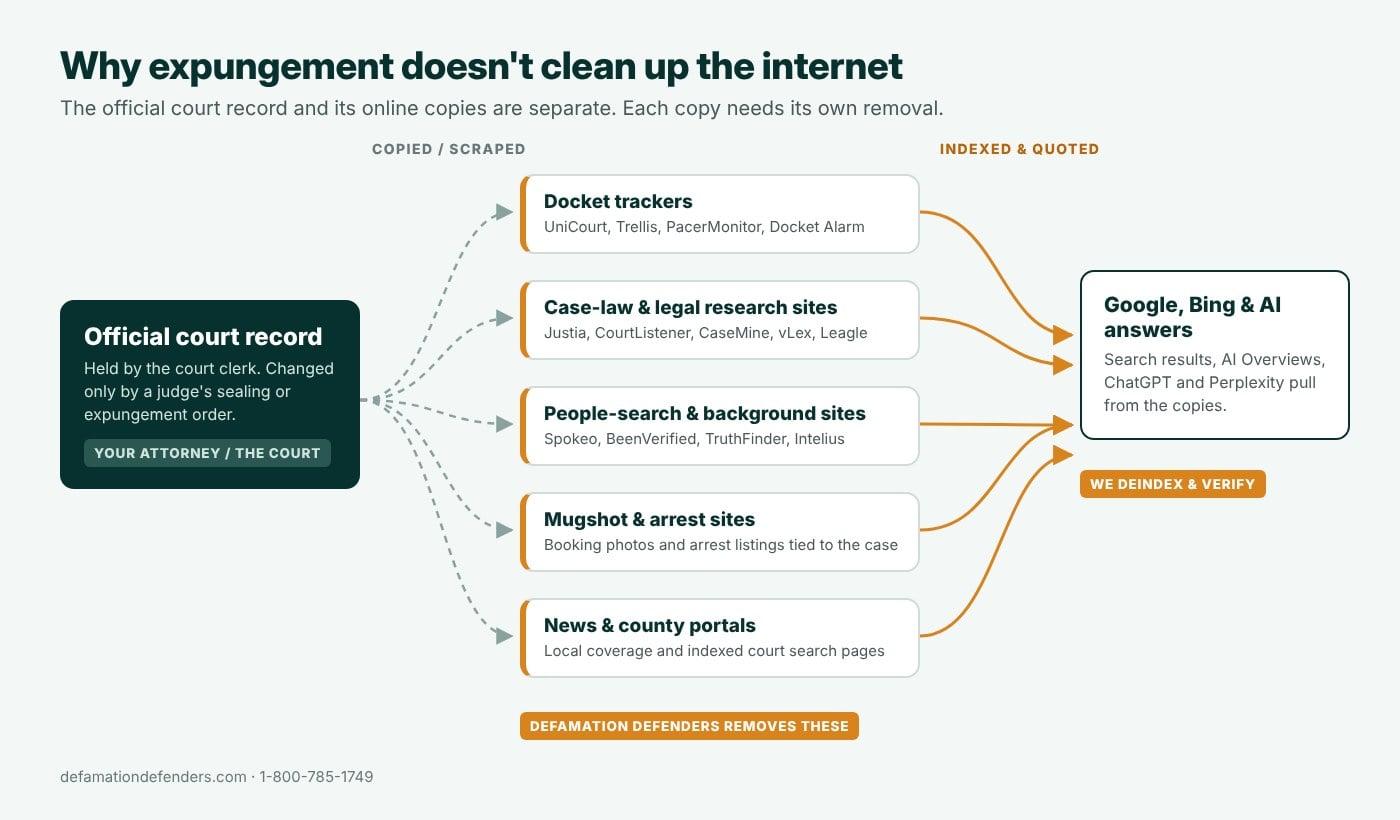
An expungement or sealing order tells the court and government agencies to restrict your record, but it does not automatically update PlainSite or any other private website that copied the case. Those sites keep showing it until someone sends them proof.
Will my case come back on PlainSite?
It can. PlainSite keeps pulling data from PACER and other government sources, and so do the other docket sites. A suppressed page usually stays suppressed, but a case can resurface when:
- New filings are added. Activity on the docket can create new document pages that were not part of the original request.
- A related case gets its own page. An appeal, a refiled case, or an adversary proceeding in a bankruptcy is a separate URL, and PlainSite says it does not suppress appealed cases as a rule.
- Another site re-scrapes the record. PacerMonitor, CourtListener, Justia, and people-search sites pull from the same courts on their own schedules.
How we keep it from coming back
- Every URL, not just the docket. We cover the case page and each document page, so there is no leftover copy for Google to surface.
- Backed by the court record where possible. If your case has been sealed, expunged, dismissed, or discharged, we include that paperwork so the result rests on the case’s actual status.
- Free re-removal. If a court record we removed is re-posted on the same site, we remove it again at no additional cost.
- Optional monitoring. We watch PlainSite and the other docket sites for your name and act early if the case shows up again.
Ask any removal company what happens if the case comes back. Our answer is in writing: we remove it again at no extra charge. See our full removal guarantee below.
Can you remove yourself from PlainSite?
You can. PlainSite’s request form is free to use. Where people get stuck is everything around it: writing a request that fits PlainSite’s factors, getting the right court order, finding every URL for the case, clearing Google, and tracking down the other sites that published the same docket.
How to submit a PlainSite removal request yourself
- Seal or expunge the case first, if you qualify. PlainSite says this is the best first step, and a court order is the only thing it says leads to deletion.
- Copy the full URLs of the PlainSite case page and any document pages that show your name.
- Open PlainSite’s Contact Us form at plainsite.org/contact. Choose “Court-ordered removal” if you have a sealing or expungement order, or “Limit information about me” to ask for search engine suppression.
- Explain the privacy harm in terms of the factors PlainSite lists, such as a personal bankruptcy, family matter, minor, or car crash, and include your order or other documents.
- Send one request per case and wait. PlainSite emails a tracking code and says replies usually take about 30 days. Calls, letters, and repeat requests do not speed things up.
- Clear Google and Bing. After PlainSite acts, use the search engines’ removal tools where they apply so the old title and snippet drop out of results.
Where do-it-yourself requests go wrong
- Asking for deletion without an order. PlainSite does not delete government-provided records without a court order, so the request needs to ask for the right thing.
- Ignoring PlainSite’s factors. A request that does not address view counts, case age, or case type gives PlainSite no reason to act.
- Missed document pages. The docket gets suppressed, but a complaint or motion page keeps ranking for your name.
- No Google follow-up, and other sites ignored. The old result lingers, and the same case is still on PacerMonitor, CourtListener, Justia, or people-search sites.
| Doing it yourself | Defamation Defenders | |
|---|---|---|
| PlainSite pages | Easy to miss document pages | Every PlainSite URL for your case found and included |
| Request wording | Generic requests are often declined | Requests written around PlainSite’s published factors |
| Court orders | On your own | We tell you when sealing or expungement is the better path first |
| Google and Bing | Separate tools; old snippet often lingers | Search engine removal filed and verified for each URL |
| Other docket sites | Not covered | PacerMonitor, CourtListener, Justia, UniCourt, people-search sites, and more |
| If it comes back | Start over | Re-removal at no extra cost |
| If it fails | Your time | Money back on any agreed removal we cannot complete |
Defamation Defenders vs. other PlainSite removal services
Several companies offer PlainSite removal. Before you hire anyone, compare what is actually in writing:
| Defamation Defenders | Typical removal services | |
|---|---|---|
| Pay after removal | Available | Some offer it; many require payment up front |
| Written money-back guarantee | Yes, on every agreed removal | Often implied, rarely defined |
| Free re-removal if it comes back | Yes, in writing | Usually not addressed |
| Every document page, not just the docket | Included | Often only the main case page |
| Honest read on PlainSite’s factors before you pay | Yes, in the free review | Varies |
| Google and Bing cleanup | Included for every URL | Varies |
| PacerMonitor, CourtListener, Justia, and others | Every copy listed in the free audit | Varies |
| AI answer checks | Before and after the project | Rarely |
| Firm price per link before work starts | Yes | Often “depends on the case” |
Questions to ask any provider: Do I pay before or after removal? What happens if the case comes back? Does the price include Google and the other sites?
Pay after removal. Money back if we can’t remove it.
Most PlainSite removal services ask you to trust them. We put it in writing: pay after removal is available on PlainSite projects, and every agreed removal is backed by a money-back guarantee and free re-removal.
Pay after removal
Pay after removal is available: you pay once the PlainSite result is removed, instead of paying up front and hoping it works. Payment plans are available for multi-site projects.
Money-back guarantee
If we agree to remove a PlainSite listing and cannot, you get a full refund for that removal.
Re-removal at no extra cost
If a court record we removed is re-posted on the same site, we remove it again at no additional charge.
Firm price up front
You see the exact price per link before work begins, with discounts when your case appears on multiple sites. All major credit cards and Zelle accepted.
What our clients say
Defamation Defenders has spent more than 10 years removing records and cleaning up search results, with more than 10,000 records removed. Here is what clients have said about working with us.


PlainSite removal FAQs
How do I remove my case from PlainSite?
PlainSite accepts requests only through its Contact Us form, one case at a time. If your case was sealed or expunged, choose court-ordered removal and include the order, and PlainSite says it will delete the information. Otherwise, you can ask it to keep the case out of search engines, which it decides by weighing its published public-interest factors. We prepare and submit these requests for you, follow up, and confirm the result.
How do I remove PlainSite from Google?
First get PlainSite to act on the page, by suppression, deletion under a court order, or shortening your name to initials. Then use Google’s and Bing’s removal tools where they apply so the old title and snippet are dropped. PlainSite does not control search engines, so every affected URL has to be handled separately.
Why is my name on PlainSite?
PlainSite collects records from federal courts through PACER, from state courts and agencies, and from federal databases, and publishes them as a transparency and legal research tool. If you were a party to a case in a covered court, your name can appear even if the case is closed.
What information does PlainSite show about me?
A PlainSite case page typically shows your name as a party, the court, the case number, filing dates, docket entries, and the attorneys involved. Many cases also have pages for individual documents, which can include the full text of complaints and motions, and sometimes addresses, financial details, or allegations that were never proven.
Does PlainSite charge to remove information?
PlainSite does not list a fee for privacy requests, and its Contact Us form is free to use. Our fee covers preparing requests that fit PlainSite’s factors, finding every URL for the case, clearing Google and Bing, and removing the copies on other sites.
Will PlainSite delete my case?
Only with a court order. PlainSite says it does not delete government-provided records without one, but if your case has been sealed or expunged and you provide the order, it will delete the information according to the order’s terms. Without an order, the realistic goal is search engine suppression.
Will PlainSite remove my bankruptcy?
Individual, uncontested bankruptcies are one of the categories PlainSite says it tries to suppress from search engines. People with multiple bankruptcy filings are the exception. We tell you during the free review how likely approval is.
Can I remove a PlainSite case if I was convicted?
It is hard. PlainSite treats serious criminal charges as a strong public-interest factor. Convictions that were later sealed, expunged, or set aside are much stronger candidates because a court order is involved. If PlainSite will not act, we can often still push the result down in Google with search result suppression.
Why was my PlainSite request denied?
PlainSite generally keeps cases public when they have about 100 or more hits, are recent or ongoing, were appealed, involve $2,500 or more, involve officials, lawyers, or businesses, or are one of several cases by the same person. Requests that do not address these factors are often declined. We review your case before you pay and only proceed when there is a real basis.
Can I resubmit a PlainSite request after a denial?
PlainSite says repeat requests do not speed things up, so sending the same request again rarely helps. A new request with a new basis can, most often a sealing or expungement order, a dismissal, or a bankruptcy discharge that did not exist the first time. We review the denial and only resubmit when there is something new to show.
How long does PlainSite removal take?
PlainSite says suppression and removal requests usually get a reply in about 30 days. Google and Bing can take additional weeks to drop the old result, which is why we use the search engines’ removal tools for each URL. If you need a sealing or expungement order first, that adds your court’s timeline.
How much does PlainSite removal cost?
Cost depends on how many PlainSite pages and other sites list the case and what type of case it is. We give you a free, firm quote per link before any work starts, with discounts for multi-site projects. Pay after removal is available, so you don’t have to pay up front and hope it works.
Can lawyers still see my case after it is suppressed?
Yes. Suppression keeps a PlainSite page out of search engines, and the official record stays with the court and remains available through PACER or the state court system. What changes is that the case no longer shows up when someone searches your name.
Will removing my case from PlainSite take it out of ChatGPT and Google AI Overviews?
Over time, for search-based answers, yes. AI tools build many answers from indexed web pages, so once the PlainSite page is out of Google and Bing, they lose that source. PlainSite also offers a connector that lets AI assistants search its database directly, which is one more reason deletion under a court order is the strongest result when it is available. We check ChatGPT, Google AI Overviews, Perplexity, and Copilot for your name before and after the project.
Does the CCPA or the right to be forgotten apply to PlainSite?
According to PlainSite, no. It says the California Consumer Privacy Act does not apply to it and that the European “right to be forgotten” does not apply in the United States. Requests built on those laws are not the way to get a PlainSite case removed.
What if my case comes back on PlainSite?
PlainSite and other docket sites keep pulling data from the courts, so new filings or related cases can create new pages. If a court record we removed is re-posted on the same site, we remove it again at no additional cost, and optional monitoring alerts us early if your case shows up again.
Is PlainSite the only site showing my case?
Rarely. The same case is usually also listed on PacerMonitor, CourtListener, Justia, UniCourt, Docket Alarm, Trellis, and people-search sites. Our free audit lists every place your case appears, and every site is a separate project with its own policy. See our court records removal service, Docket Alarm removal, and Justia removal pages.
Can I sue PlainSite to force removal?
In practice, this rarely works. Republishing accurate public court records is generally lawful, so a lawsuit to force removal is unlikely to succeed and costs far more than the removal process. Getting the record sealed or expunged, then using PlainSite’s own process and search engine removal, is the faster and cheaper route. Defamation Defenders is not a law firm; speak with an attorney about legal options.
Is PlainSite removal legal? Do I need a lawyer?
Yes, it is legal. We do not alter official court files. We use PlainSite’s own privacy policy, search engine removal processes, and your lawful court orders. You only need a lawyer if you want the official court record sealed or expunged. Defamation Defenders is not a law firm and does not give legal advice.
Is my case kept confidential?
Yes. Your review is free and confidential, and we never publish client names or case details.
Find out if your PlainSite case can be removed, free
Send us your name or the PlainSite link. We’ll show you every place your case appears and give you a firm, guaranteed quote. Call 1-800-785-1749, Monday to Saturday, 8 AM to 6 PM.
Defamation Defenders is an online reputation and content removal company, not a law firm, and nothing on this page is legal advice. We are not affiliated with PlainSite or Think Computer Corporation. We do not alter official court records. Results depend on each publisher’s policies and the facts of your case. Last updated October 2026.
Published · Last updated by the Defamation Defenders team