
Content Removal › Court Records › FindLaw
FindLaw Removal Service
Is a court opinion that names you on FindLaw showing up when people Google you? We find every FindLaw page and copy, build the removal request FindLaw requires, and clear the results from Google and Bing. Pay after removal is available, and every agreed removal is backed by a money-back guarantee.
- ✓ Pay after removal available
- ✓ Money-back guarantee
- ✓ Free confidential review
- ✓ Firm price before any work
- ✓ Free re-removal if it’s re-posted
Reviewed by Joseph Chierotti, Defamation Defenders · Updated November 2026
Can you remove a case from FindLaw?
Yes, sometimes, but FindLaw is strict. FindLaw says it rarely removes cases that are part of the public record, and it only accepts case removal requests from a named party, their attorney or their guardian. It does not accept requests from reputation management companies.
So we do the work behind the request: we map every FindLaw page that names you, decide which grounds actually apply, gather the proof FindLaw asks for, and prepare a request for you or your attorney to send. Then we clear Google and Bing and the other case-law sites that copy the same opinion, such as Justia, Leagle and CourtListener.
Key facts about FindLaw case removal
- FindLaw covers a lot. Free state and federal court opinions, including the U.S. Supreme Court, every federal court of appeals, all 50 states, U.S. territories, the Tax Court and bankruptcy courts. FindLaw says its case law comes from Westlaw.
- It’s part of Internet Brands. FindLaw says it was acquired by Internet Brands in 2024, joining Martindale-Hubbell, Avvo and Nolo.
- Requests are judged case by case. FindLaw balances the harm to you against the research value of the case, and says removing public-record cases is rare.
- Only you, your attorney or your guardian can ask. FindLaw does not accept case removal requests from third parties.
- Expect 1 to 2 weeks for a reply. FindLaw says its team usually follows up by email within 1 to 2 weeks.
- Google is a separate step. FindLaw’s request covers FindLaw.com only, not search engines or other websites.
What FindLaw will and won’t remove
FindLaw publishes its rules in two places: its editorial policy and its Case Removal Request form. Here is what they say, in plain English.
A court order to seal or redact
If a court has ordered the case or document sealed or redacted, FindLaw says it will ask you for that order in its follow-up. This is the strongest ground there is. If your case has been sealed or expunged, start here.
Proof the case is not a public record
FindLaw also asks whether you can prove the case is not a public record. If you can, it will ask for that proof in its follow-up.
Harm that outweighs the research value
Without an order or proof, FindLaw weighs the harm the page causes you against the value of the opinion to attorneys and the public. Its editorial policy says it reserves the right to leave up content it considers valuable. Requests on this ground are decided case by case, so a clear, documented explanation of harm matters.
Errors
FindLaw’s editorial policy says it will promptly correct information it learns is in error. That can help when a case summary or article gets the facts wrong or points at the wrong person.
What FindLaw won’t do
- Accept case removal requests from third parties, including reputation management companies.
- Remove results from Google or other websites through its form. It handles FindLaw.com only.
- Promise to remove a public opinion that has research value.
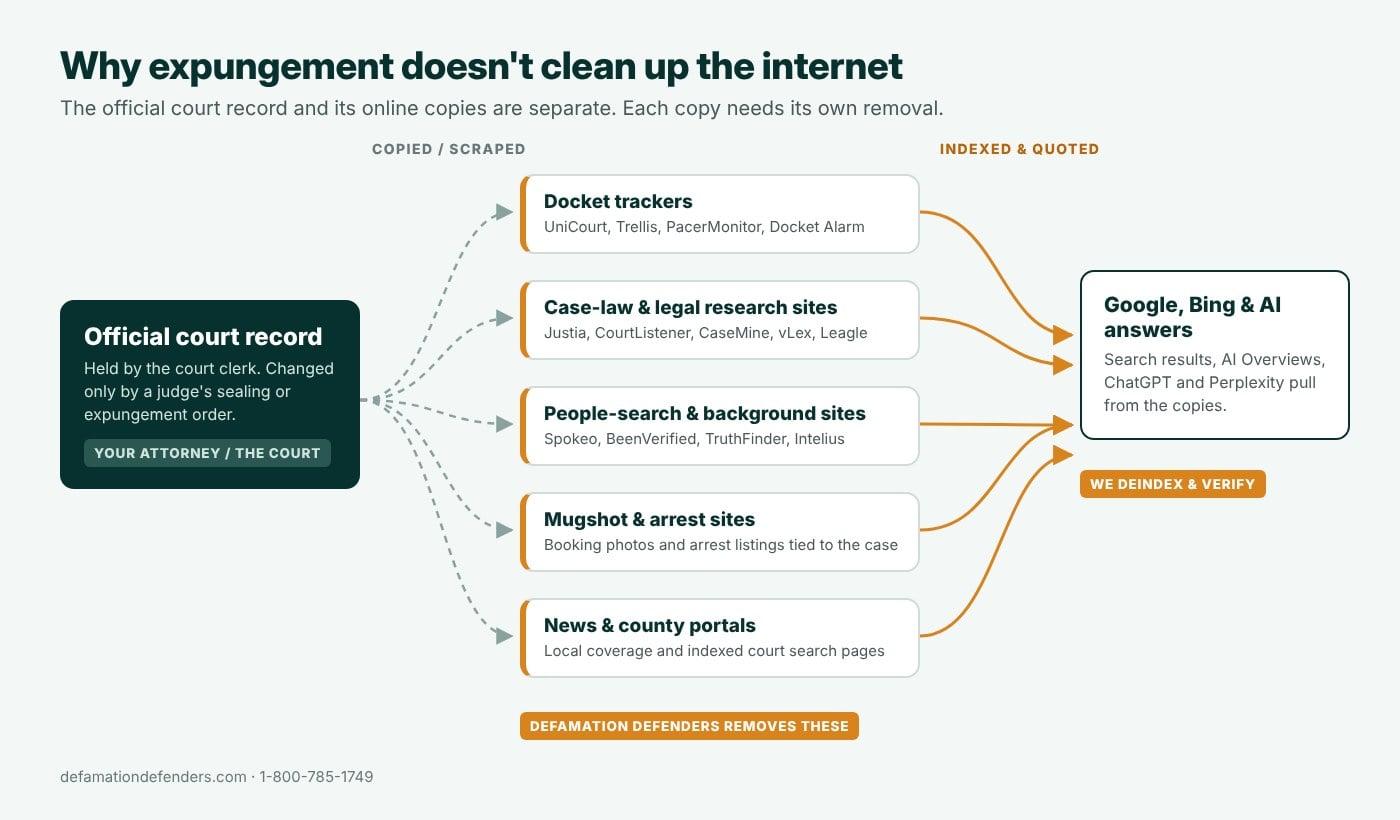
- Change the official court record. Only the court can seal or expunge a case.
Why a FindLaw listing hurts, even if you did nothing wrong
FindLaw calls itself the most visited legal information website, with more than six million visitors a month. That authority carries over to Google, so a court opinion that names you can sit near the top of your search results for years, even if you won the appeal or the case was minor.
Employers and background checks
Clients and customers
Landlords, lenders and partners
AI answers
What we remove from FindLaw
Court opinions and case pages
- Civil appeals and lawsuits you won, settled or that were dismissed
- Criminal appeals and post-conviction opinions
- Family, divorce and custody opinions
- Employment, bankruptcy and business disputes
Case summaries and FindLaw articles
- FindLaw case summaries that name you
- FindLaw blog posts or articles that discuss your case
- Pages with errors or the wrong person
The copies everywhere else
- Google and Bing results for the FindLaw URL
- Copies of the same opinion on Justia, Leagle, CourtListener, CaseMine and vLex
- AI answers that cite those pages
How to remove FindLaw from Google
FindLaw’s request form covers FindLaw.com only, and Google keeps showing the old result until it recrawls the page or receives a request. Here is the order that works.
- Fix FindLaw first. Get the page removed or your name changed on FindLaw.com.
- Ask Google to refresh it. Submit each URL through Google’s Refresh Outdated Content tool once the page is gone or changed.
- Do the same on Bing. Bing has its own content removal tool.
- Clear the copies, then suppress what’s left. The same opinion often lives on other case-law sites. We request removal from each one and, where removal isn’t possible, use Google deindexing and search result suppression.
Which FindLaw cases are easiest to remove?
We tell you up front what is realistic. This is our experience across case-law sites, not a FindLaw rule. FindLaw decides every request case by case.
| Likelihood | Typical situations |
|---|---|
| Strong candidates | Cases a court has sealed, expunged or ordered redacted; cases that should never have been public; pages that name the wrong person or contain errors. |
| Case by case | Older civil or family opinions about private people, dismissed or settled cases, and cases where the harm to you is serious and well documented. |
| Hardest | Published opinions that are widely cited as precedent, cases involving public officials or public money, and recent criminal appeals. Here we usually focus on Google, the copies and suppression. |
Our FindLaw removal process
Free confidential review
Send us your name or the FindLaw link. We find every FindLaw page that names you, plus the copies on other sites.
Firm quote per link
You get a written, per-link price before any work starts. No public price lists, no surprises.
We build your request
We pick the right grounds, gather the proof and write the explanation of harm, ready for you or your attorney to send, as FindLaw requires.
We handle the follow-up
When FindLaw replies, we help you answer its questions and send the court order or proof it asks for.
Google, Bing and the copies
Once FindLaw acts, we clear Google and Bing and work through the other case-law sites. With pay after removal, you pay once it’s done.
How long does FindLaw removal take?
Each stage runs on its own clock. FindLaw publishes one figure, the time to its first reply. The rest depends on your case.
| Stage | Typical timing |
|---|---|
| FindLaw’s first reply | Usually 1 to 2 weeks, per FindLaw |
| Proof and follow-up | Depends on how fast the court order or proof is ready |
| Change on FindLaw.com | Case by case after FindLaw’s decision |
| Google and Bing | Can take several weeks on their own schedule after the page changes |
| Other case-law sites | Varies by site |
| ChatGPT and AI Overviews | Follow once the sources are removed or updated |
Why FindLaw requests get denied, and how we avoid it
FindLaw can deny a request or leave a page up. These are the most common reasons we see, and what we do about each.
Why requests get denied
- The request came from a third party. FindLaw says it won’t accept requests from reputation companies, so we prepare the request for you or your attorney to send.
- No proof or court order. Without either, FindLaw falls back on weighing harm against research value.
- The opinion has research value. Opinions that are cited or set precedent are the hardest to remove.
- A vague explanation. “It’s embarrassing” rarely outweighs public interest. Specific, documented harm does better.
- Wrong details. A missing URL or wrong case name slows everything down.
What strengthens a request
- A certified copy of a sealing, expungement or redaction order
- Proof the case is not a public record
- A clear, documented account of the harm, such as safety risks, lost work or mistaken identity
- The exact case name and every FindLaw URL
- A request sent by your attorney when the case is complex
Will my case come back on FindLaw?
It can. FindLaw says its case law comes from Westlaw, and the same opinion is usually published by the court and copied by other case-law sites. A removed page can come back if the opinion is re-imported or re-posted, and Google can pick up another copy.
How we keep it gone
- We remove or address every copy we find, not just the FindLaw page.
- We ask Google and Bing to drop each URL once it’s gone.
- We check your name again after removal, including AI answers.
Can you remove yourself from FindLaw?
You can. FindLaw offers a free Case Removal Request form, and it accepts requests from named parties, their attorneys and guardians. Here is how to do it yourself.
- Find the exact case page on FindLaw and copy its URL.
- Open FindLaw’s Case Removal Request page (linked from its Contact Us and Privacy Statement pages).
- Enter your name, email and phone, and say whether you are a named party, attorney or guardian.
- Enter the case name, the FindLaw URL and your basis for removal.
- Answer its two questions: can you prove the case isn’t a public record, and do you have a court order to redact or seal it?
- Watch for FindLaw’s follow-up email, usually within 1 to 2 weeks, and send any proof it asks for.
- Once the page changes, submit the URL to Google’s Refresh Outdated Content tool and to Bing.
Where DIY goes wrong
- A short, emotional basis instead of a specific, documented one
- Missing other FindLaw pages, such as case summaries or articles
- Forgetting Google, Bing and the copies on other case-law sites
- Not knowing whether a sealing or expungement order is worth getting first
| Doing it yourself | With Defamation Defenders | |
|---|---|---|
| Writing the basis | You write it | We draft it with you |
| Proof and court orders | You figure out what’s needed | We tell you exactly what helps |
| Other case-law sites | A separate request for each | Included in your quote |
| Google and Bing | Your job | Included |
| If FindLaw says no | Start over | We adjust the approach and look at suppression |
Defamation Defenders vs. other FindLaw removal services
Several companies offer FindLaw removal. Before you choose one, compare what they actually put in writing.
| Defamation Defenders | Typical removal services | |
|---|---|---|
| Pay after removal | Available | Some offer it; many require payment up front |
| Written money-back guarantee | Yes, on every agreed removal | Often implied, rarely defined |
| Free re-removal if it’s re-posted | Yes, in writing | Usually not addressed |
| Built for FindLaw’s named-party rule | Yes, prepared for you or your attorney to send | Varies |
| Copies on Justia, Leagle, CourtListener and others | Every copy listed in the free review | Varies |
| Google and Bing cleanup | Included for every URL | Varies |
| AI answer checks | Before and after | Rarely |
| Firm price before work | Yes | Varies |
Pay after removal. Money back if we can’t remove it.
Most removal services ask you to trust them up front. We put our terms in writing instead. We accept all major cards and Zelle, and payment plans are available.
Pay after removal
Available on qualifying cases, so you pay once the agreed removal is done.
Money-back guarantee
If we can’t complete an agreed removal, you get your money back.
Free re-removal
If a court record we removed is re-posted on the same site, we remove it again for free.
Firm price up front
A written per-link quote before any work starts.
What our clients say
Defamation Defenders has spent more than 10 years removing records and cleaning up search results, with more than 10,000 records removed. Here is what clients have said about working with us.


FindLaw removal FAQs
How do I remove my case from FindLaw?
Use FindLaw’s Case Removal Request form. You must be a named party, their attorney or their guardian. Give the case name, the FindLaw URL and your basis for removal, then send any court order or proof FindLaw asks for in its follow-up. We prepare all of this for you.
Will FindLaw remove a court case?
Sometimes. FindLaw says it rarely removes cases that are in the public record. It weighs the harm to you against the research value of the case, and it is most receptive when you have a court order to seal or redact, or proof the case is not public.
Can a reputation company submit the request for me?
No. FindLaw says it does not accept case removal requests from third parties, including reputation management companies. We build the request and the supporting material, and you or your attorney send it.
How do I remove FindLaw from Google?
Get the FindLaw page removed or changed first, then submit the URL to Google’s Refresh Outdated Content tool and to Bing. FindLaw’s form does not cover search engines, so this is a separate step that we handle for every URL.
Why is my case on FindLaw?
FindLaw publishes state and federal court opinions, which it says come from Westlaw. If a court wrote an opinion in your case, such as an appeal, it may appear on FindLaw and on other case-law sites.
What information does a FindLaw case page show?
Usually the case name, court, date, docket or citation, and the full text of the opinion, which can include names, facts and allegations. Some cases also have a FindLaw case summary.
Does it cost anything to ask FindLaw?
FindLaw’s request form is free to use. Our service is paid, with a firm per-link quote before any work and pay after removal available.
Can you remove a criminal conviction from FindLaw?
It depends. A conviction that has been sealed or expunged is a strong candidate. An unsealed criminal appeal is much harder, so we often focus on the copies, Google and suppression.
What if FindLaw denies my request?
A denial isn’t the end. We can strengthen the request with a court order or better documentation, address the copies on other sites, and use Google deindexing and suppression to push the page down.
Can I resubmit a request to FindLaw?
Yes, especially if something has changed, such as a new sealing or expungement order. A resubmission should add new proof, not repeat the same request.
How long does FindLaw removal take?
FindLaw says its first reply usually takes 1 to 2 weeks. The rest depends on how quickly proof is ready, FindLaw’s decision, and how fast Google and Bing update.
How much does FindLaw removal cost?
We don’t publish prices because every case is different. After a free confidential review, you get a firm per-link quote. Payment plans are available, and we accept all major cards and Zelle.
Can lawyers still see my case after it’s gone from Google?
Possibly. Removing a page from FindLaw or Google does not change the official court record, and lawyers can still find it through the court or paid legal databases.
Will my case still show up in ChatGPT or AI answers?
AI tools draw on the pages they can find. Once FindLaw and the copies are removed or changed, AI answers usually follow. We check them before and after.
Is my case on other sites besides FindLaw?
Usually. Court opinions are often copied by Justia, Leagle, CourtListener, CaseMine, vLex and others. Our free review lists every copy we find.
Can my case come back after it’s removed?
It can, if the opinion is re-imported or re-posted. If a court record we removed is re-posted on the same site, we remove it again at no extra cost.
Can I sue FindLaw to remove my case?
Lawsuits over accurate court opinions rarely succeed, and they can draw more attention to the case. Talk to a lawyer about your situation. In most cases, a sealing or expungement order is the stronger route.
Is FindLaw removal legal?
Yes. Asking a website to remove or update a page is legal. We use FindLaw’s own process, search engine tools and suppression. We do not alter official court records.
Do I need a lawyer?
Not to ask FindLaw, since named parties can submit their own requests. A lawyer helps if you need a sealing or expungement order, or if your case is complex.
Is this confidential?
Yes. Your review and everything you share with us is kept confidential.
Related removal services
Find out if your FindLaw case can be removed
Send us your name or the FindLaw link. We’ll check every page and copy, tell you what’s realistic, and give you a firm quote, free and confidential. Prefer to talk? Call 1-800-785-1749.
Defamation Defenders is an online reputation and content removal company, not a law firm, and this page is not legal advice. We are not affiliated with FindLaw, Internet Brands, Thomson Reuters or Westlaw. We do not alter official court records; only a court can seal or expunge a case. FindLaw policy details on this page are summarized from FindLaw’s own published pages as of November 2026.
Published · Last updated by the Defamation Defenders team