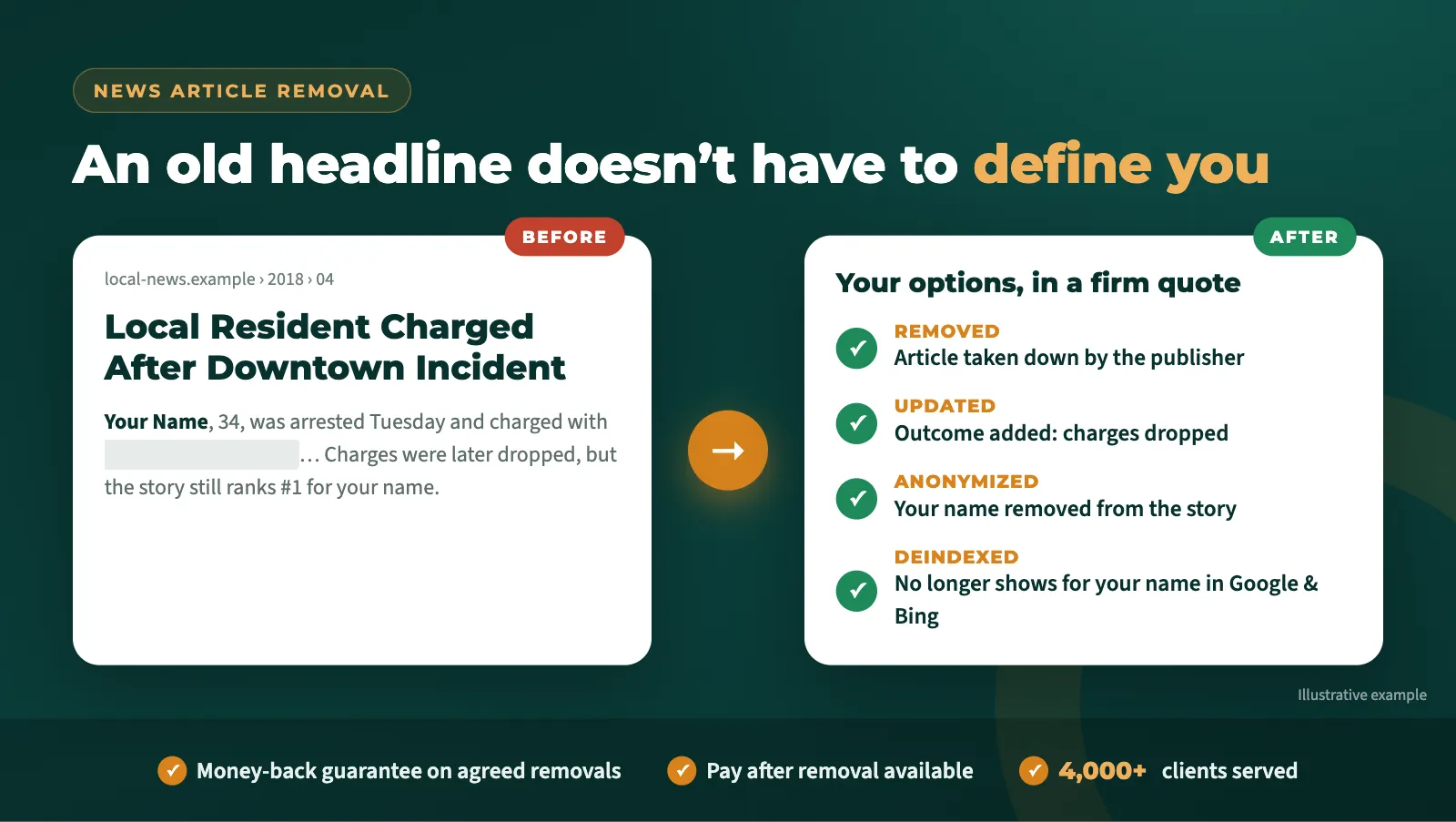
Trying to remove a news article from the internet or Google Search? Send Defamation Defenders the article URL for a free, confidential review. We check the original story and identifiable copies, then explain which options fit each URL: publisher removal, a correction or update, anonymization, or a change to eligible search results.
Yes, in some cases. Start with the publisher if you want the article removed or changed on the news site. The editor can consider a correction, an update, anonymization, or unpublishing under the outlet’s policies. If the publisher already removed the page or deleted the wording that still appears in Google Search, use Google’s Refresh Outdated Content tool. If the article is still live and unchanged, check whether a separate Google removal policy applies.
For an old arrest story, include the article URL, the exact detail that needs updating, and any public documentation of the outcome. List syndicated copies separately so each publisher and search result can be checked.
Written by the Defamation Defenders removal team · Last updated November 10, 2026
On this pageArticle review includes the original story and independently published copies.
Practical starting point
What should a news article removal request say?
Keep the request specific, factual and respectful. Explain the requested change and the evidence supporting it; follow the outlet's published process.
Subject: Request to review [headline / article URL]
Hello [editor or standards team],
I am requesting a review of [URL], published on [date]. The article states [specific passage or issue]. The attached [relevant record] documents [correct fact or subsequent outcome].
Please consider [correction, outcome update, name redaction or removal] under your [corrections or unpublishing policy, if applicable]. If full removal is unavailable, would you consider [specific alternative]?
Please let me know whether further documentation is needed. Thank you for reviewing the request.
How to compare news article removal services
Ask for an assessment tied to your actual URLs and the publisher's policy.
Get the proposed outcome, covered copies and fees in writing.
Distinguish publisher deletion from Google-only delisting or suppression.
Review guarantee conditions, follow-up responsibilities and monitoring coverage.
Ask how legal questions will be handled and who will manage your case.
A useful assessment explains why a request may succeed, what can remain visible and what happens if the publisher declines.
News sites carry a lot of weight with Google, so their articles tend to rank near the top for your name and stay there long after a case is closed or the story is out of date.
It ranks for your name
A single article can hold the first page of Google for your name or business for years, often above your own website and profiles.
It gets copied
Wire stories, TV station sites, aggregators and scraper sites republish the same article, so removing the original alone rarely clears your search results.
It shapes first impressions
Employers, landlords, clients, dates and AI assistants all pull from search results. An outdated headline gets read as today's truth.
Eligibility
Which news articles can be removed?
Every publisher has its own policies, and many newsrooms now have formal processes for updating or unpublishing older stories. Here's how the most common situations usually play out:
Type of news article
Removable?
Typical path
Arrest story where the charges were dropped, dismissed or ended in acquittal
Case-dependent
Request with court records to unpublish, anonymize or update the story, then clear it from Google and Bing
Article about a record that has since been expunged or sealed
Case-dependent
Request with the expungement or sealing order, then search engine cleanup
Older story about a minor offense or a private person
Case-dependent
Publisher unpublishing or "fresh start" request, name removal or a noindex tag
Copies on aggregator, scraper or republishing sites
Case-dependent
Requests to the site, its host and the search engines, including copyright claims where they genuinely apply
Article that exposes private information (home address, phone, medical or financial details, a minor's name)
Sometimes
Redaction request to the publisher plus search engine personal-information removals
False or defamatory reporting
Sometimes
Correction or retraction demand; with our attorney partners, legal action or a court order for search engines to review
Accurate, recent coverage of a newsworthy event or public figure
Rarely
Requesting a factual update or the case outcome; accurate reporting generally stays online
The publisher and the search engines make the final decisions. We'll tell you up front which articles have a realistic chance of removal and which are better handled another way.
Our process
How our news article removal process works
No fake legal notices, no threats to reporters and no shortcuts that can backfire. Every request is specific, documented and sent to the right person.
Five separate stages help track progress from review through monitoring.
Free article review
We look at the article, look for syndicated and republished copies, and check the publisher's correction and unpublishing policies against your situation.
Written removal plan
You get a plan in writing: which path we'll use for each URL, what documents we need from you, the timeline, the cost and the guarantee.
Publisher requests
We prepare and send a professional request to the right editor or standards contact, with the court records or evidence that support it, and handle the follow-up.
Search engine cleanup
Once a story is removed or changed, we get the outdated result, snippet and images cleared from Google and Bing, and go after the copies on other sites.
Monitoring
We watch for the story resurfacing on new sites and let you know if a copy appears, so you can decide on next steps.
Doing it yourself
Why asking a newspaper yourself often fails
You can contact a publisher on your own, and sometimes it works. These are the mistakes we see most often when it doesn't:
Common approach
What usually happens
What we do instead
Emailing the reporter who wrote the story
Reporters rarely make removal decisions, and the request can sit unanswered
Go to the editor or standards contact who handles corrections and unpublishing
Threatening a lawsuit without a clear legal basis
The request goes to the legal team and the publisher digs in, or writes about it
Raise legal options only when the facts support them, with our attorney partners
Asking without documentation
"We stand by our reporting" and a closed request
Lead with court records, expungement orders or evidence of the error
Getting the original removed and stopping there
Syndicated copies and the old Google result keep showing
Track down every copy and request the outdated result be cleared
Filing a copyright claim on content you don't own
The claim is rejected and can expose you to legal liability
Use copyright claims only where you actually own the content
When removal isn't possible
What to do about a news article that stays up
Some articles are accurate, recent reporting on a newsworthy event and won't be taken down. We'll tell you that honestly, then help you limit the damage:
Article updates that add the outcome of your case, such as a dismissal or acquittal, so readers see the full story.
Name removal or anonymization, where the publisher keeps the story but takes your name out of it.
De-indexing, where the publisher adds a noindex tag so the article drops out of Google and Bing while staying on the site.
Search result suppression that pushes the article down with strong, accurate content about you or your business.
EU and UK delisting requests for people covered by the "right to be forgotten."
What we will never do
We never file fake copyright claims, use forged or fake court orders, impersonate anyone, hack sites, or harass or threaten journalists. These tactics can get you sued, draw more attention to the story and make a legitimate removal harder.
Our guarantee: after your free review, we agree in writing which articles we'll pursue. If we can't remove an agreed article, you get your money back for it.
Why Defamation Defenders
Why people and businesses choose us for news article removal
Honest assessments
If an article isn't removable, we say so before you pay anything and point you to the option that will actually help.
Every copy, not just the original
We track down syndicated versions, aggregator copies, cached results and images so the story doesn't simply reappear somewhere else.
Attorney partners when the law matters
For defamation, retraction demands and court orders, we work with experienced internet attorneys instead of bluffing with legal threats.
One account manager, start to finish
You'll have one point of contact who keeps you updated and answers your questions until the work is done.
Understand your options
News article removal vs. de-indexing vs. suppression
Source removal, search delisting and suppression produce different outcomes.
Source removal deletes the publisher's page. De-indexing removes a result from a search engine. Suppression aims to reduce its ranking. These outcomes solve different problems, so your plan should identify exactly which one is being pursued for each URL.
Outcome
What changes
What can remain
Publisher removal / unpublishing
The original article is taken offline.
Independent copies, screenshots, archives and search results awaiting refresh.
Correction or case update
The story adds accurate facts or the final outcome.
The article and your name may still appear in search.
Name removal / anonymization
The publisher removes identifying details.
Other identifiers, copies and outdated snippets may need attention.
Publisher noindex
The publisher asks supporting search engines to exclude the page after recrawling.
The page remains accessible through its URL and other links.
Search engine delisting
A search engine excludes a result under an applicable policy or legal process.
The source stays live; limits can depend on the query or jurisdiction.
Search result suppression
Relevant, accurate content competes for visibility.
The article remains online, and rankings can change.
The correct request depends on whether the article is still live, has changed, or contains information covered by a removal policy. An old publication date alone does not qualify a live page for Google's outdated-content tool.
The publisher removed or changed it
Use Google's Refresh Outdated Content guidance when the page is gone or important content has been deleted. A changed page may remain indexed with an updated snippet.
The article exposes private information
Check Google's personal information removal policy. Public-interest reporting can affect eligibility. Search removal does not delete the publisher's page.
There may be a legal basis
Review Google's web-result removal routes and obtain legal advice where needed. A claim of defamation or a court order does not make every URL automatically eligible.
Google makes its own decisions. Bing and other services have separate processes; approval by one does not guarantee removal by another.
Prepare your request
What documents help get an old news article removed?
A clear request connects the exact article to verifiable evidence. Start with the URL and a short explanation of what is incorrect, incomplete or covered by the publisher's policy.
Article details: original URL, headline, publication date and any known copies.
Case outcome: dismissal, acquittal, disposition or other relevant court documentation.
Record changes: an expungement or sealing order, when relevant.
Factual errors: exact passages alongside records that establish the correct facts.
Previous outreach: publisher responses and the request already submitted.
Requested outcome: removal, an update, name redaction, photo removal or noindex.
Does expungement automatically remove news coverage?
No. A change to a court record does not automatically delete a separately published news story. The publisher's policy, the reporting and applicable law need separate review.
For an accurate arrest report that omits a later dismissal, a prominent case update may be more attainable than complete deletion. Distinguish reporting that was false when published from reporting that has become incomplete.
Share only documents relevant to the review through the agreed intake channel. You do not need to post sensitive records publicly to request help.
Cost and timing
How much does news article removal cost?
Pricing depends on the publication, the number of URLs, the evidence and the work needed for the agreed outcome. Defamation Defenders provides a written quote after the free article review. A quote for one article should make clear whether syndicated copies and search cleanup are included.
Publisher and removal route
An editorial update, privacy request and case requiring attorney involvement have different scopes. Ask which route the quote covers and whether any legal fees are separate.
Copies and search visibility
One story can create several independent removal tasks. Confirm the covered URLs, images, search engines and monitoring period before work begins.
Success and guarantee terms
Specify whether success means source deletion, name removal or search delisting. Review the written refund terms for the agreed articles.
Why timelines vary
Publisher review, requests for additional records, separate republications and search-engine recrawling can each add time. Source changes and search-result updates are separate milestones. A realistic estimate should account for both; an unanswered request is not evidence that removal is imminent.
No. Each independently hosted copy may require a separate request. Local news sites, television stations, wire-service partners and aggregators can retain their own versions after the original changes.
Identify the original: compare the byline, attribution and publication dates to understand where the story began.
Inventory the copies: search the headline, distinctive passages and relevant name variations; record each URL and publisher.
Request changes at each source: ask whether a correction can be distributed to syndication partners, then verify those partners' pages separately.
Recheck search results: address outdated snippets and images where eligible, and monitor for new copies.
Appearing in a story does not make you the copyright owner. A copyright complaint requires a genuine ownership or authorization basis; it is not a general tool for deleting unwanted coverage.
What happens when an AI answer cites an outdated news article?
Start with the cited source and the exact factual error. A search-based AI answer may draw on a live article, a republished copy or another page summarizing the story. Fixing the original source can help future answers reflect accurate information, but it does not guarantee that every AI system immediately changes.
Record the answer and citation
Save the prompt, date, response and linked sources. Check whether the answer omits a dismissal, confuses two people or repeats a factual error.
Correct the underlying evidence
Seek an article correction, outcome update or eligible removal. Review independently hosted copies and ensure your own factual profiles accurately identify you or your business.
Report and recheck
Use the AI provider's available feedback process for incorrect answers. Recheck the same question over time: answers and citations can vary between services and sessions.
Removing a web page does not establish that a model's training data has been erased. AI answers using web search and answers generated from learned information can behave differently.
FAQ
News article removal FAQs
How do I get a news article removed?
Start with the publisher. Find the outlet's corrections or unpublishing policy and send a short, respectful request to the editor or standards contact, with documents that support it, such as a dismissal, acquittal or expungement order. If the story is removed or changed, ask Google and Bing to refresh the outdated result, then deal with any copies on other sites. A news article removal service handles all of those steps for you.
Will Google remove a news article about me?
Usually not on its own. Google generally leaves news articles in its results unless the page has been removed or changed by the publisher, it exposes certain personal information, it infringes copyright, or a court has found it unlawful. Once a publisher removes or updates a story, Google can be asked to clear the outdated result and snippet.
Can an old arrest article be removed?
Sometimes. A dismissal, acquittal, expungement or sealing order can support a publisher review, but does not automatically require a news article to be deleted. Depending on the outlet, an outcome update or name redaction may be available. For arrest records and booking photos on mugshot sites, see our mugshot removal service.
What if the article is true?
Accurate reporting can still be removed or de-indexed in some cases, for example when it's old, about a private person or a minor offense, or the case ended in your favor. If it's recent and newsworthy, the better options are usually an update with the outcome, name removal or search result suppression.
How long does news article removal take?
It depends on the publisher and the path. Some requests are resolved in a few weeks, while cases that involve legal steps or many copies of a story can take a few months. Your written plan includes a timeline for each article.
Will the article come back after it's removed?
Copies can resurface on new sites. We monitor for that and let you know if a removed article comes back. Removing a new copy is quoted separately, since free re-removal does not apply to news articles.
Can you remove a negative news article about my business?
Yes, when there's a valid basis, such as false or outdated reporting, unauthorized copies or a story the publisher agrees to update. For coverage that stays up, we combine updates and suppression with our business reputation management services.
Can I pay a newspaper to remove an article?
Reputable newsrooms don't remove stories for money, and offering payment can backfire. Removal comes from a valid reason, the right documentation and the right request. What you pay a removal service for is the work of finding that reason and managing the process.
Free, confidential review
Find out if your news article can be removed
Send us the link. We'll look at the article and every copy of it, then tell you in writing what can be removed, how long it takes, what it costs and what we guarantee.