
Quick answer: To legally remove defamatory content in 2026, you generally need to show the content is a false statement of fact that harms your reputation. The fastest routes are (1) a direct takedown request to the author or website, (2) a policy-based report to the platform, and (3) when those fail, a court order declaring the content defamatory, which Google and most major sites will act on. Section 230 still shields platforms from liability for user posts, so the legal pressure usually has to land on the author, with the platform removing content afterward.
Need help with this? Our internet defamation removal service can handle it for you, starting with a free, confidential review and a firm quote before any work begins.
False reviews, fake “exposé” posts, and invented accusations can cost you clients, jobs, and peace of mind. This updated 2026 guide explains how defamation removal law actually works, what has changed recently, and the step-by-step legal strategy we use to get false content taken down and de-indexed from search results.
Not legal advice: Defamation Defenders is a reputation management and content removal firm, not a law firm. For lawsuits and legal opinions, consult a licensed attorney in your state.
Table Of Content
What Counts as Defamation Under the Law?
Defamation is a false statement presented as fact that damages the reputation of a person or business. It comes in two forms (see our full breakdown of libel vs. slander vs. defamation):
- Libel: written or published defamation, including blog posts, reviews, social media posts, forum threads, and videos. Nearly all online defamation is libel.
- Slander: spoken defamation, such as statements made in person or on a live broadcast.
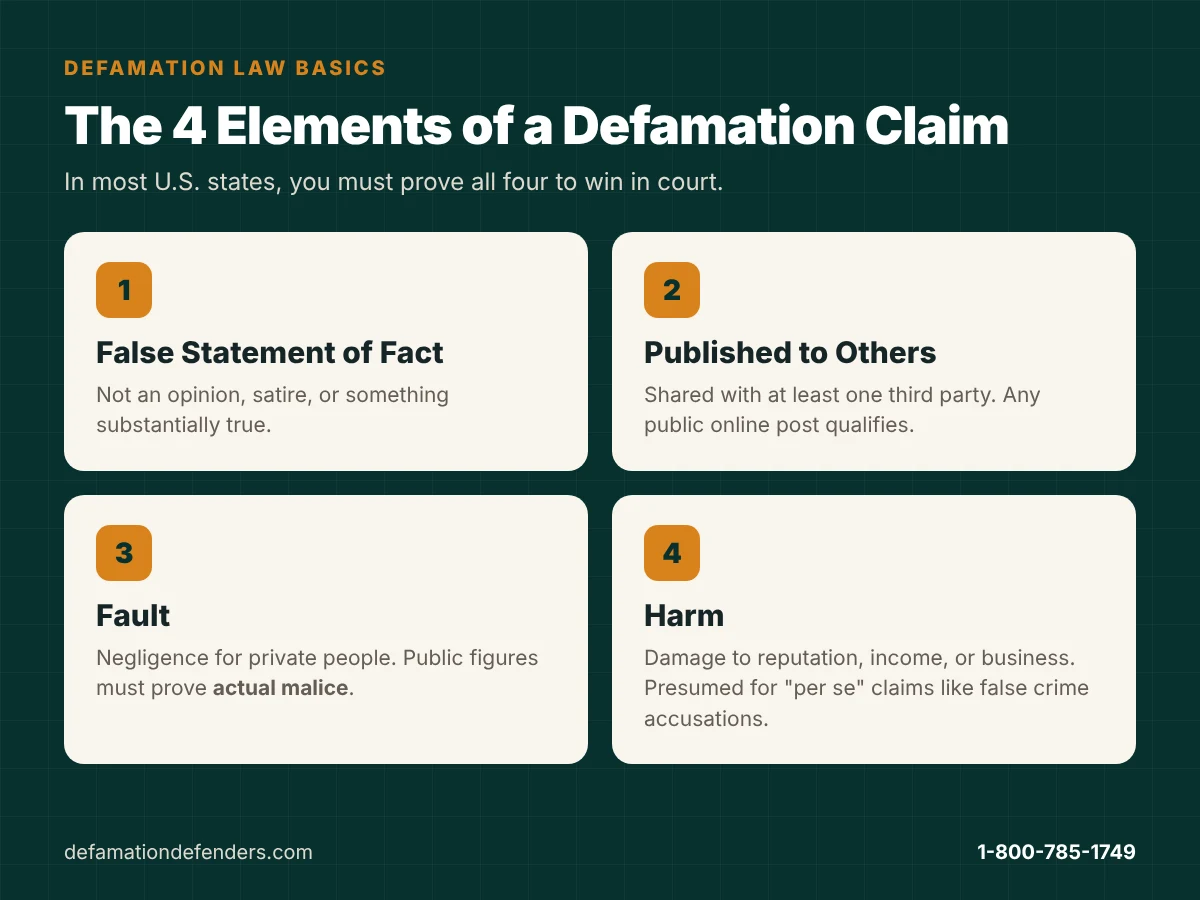
The Four Elements of a Defamation Claim
In nearly every U.S. state, you must prove:
- A false statement of fact. Not an opinion, and not something that is substantially true.
- Publication to a third party. Posting online easily meets this.
- Fault. At least negligence for private individuals. Public figures must prove actual malice, meaning the speaker knew the statement was false or recklessly disregarded the truth (the standard from New York Times v. Sullivan).
- Harm. Damage to your reputation, business, or finances. Some statements, like falsely accusing someone of a crime, are treated as “defamation per se,” where harm is presumed.
Not sure your situation qualifies? Read what counts as internet defamation and where free speech ends and defamation begins.
Key Defamation Removal Laws to Know in 2026
1. Section 230 of the Communications Decency Act
Section 230 says websites and platforms generally cannot be treated as the publisher of content their users post. In practice, that means:
- You usually cannot sue Google, Reddit, Yelp, or Facebook for a defamatory post a user wrote.
- You can sue the person who wrote it, and a judgment against them is what most platforms need before they remove content.
- Platforms can still remove content voluntarily when it violates their policies, which is why policy-based reporting is often the fastest path.
What’s new in 2026: Congress is again debating Section 230. Bipartisan bills such as the Sunset Section 230 Act (S. 3546) and a companion House bill would end the immunity on a delayed timeline. As of this update, none has become law, so platforms remain largely protected. We’ll update this guide if that changes.
2. The TAKE IT DOWN Act (Now Enforced)
The federal TAKE IT DOWN Act makes it a crime to publish non-consensual intimate images, including AI-generated deepfakes. Since May 19, 2026, covered platforms must remove reported content within 48 hours of a valid request, and the FTC is now enforcing compliance. This is not a defamation law, but it’s often the fastest legal tool when false content includes fake or leaked intimate images. See our guides to leaked content removal and reporting leaked personal content.
3. State Defamation Laws and Statutes of Limitation
Defamation is mainly governed by state law, and the details vary:
- Statute of limitations: often just 1 to 3 years, and many states start the clock when content is first published, not when you discover it. Waiting can cost you your legal options.
- Retraction statutes: some states require or reward a written retraction demand before you sue.
- Anti-SLAPP laws: more than 30 states let defendants quickly dismiss weak defamation suits, sometimes with attorney’s fees awarded against the plaintiff. Strong evidence matters before filing.
4. Court Orders and Search Engine De-Indexing
A court order finding content defamatory is the most powerful removal tool available. Google, Bing, and most major platforms will remove or de-index content once a valid order is submitted. Learn how to get a court order to remove a website, or explore other legal remedies for defamatory content.
Two cautions: a court order technically binds only the parties to the case, so some sites refuse to comply, and search engines now scrutinize orders closely after years of fraudulent submissions. A properly obtained, specific order makes all the difference.
5. International Laws
- EU (GDPR and the Digital Services Act): the “right to be forgotten” lets EU residents request delisting of outdated or inaccurate personal information, and the DSA requires platforms to run notice-and-action systems for illegal content. See can the right to be forgotten remove your info from Google?
- UK (Defamation Act 2013): claimants must show “serious harm,” and website operators have a defense if they follow a complaint procedure.
- Australia: recent reforms clarify when digital intermediaries are liable and encourage them to act on complaints.
Step-by-Step: How to Legally Remove Defamatory Content
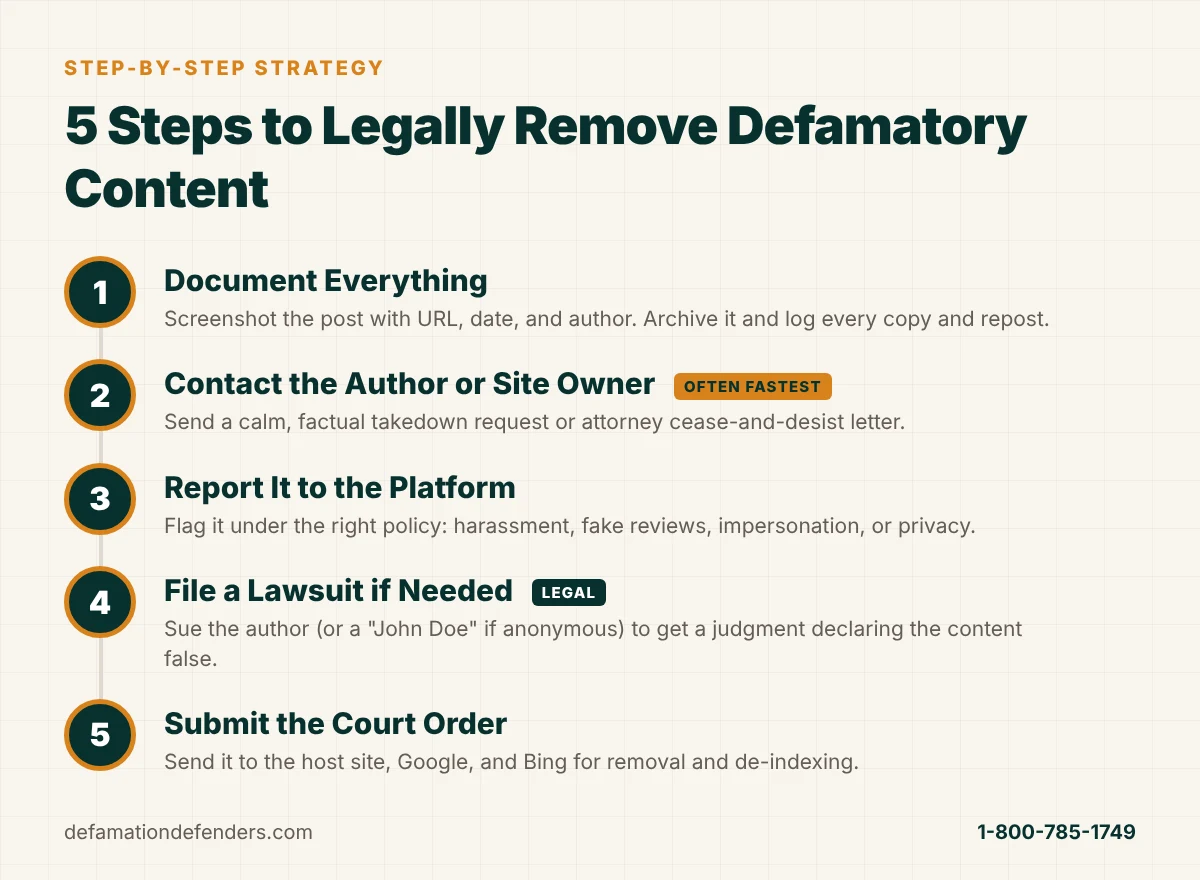
Step 1: Document Everything Immediately
Content gets edited or deleted once the author senses trouble. Before you take any action:
- Take full-page screenshots showing the date, URL, and author name or username.
- Save the page with a web archive service or PDF.
- Record evidence of harm: lost clients, canceled contracts, messages from people who saw the post.
- Note every copy and repost. Removing one URL won’t help if duplicates keep ranking.
Step 2: Contact the Author or Website Owner
A calm, factual takedown request or attorney cease-and-desist letter resolves more cases than you’d expect. Stick to facts, identify the false statements, and request removal by a specific date. Avoid threats or public arguments. Aggressive responses can trigger the Streisand Effect and spread the content further. Our guide to writing takedown requests that work walks through it.
Step 3: Report the Content to the Platform
Most platforms prohibit harassment, impersonation, fake reviews, and doxxing, even when they won’t judge whether something is defamatory. Reporting under the right policy often gets faster results than a defamation claim. Platform guides:
- Google: use Google’s legal removal request tool, and read our full guide to Google defamation removal.
- Social media: how to report and remove social media defamation, or see our Facebook and TikTok removal services.
- Reddit: how to remove Reddit posts and threads.
- Reviews: removing fake and malicious reviews and our Google review removal service.
Step 4: File a Lawsuit if Necessary
If the author refuses and the platform won’t act, a defamation suit may be the only path to a court order. Most clients don’t want money from the poster; they want a judgment that gets the content removed. Read our defamation lawsuit guide, learn how to sue for online defamation, and see when to hire an internet defamation lawyer.
Step 5: Submit the Court Order for Removal and De-Indexing
Once you have an order, submit it to the host website, Google, Bing, and any site carrying copies. Keep in mind that Google may send copies of legal removal requests to the public Lumen database, so the request process itself should be handled carefully.
Platforms That Usually Require Legal Action
- Google Search: generally removes defamatory results only with a court order in the U.S.
- Ripoff Report: famously refuses to delete reports. See our Ripoff Report removal guide and complaint site removal.
- Reddit and forums: may require legal pressure when content doesn’t break site rules. Our Reddit removal service handles this.
- News sites and aggregators: rarely remove articles without a correction request or legal grounds. See news article removal and removing negative articles from Google.
- “Cheater” and gossip sites: see our cheater website removal service.
What If the Defamer Is Anonymous?
Anonymous posters can often be identified. Your attorney files a “John Doe” lawsuit, then subpoenas the platform or internet provider for account details, IP addresses, and email addresses. Courts weigh the poster’s free speech rights, so you’ll typically need to show a strong case first. Once identified, the poster can be named in the suit or pressured to remove the content. Learn more in how to handle online defamation.
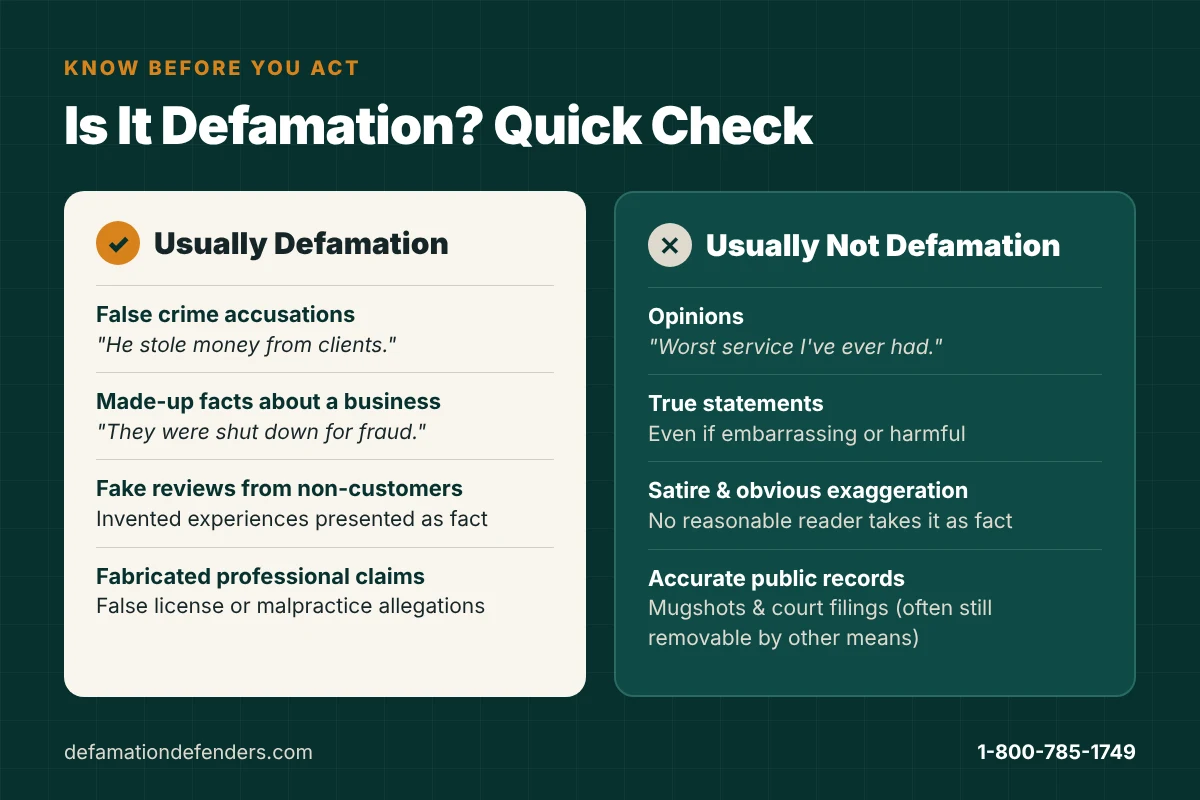
When Content Doesn’t Legally Qualify as Defamation
Many harmful posts are not defamatory in a legal sense:
- Opinions: “This was the worst service ever” is protected. “The owner steals from customers” may not be.
- True statements: truth is a complete defense, even when it’s embarrassing.
- Satire and obvious exaggeration: generally protected.
- Public records: mugshots, arrest records, and court filings are usually accurate public records, not defamation.
That doesn’t mean you’re stuck. Accurate but harmful content can often still be removed through site policies, privacy laws, or negotiation. Examples include mugshot removal, court case removal, personal information removal, and DMCA takedowns for copied photos or content.
Non-Legal Tactics That Work Alongside the Law
Legal action takes time. These strategies protect your reputation while it plays out, or replace it entirely when a lawsuit isn’t worth it (see legal vs. non-legal defamation tactics):
- Search result suppression: publish and promote positive, accurate content so false results drop off page one. Learn about our search result suppression service.
- Reputation monitoring: catch new posts and reposts early with privacy and reputation monitoring tools.
- Professional removal services: experienced teams know which policies, contacts, and legal levers work on each site. See our internet defamation removal service.
How Defamation Defenders Can Help
We’ve helped individuals and businesses remove false content from review sites, forums, social media, complaint boards, and Google search results. Every case starts with a confidential review of what was posted, where it appears, and which legal or policy path will be fastest. Agreed removals are backed by our money-back guarantee, and you’ll know the scope and price before work begins (see what removal typically costs).
Get a free, confidential consultation today, or call 1-800-785-1749.
Frequently Asked Questions
Is it legal to remove defamatory content from the internet?
Yes. Requesting removal of false, defamatory content through takedown requests, platform reports, or court orders is fully legal. Removing content you don’t like but that’s true or opinion is harder and depends on site policies and privacy laws.
Can I remove defamation without a lawyer?
Often, yes. Many cases are resolved through direct requests, platform policy reports, or a professional removal service. A lawyer becomes necessary when you need a court order or want to identify an anonymous poster.
How long does defamation removal take?
Policy-based removals can take days to a few weeks. Cases that require a lawsuit and court order can take several months. Search engines usually update within days to weeks after a page is removed.
Can Google be forced to remove defamatory search results?
Google is generally protected by Section 230, but it typically de-indexes content once you provide a valid court order finding it defamatory. Without an order, Google rarely removes defamation in the U.S. Read our Google defamation removal guide.
What is the statute of limitations for online defamation?
It’s usually 1 to 3 years depending on the state, and often starts when the content was first published. Speak with an attorney quickly if you’re considering a lawsuit.
Can someone go to jail for online defamation?
Rarely. Defamation is mostly a civil matter in the U.S., though a handful of states still have criminal defamation laws. Learn more: can you go to jail for online defamation?
Can public figures remove defamatory content?
Yes, but it’s harder legally because they must prove actual malice. Policy-based removal and search suppression are often more practical options.
What’s the difference between libel and slander?
Libel is written or published defamation (including online posts); slander is spoken. See libel vs. slander explained.
Related Guides
- How to Respond to Online Defamation
- Steps to Take When Facing an Online Slander Attack
- How to Recover From Defamation
- Social Media Defamation Lawsuit Guide
Sources: Cornell Law School LII: Defamation; Congress.gov: S. 3546; FTC: Complying With the TAKE IT DOWN Act.
