
Content Removal › Complaint Sites › Scam Detector
Scam Detector Removal Service
Is a Scam-Detector.com page asking whether your website is a scam, or showing a low trust score, when customers search your brand? We dispute the score with the proof Scam Detector asks for, get false and abusive comments taken down, and clean up what Google shows. Pay after removal is available on eligible cases, and every agreed removal is backed by a money-back guarantee.
- ✓ Pay after removal available
- ✓ Free, confidential review
- ✓ Firm per-link quote before work starts
- ✓ Money-back guarantee on agreed removals
- ✓ 10+ years, 4,000+ clients served
Reviewed by Joe Chierotti, Defamation Defenders · Updated November 2026
Send us your domain or the Scam Detector link. A removal specialist reviews your validator page, its comments, look-alike pages and what shows in Google, tells you what can realistically be fixed, and gives you a firm per-link quote before any work starts.
Free Expert Consultation

Prefer to talk? Call 1-800-785-1749
Can you remove a page from Scam Detector?
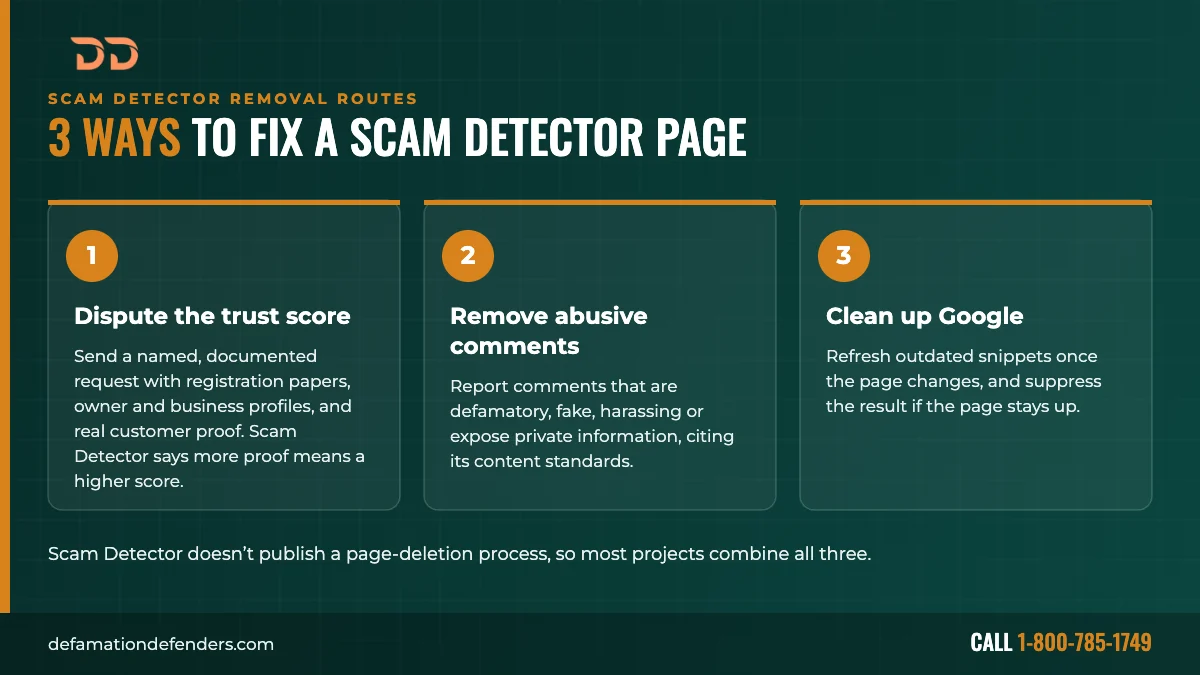
Short answer: Sometimes, and you can almost always fix what it says. Scam Detector doesn’t publish a way to delete a validator page, but it does invite website owners to challenge their trust score with evidence and says it will update the review based on that proof. Its terms also let it remove comments that break its content standards. A typical project combines (1) a documented trust score dispute, (2) reports on false or abusive comments, and (3) removing or suppressing the page in Google so it stops costing you customers.
Scam Detector is a free scam-prevention site that publishes automated “Is this site a scam or legit?” reviews for a very large number of websites through its VLDTR validator. Each page gives the domain a trust score from 1 to 100, adds tags and technical checks, and invites visitors to comment. Defamation Defenders has spent more than ten years fixing harmful search results for over 4,000 individuals and businesses, and Scam Detector is one of the complaint and scam-rating sites we work on most.
| Question | Answer |
|---|---|
| Who runs it | Scam Detector is one of the brands of Zeus, LLC dba Guiding Tech Media, based in San Juan, Puerto Rico |
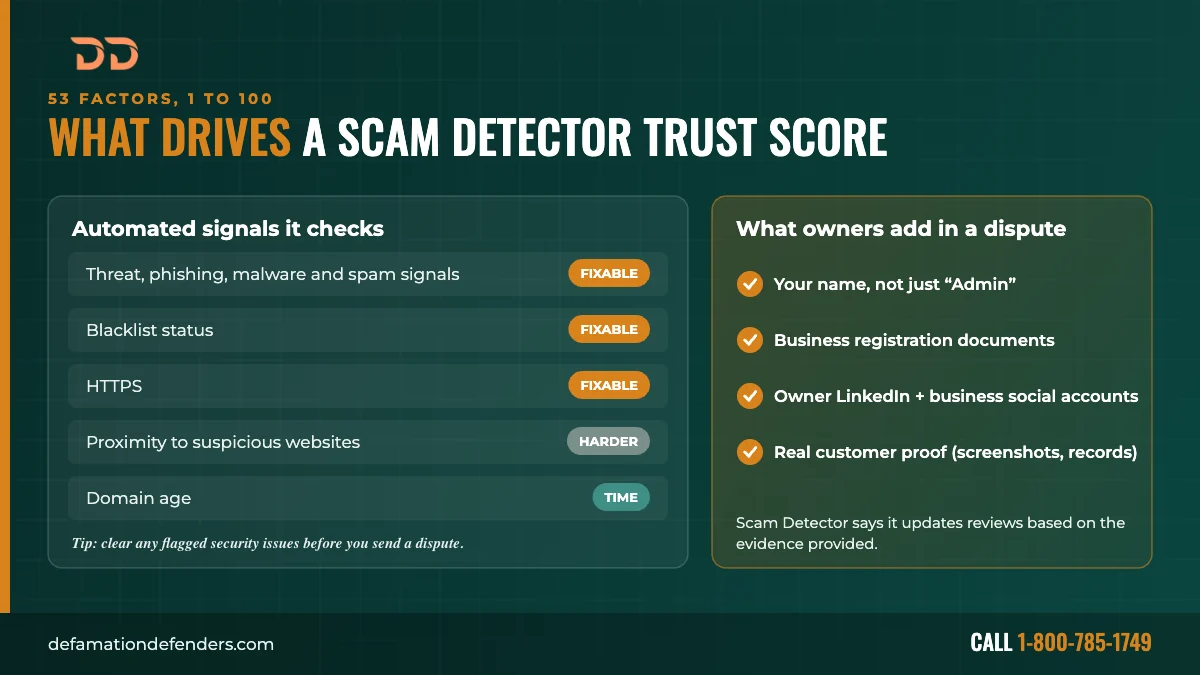
| How the score works | An algorithm scores each site from 1 to 100 using 53 factors, including proximity to suspicious websites, threat, phishing, malware and spam signals, blacklist status, HTTPS and domain age |
| Can owners dispute it | Yes. Owners who introduce themselves by name and send proof of legitimacy can ask for the review to be updated |
| What proof it asks for | Business registration documents, the owner’s LinkedIn profile, business social accounts, and real customer evidence such as screenshots or order and cancellation records |
| Can comments be removed | Its terms prohibit defamatory, harassing, deceptive and privacy-violating posts and let it remove user contributions at its discretion |
| Sites it won’t verify | Non-operational or redirected websites, and high-risk financial, gambling, adult or illegal sites |
| Cost with us | A firm per-link quote after a free review; pay after removal on eligible cases, money-back guarantee on agreed removals |
What Scam Detector will and won’t do
Everything below comes from Scam Detector’s own validator pages and the Guiding Tech Media terms of use. Where it doesn’t publish a rule, we treat the request as case by case.
| Scam Detector will usually | Scam Detector won’t usually |
|---|---|
| Review a trust score when a named owner sends documented proof | Delete a validator page just because the owner asks |
| Update the review and score based on that evidence | Raise a score on an anonymous or “Admin” request |
| Remove comments that are defamatory, harassing, deceptive or violate privacy | Remove honest negative comments from real customers |
| Handle copyright complaints through Guiding Tech Media | Verify offline, redirected, or high-risk category websites |
| Show updated scores once technical problems are fixed | Promise any response time, or control what Google shows |
Trust score disputes from website owners
Scam Detector asks owners to introduce themselves by name, not just as “Admin,” and to send proof of legitimacy: business documentation such as a certificate of incorporation or business registration, the owner’s personal LinkedIn profile and the business’s social media accounts, and, where available, proof of satisfied customers (screenshots, not testimonials on your own site), evidence of inventory, or records of handling order cancellations properly. It says it is willing to update the review based on that evidence, and that more proof means a higher trust score.
Comments that break its content standards
The terms prohibit user posts that are defamatory, harassing or deceptive, that violate privacy or publicity rights, or that impersonate someone, and the company reserves the right to remove any user contribution at its sole discretion. It doesn’t promise prompt removal.
What we remove and fix on Scam Detector
We handle the full footprint, not just the score.
Unfair trust scores
False and abusive comments
Look-alike domain pages
Technical red flags
Google and Bing results
Other scam-rating sites
Why a Scam Detector page hurts, even if you’re legitimate
Scam Detector’s pages are titled “[your domain] Reviews: Is this site a scam or legit?” That title alone can rank for your brand name, and most people never read past the score.
Customers check before they buy
Scores can lag reality
Comments pile on
AI answers repeat it
Business partners, payment providers and journalists may look these pages up too. If the problem goes beyond Scam Detector, our business reputation management and brand protection services cover the rest of your search results.
How we fix a Scam Detector page
Every case gets the routes that fit the problem. Most use more than one.
A documented trust score dispute
We put together the evidence Scam Detector asks for, from registration documents and owner profiles to real customer proof and cancellation records, and submit it as a named, organized request. A clear dispute is the main way scores get reviewed and raised.
Fixing the technical signals behind the score
Blacklist listings, malware or phishing flags, missing HTTPS and similar issues feed the algorithm. We check the public blacklist and safe-browsing tools, show your team what to fix, and cite the fixes in the dispute.
Comment removal reports
We report comments that are defamatory, fake, harassing, or that expose personal information, citing the specific content standard each one breaks.
Partner attorney letters for clear defamation
When a comment makes false statements of fact that damage your business, a partner attorney can send a formal demand. Automated scores themselves are rarely a good legal target.
Removing or refreshing the result in Google
Once a page changes, Google can keep showing the old snippet. We request a refresh of the outdated result, and if a page comes down entirely we ask Google to drop it.
Suppression for pages that stay up
If the page stays, we build and strengthen positive results for your brand so the Scam Detector page moves off page one. See search result suppression.
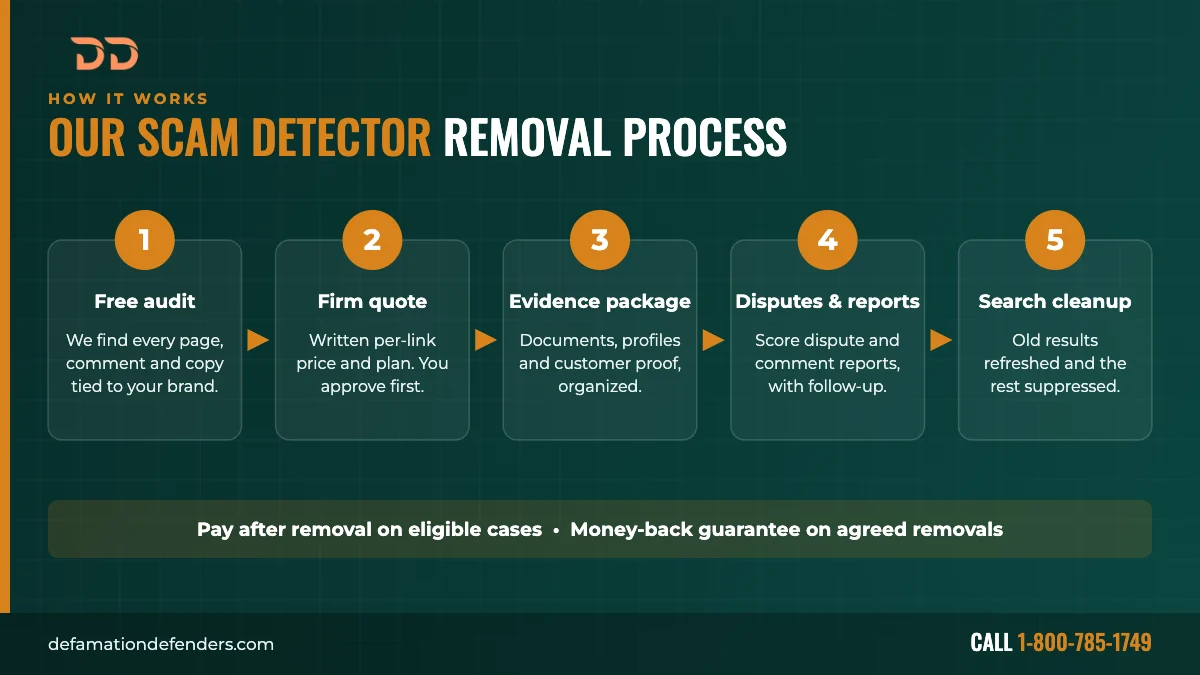
Our Scam Detector removal process

Free confidential audit
Send your domain or link. We find every Scam Detector page, comment and copy tied to your brand, plus what shows in Google and AI answers.
Firm per-link quote
You get a written price and plan for each link before work starts. Pay after removal and payment plans are available.
Evidence package
We gather and organize the documents Scam Detector asks for, and flag any technical issues to fix first.
Disputes and reports
We submit the trust score dispute, report comments that break its standards, and follow up.
Search cleanup
We get outdated results refreshed, suppress what remains, and confirm each result.
Afterward, our reputation monitoring can alert you to new comments, look-alike pages or score changes.
How long does Scam Detector removal take?
Most removals resolve within a few days to a few weeks. Scam Detector doesn’t publish response times, so every stage below is a typical range, not a promise.
| Stage | Typical timing |
|---|---|
| Building your evidence package | Depends on how quickly documents and proof are available |
| Trust score dispute | No published turnaround; varies by case |
| Comment removal reports | No published turnaround; at Scam Detector’s discretion |
| Google updating the result | Usually days to a few weeks after the page changes, depending on when Google re-crawls it |
| Suppression of a page that stays up | Builds over weeks to months, depending on competition for your brand name |
Your quote will tell you what to expect for each link.
Why Scam Detector disputes get turned down
Disputes usually stall for predictable reasons:
- Anonymous requests. Scam Detector asks owners to introduce themselves by name, not just “Admin.”
- Thin proof. Testimonials on your own site don’t count; it asks for screenshots and records.
- No business paper trail. Missing registration documents or social profiles.
- Unresolved technical flags. Blacklist or malware listings still showing.
- Excluded sites. Offline, redirected, or high-risk category websites.
What strengthens a dispute
- A named owner with a real LinkedIn profile
- Official registration or incorporation documents that match the domain and business name
- Active business social accounts
- Real customer evidence: screenshots of reviews on third-party sites, order and refund records
- Proof that any blacklist or security flags have been cleared
The more proof, the stronger the case. We build this package for every client.
Can you fix a Scam Detector page yourself?
You can. The trust score dispute is free, and many owners send it themselves. Here’s the basic process:
- Open your Scam Detector validator page and note the score, tags and any comments.
- Check your domain on public safe-browsing and blacklist tools and fix any flags first.
- Gather proof: business registration, the owner’s LinkedIn profile, business social accounts, and real customer evidence such as screenshots or order and cancellation records.
- Contact Scam Detector through the owner instructions on your validator page, introduce yourself by name, and explain why the score is wrong.
- Report any comments that are defamatory, fake, or expose personal information.
- Once the page changes, check Google and request a refresh of the outdated result.
Our guides on ScamAdviser trust scores and negative search results removal cover the same ideas for other sites.
| Doing it yourself | Defamation Defenders | |
|---|---|---|
| Cost of the dispute | Free | Firm per-link quote; pay after removal on eligible cases |
| Evidence package | You assemble it | We build and present it |
| Technical flags | You find them | We identify them for your team |
| Comment reports | You file each one | Included |
| Google, AI answers and look-alike pages | Often missed | Included |
| Guarantee | None | Money-back guarantee on agreed removals |
Can you sue Scam Detector?
Usually it isn’t the best route. Under Section 230 of the Communications Decency Act, websites are generally not liable for what users post, and an automated score is often treated as opinion, which is hard to challenge as defamation. Scam Detector’s terms also set Puerto Rico law and courts and a one-year limit on claims. A false comment by an identifiable person is a different matter, and a partner attorney can advise on it.
| Lawsuit | Dispute and removal | |
|---|---|---|
| Goal | A court ruling and possibly damages | A corrected score, removed comments and a cleaner Google page one |
| Typical timeline | Months to years | Most removals resolve within a few days to a few weeks |
| Cost | Attorney fees, often substantial | Firm per-link quote; pay after removal on eligible cases |
| Privacy | Court filings are usually public | Confidential |
| Best for | Clearly false, damaging statements by an identifiable person | Most unfair scores, fake comments and search results |
Learn more in our guide to defamation removal law. This isn’t legal advice; talk to a licensed attorney about your situation.
Which Scam Detector problems are easiest to fix?
We tell you up front what’s realistic. Scam Detector doesn’t publish decision criteria, so this reflects how these requests generally go, judged case by case.
| Likelihood | Typical situations |
|---|---|
| Strong candidates | Registered, operating businesses with documentation, real social profiles and customer proof; comments that are defamatory, fake or expose personal information |
| Possible with more work | Newer domains, businesses with mixed customer feedback, sites with recently cleared security flags, and pages for look-alike domains you don’t own |
| Harder | Sites that are offline or redirect elsewhere, and high-risk financial, gambling or adult sites, which Scam Detector says it doesn’t verify |
Even in harder cases, the Google side can usually be improved with suppression.
Will a Scam Detector problem come back?
It can. Scam Detector’s scores come from an algorithm and the page stays open to comments, so a few things can bring problems back:
- New comments. Anyone can post under your score.
- Score changes. Automated factors like blacklist status or proximity to suspicious sites can shift.
- New look-alike pages. Validator pages can appear for misspelled or similar versions of your domain.
- Copies elsewhere. Other scam-rating sites can show similar warnings.
Re-removal terms: Your written quote states exactly what is covered if a comment or page comes back. We keep your evidence package on file so a new dispute can go out quickly, and optional monitoring catches new comments and pages early.
For ongoing attacks across several sites, see our negative content removal service.
Defamation Defenders vs. other options
| Defamation Defenders | Typical removal company | Lawyer only | Doing it yourself | |
|---|---|---|---|---|
| Free review | Yes | Varies | Consultation fee varies | N/A |
| Firm quote before work | Yes, per link | Varies | Hourly or retainer | Free |
| Pay after removal | Available on eligible cases | Varies, often upfront | Rarely | N/A |
| Money-back guarantee | Yes, on agreed removals | Varies | No | No |
| Uses Scam Detector’s own dispute process | Yes | Varies | Rarely | Yes |
| Comments, look-alike pages and Google | Included | Often extra | No | Often missed |
| Partner attorneys when needed | Yes | Varies | Yes | No |
Got a quote elsewhere? Send it to us and we’ll tell you what it covers.
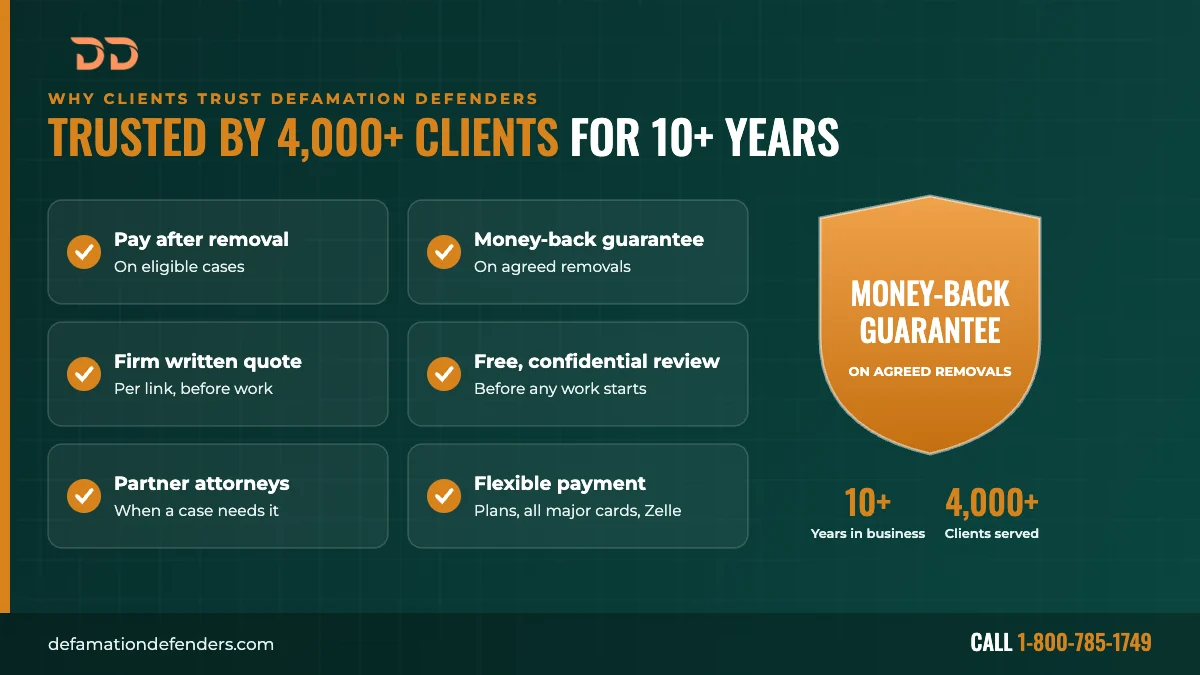
Pay after removal. Money back if we don’t deliver.
Most Scam Detector removal services ask you to trust them. We put our terms in writing before any work starts.
Pay after removal
Available on eligible cases, with no upfront fee. We’ll tell you during your free review if your case qualifies.
Money-back guarantee
Every removal we agree to is backed by a money-back guarantee.
Firm per-link quote
You know the price for each link before we start. No hourly billing, no surprises.
Flexible payment
Payment plans available. We accept all major cards and Zelle.
See how our guaranteed removals work.
Scam Detector removal reviews
Here’s what Defamation Defenders clients say about working with us. You can read more on our reviews page.
Buddika R
The service was very helpful and I would really recommend it to anyone else. It has helped me maintain my name online and escape from cyber bully.
Tim R
I used Defamation Defenders to remove negative items about me from the internet and also help build me a more positive and professional reputation online so that I could find a suitable job in my industry. Today my online reputation is stellar and I’m happily employed, likely in part to the work Defamation Defenders did on my reputation.
John Wester
it is a great service, I suggest to everyone to use this service.thanks for this service
Toni P.
A very good business that offers the personal reputation management services that actually work. Great solution to clean personal information off the internet and scrub your reputation if you are unfairly included in a negative article or defamatory posting online.
N. Helaki
Where to check and dispute your listing
If you want to start on your own, these are the official places to check. Keep copies of everything you submit.
- Scam-Detector.com (find your validator page; owner dispute instructions are on each page)
- Google Safe Browsing site status (check whether Google flags your domain)
- VirusTotal (check your domain against security vendors and blacklists)
- Google Refresh Outdated Content tool (ask Google to update an old snippet)
- Google Search Console (security issues and manual actions for your own site)
Scam Detector removal FAQs
How do I remove my website from Scam Detector?
Scam Detector doesn’t publish a process for deleting validator pages. It does let website owners dispute their trust score with proof of legitimacy, and it can remove comments that break its content standards. We prepare the evidence, submit the dispute and comment reports, and clean up the search results.
What is a Scam Detector removal service?
A Scam Detector removal service fixes what a Scam-Detector.com page says about your website and what Google shows for it. That includes preparing a documented trust score dispute, reporting false or abusive comments, handling look-alike pages, and removing or suppressing the result in search.
How do I remove Scam Detector from Google?
Once a page is updated or removed at the source, you can ask Google to refresh the outdated result. If the page stays up, the practical option is suppression: building stronger results for your brand so it moves off page one. We handle both.
Why is my website on Scam Detector?
Scam Detector’s validator publishes automated review pages for a very large number of websites. A page can exist for your domain even if no one ever reported you.
How is the Scam Detector trust score calculated?
Scam Detector says its algorithm scores each site from 1 to 100 using 53 factors, including proximity to suspicious websites, threat, phishing, malware and spam signals, blacklist status, HTTPS and domain age.
Can Scam Detector raise my trust score?
Yes. It says it will update a review based on the evidence an owner provides, and that more proof means a higher score. It asks for business documents, the owner’s LinkedIn and business social accounts, and real customer evidence.
Is it free to dispute a Scam Detector score?
Scam Detector doesn’t list a fee for trust score disputes. Our fee covers preparing and managing the whole project, with a firm per-link quote before any work starts.
How much does Scam Detector removal cost with Defamation Defenders?
We give you a firm per-link quote after a free, confidential review. Pay after removal is available on eligible cases, payment plans are available, and we accept all major cards and Zelle.
What if Scam Detector rejects my dispute?
We look at what was missing, strengthen the evidence, and resubmit where it makes sense. We can also remove abusive comments and suppress the page in search while the score is reviewed. Every agreed removal is backed by a money-back guarantee.
How long does Scam Detector removal take?
Scam Detector doesn’t publish response times. Google updates depend on when it re-crawls the page, and suppression builds over weeks to months. We give you a realistic estimate after a free review.
Can you remove comments on my Scam Detector page?
Often. Its terms prohibit comments that are defamatory, deceptive, harassing, or that violate privacy, and the company can remove user contributions at its discretion. We report comments that cross those lines.
Can Scam Detector delete the whole page?
It doesn’t publish a page-deletion option, and it says it can’t verify sites that are offline or redirected. Requests to remove a page outright are handled case by case.
Will AI tools still say my site might be a scam?
They can, while the page and its snippet are indexed. Fixing the score, removing bad comments, and cleaning up search results cuts off what AI answers draw on.
Is my business on other scam-rating sites?
Often, yes. Similar trust-score and scam-warning sites exist, and our free review checks where else your brand shows up.
Can a Scam Detector problem come back?
Yes. New comments can be posted, automated score factors can change, and look-alike domain pages can appear. Your written quote states what is covered, and optional monitoring lets us catch new problems early.
Can I sue Scam Detector?
Usually it isn’t the best route. Websites are generally protected from liability for user posts, automated scores are hard to challenge as defamation, and its terms set Puerto Rico law and a one-year limit on claims. Most businesses get faster results through the dispute process and comment reports. For legal advice, talk to a licensed attorney.
Can my personal details be removed from a Scam Detector page?
Validator pages can show domain registration details. Turning on WHOIS privacy with your registrar helps going forward, and requests to remove personal information are handled case by case.
Is Defamation Defenders a law firm?
No. Defamation Defenders is an online reputation and content removal company, not a law firm, and nothing on this page is legal advice. We prepare and submit requests on your behalf and work with partner attorneys when a case needs legal action.
Related removal services
- Complaint site removal
- ScamAdviser removal guide
- PissedConsumer removal
- Ripoff Report removal guide
- Trustpilot review removal
- BBB review removal
- Review removal
- Internet defamation removal
- Negative content removal
- Google deindexing
- Search result suppression
- Business reputation management
- News article removal
- Personal information removal
- All content removal services
Find out if your Scam Detector page can be fixed
Send us your domain or the Scam Detector link. We’ll review everything tied to your brand confidentially and give you a firm per-link quote. Pay after removal is available on eligible cases, and every agreed removal is backed by a money-back guarantee.
Defamation Defenders is an online reputation and content removal company, not a law firm, and nothing on this page is legal advice. Some matters are referred to partner attorneys. Defamation Defenders is not affiliated with Scam Detector, Zeus, LLC dba Guiding Tech Media, Google or any other company named on this page. Results depend on each publisher’s policies and the facts of your case.
Published · Last updated by the Defamation Defenders team