
Estimated reading time: 10 minutes
Quick answer: You can’t delete a Trustpilot review yourself, and Trustpilot won’t remove a review just because it’s negative. A review can be removed when it breaks Trustpilot’s guidelines — for example, it’s fake, isn’t based on a genuine experience, contains personal information, hate speech or promotional content, or makes false, defamatory claims. To remove it, claim your free Trustpilot Business account, flag the review under the correct violation reason, provide evidence if asked, and escalate legally if the content is false and damaging. Reviews that can’t be removed should be answered publicly and outweighed with new, genuine reviews.
Last updated: October 2026
Table Of Content
Key Takeaways
- Only reviews that violate Trustpilot’s guidelines can be removed — an honest negative opinion does not qualify.
- Businesses report reviews from their Trustpilot Business account by flagging the review and choosing the most accurate reason.
- If you flag a review as “not based on a genuine experience,” Trustpilot can ask the reviewer for proof of the experience.
- Never pay for, incentivize or post fake reviews; Trustpilot can add a public consumer warning to profiles that break its rules.
- For false, damaging reviews Trustpilot won’t take down, legal action or a professional Trustpilot review removal service is the next step.
Can You Remove a Bad Review from Trustpilot?
Yes, but only if the review breaks Trustpilot’s rules. Trustpilot is an open review platform: businesses cannot delete reviews, hide them, or pay to have them removed — even on a paid plan. Only Trustpilot’s content integrity team (or the reviewer who wrote it) can take a review down. Your job as a business owner is to identify which reviews actually violate the guidelines, report them correctly, and back up the report with evidence.
Why Trustpilot Reviews Matter for Your Business
Trustpilot hosts hundreds of millions of reviews, and its company pages frequently rank on page one of Google for searches like “[your company] reviews.” Trustpilot ratings can also feed Google seller ratings, and AI assistants and search engines often cite review sites when people ask whether a business is trustworthy. Even a few damaging reviews can affect your:
- Search engine visibility and branded search results
- Customer acquisition and conversion rates
- TrustScore and star rating shown across the web
- Online brand trust and partner or investor perception
Want to understand the wider impact? See how bad reviews affect business success and how to check your online reputation score.
Which Trustpilot Reviews Can Be Removed?
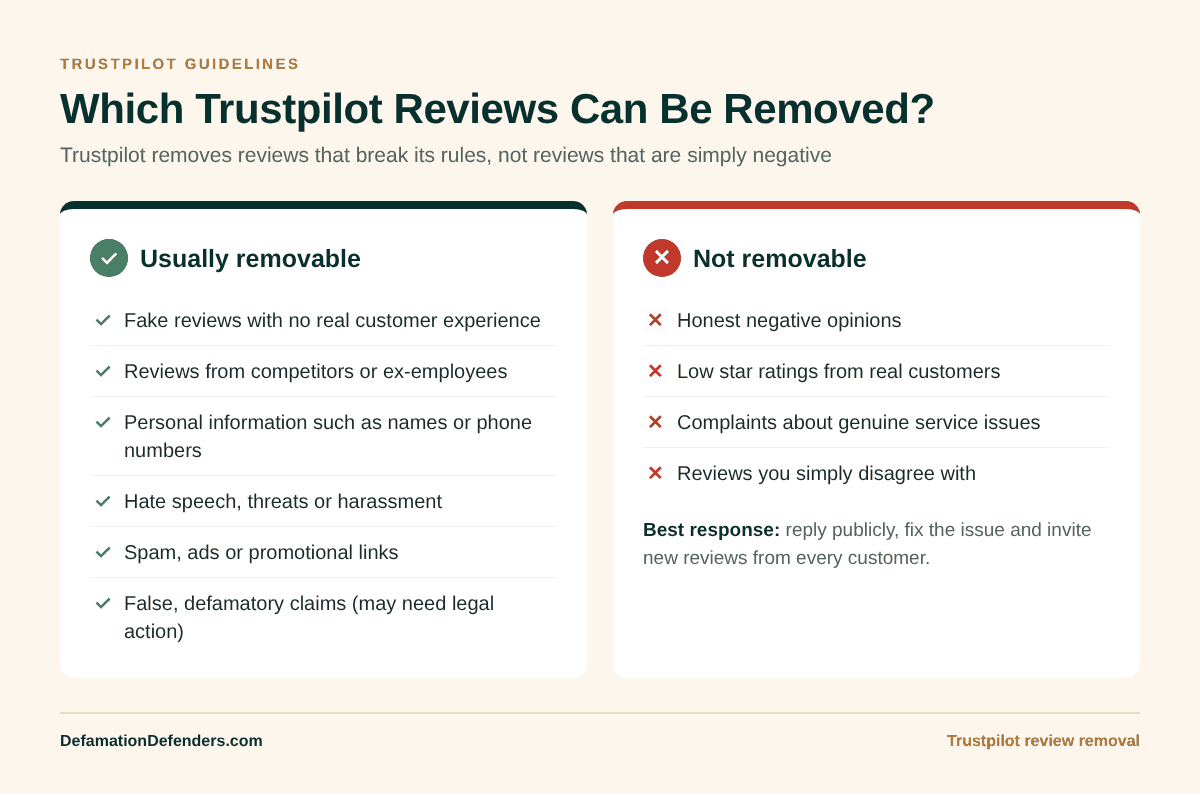
Before reporting a review, it’s critical to understand what Trustpilot does and does not allow. Use this table to see whether a review is likely to qualify:
| Type of review | Can it be removed? | What to do |
|---|---|---|
| Fake review or no real customer experience | Usually | Flag as “not based on a genuine experience” and provide records showing no matching customer |
| Posted by a competitor, ex-employee or someone with a conflict of interest | Usually | Flag and explain the conflict of interest with supporting evidence |
| Contains personal information (names, phone numbers, addresses) | Yes | Flag for personal information |
| Hate speech, threats, harassment or obscene language | Yes | Flag as harmful or illegal |
| Spam, advertising or promotional links | Yes | Flag as advertising or promotional |
| False statements of fact that harm your business (defamation) | Sometimes | Report through Trustpilot’s legal process; a court order may be required |
| Honest negative opinion or low star rating | No | Respond publicly, resolve the issue and invite new reviews |
Multiple reviews from the same person about the same experience can also be reported. Read the Trustpilot Guidelines for Reviewers and Guidelines for Businesses for full policy details.
How to Remove Bad Reviews from Trustpilot: Step-by-Step
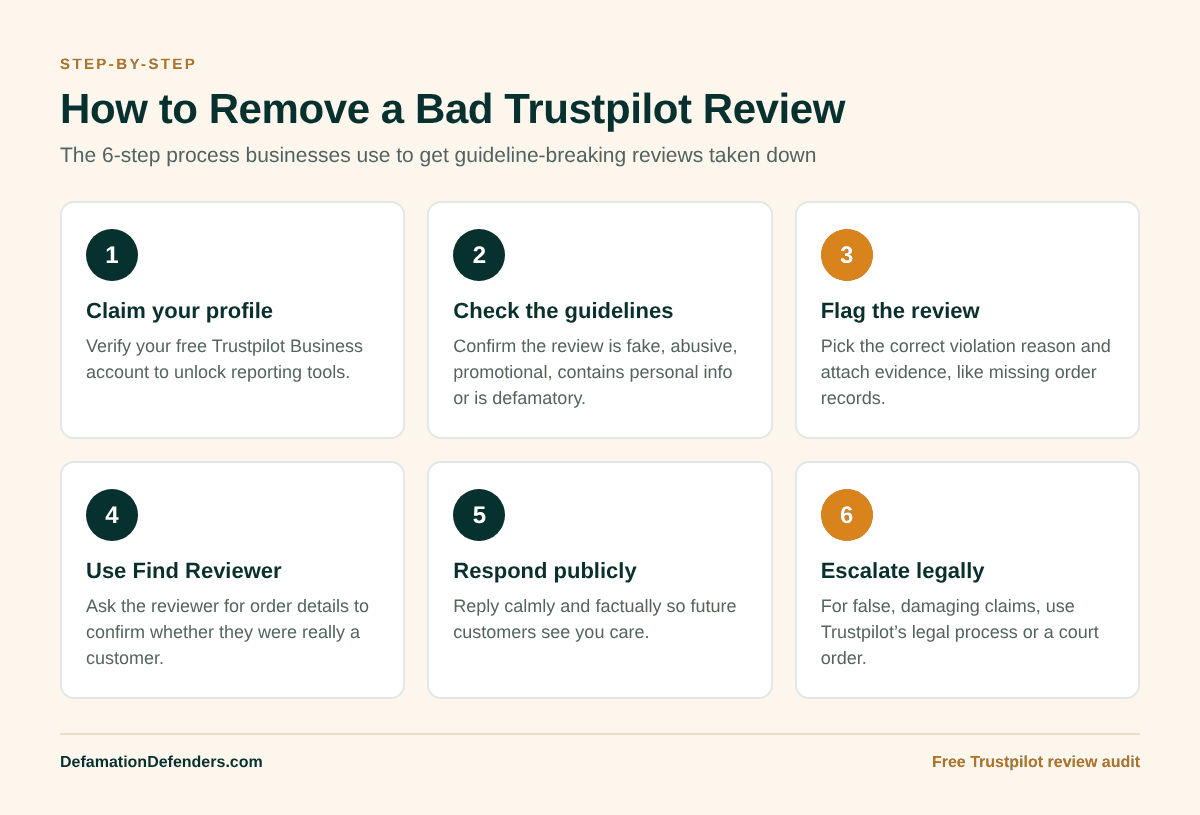
Step 1: Claim and Verify Your Trustpilot Business Profile
Reporting tools are only available to verified business users. If you haven’t already:
- Go to business.trustpilot.com.
- Search for your company and claim the listing (a free account is enough).
- Complete domain or email verification.
This gives you access to review reporting, replies, analytics and customer invitation tools.
Step 2: Check the Review Against Trustpilot’s Guidelines
Trustpilot only acts on clear violations, so screen each review first. Ask:
- Does it use profane, hateful or threatening language?
- Does it include anyone’s personal information?
- Is it demonstrably false, or does it describe an experience that never happened?
- Is the reviewer a competitor, former employee or someone with a conflict of interest?
- Is it promotional or spam?
If the answer to any of these is yes, the review is a candidate for removal.
Step 3: Flag (Report) the Review
- Log in to your Trustpilot Business account and open your service reviews.
- Find the review and click the flag (report) icon.
- Choose the reason that best matches the violation — picking the wrong reason is one of the most common reasons reports are rejected.
- Add a short, factual explanation and attach evidence, such as order records showing no matching customer.
Trustpilot doesn’t publish a fixed timeline. Clear-cut violations are often handled within a few days, while cases that require the reviewer to supply proof of their experience can take longer.
Not sure which reviews qualify?
Defamation Defenders reviews your Trustpilot profile for free, identifies which reviews break Trustpilot’s guidelines, and builds and manages each removal case using only methods that comply with Trustpilot’s rules.
Step 4: Use “Find Reviewer” to Verify the Customer
Trustpilot’s Find Reviewer feature lets you ask a reviewer for details such as an order number so you can locate them in your records. It helps you resolve legitimate complaints — and helps document cases where no matching customer exists.
Step 5: Respond Publicly and Professionally
Not every review will qualify for removal, but a good reply reduces its impact on future customers:
- Be polite, brief and professional.
- Address the key points factually without revealing private customer details.
- Invite the reviewer to continue the conversation offline.
- Show what you’ve done or will do to fix the issue.
Future readers see your reply, so it’s an opportunity to show you’re attentive and customer-focused. For more, read our guide on how to prevent 1-star reviews.
Step 6: Escalate Legally if the Review Is Defamatory
If Trustpilot rejects your report but the review contains false statements of fact that damage your reputation, you may be able to escalate through legal channels. You’ll typically need to:
- Document exactly what is false and the harm it has caused.
- Submit a legal complaint through Trustpilot’s legal process, which may require a court order.
- Work with professionals experienced in online defamation — see our guide to legal action against bad reviews.
Learn more: Trustpilot Legal Process Overview
What to Do If Trustpilot Refuses to Remove a Review
Trustpilot sometimes declines removal on the basis that a review is the reviewer’s opinion. If that happens:
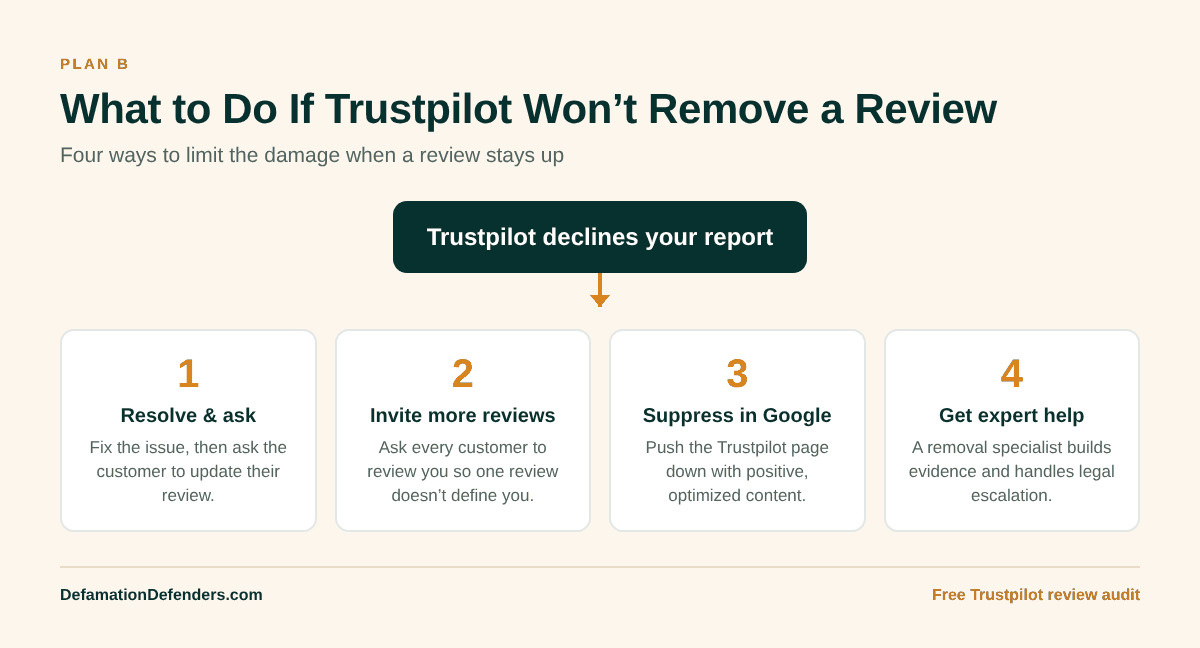
- Resolve the issue and politely ask the customer to update or delete their review — reviewers can edit their own reviews at any time.
- Invite all of your customers to leave reviews so one negative review is outweighed by an accurate overall picture.
- Push the Trustpilot page down in Google with search result suppression.
- Get expert help from a Trustpilot review removal specialist.
How to Push a Negative Trustpilot Page Down in Google
Search engines index Trustpilot pages heavily. If a bad review ranks for your brand name, it can do more harm than expected. To fight back:
- Publish optimized content such as blog posts, press releases and service pages.
- Build positive brand mentions and profiles on reputable domains.
- Use Google Business Profile, social media and YouTube to strengthen page one.
Defamation Defenders can help with all of the above through our online reputation management and business reputation management services.
Case Study: Local Business Restores Its Reputation in 3 Months
A regional HVAC company saw a 30% drop in conversions after a customer posted a misleading review accusing them of fraud. After:
- Filing a dispute (which Trustpilot rejected)
- Responding publicly and politely
- Launching a content suppression campaign
- Generating 40+ authentic 5-star reviews
Their Trustpilot score rebounded from 2.8 to 4.6 stars. Within three months, their sales pipeline stabilized and returned to pre-review levels.
What You Should Never Do
- ❌ Don’t pay or pressure reviewers to remove reviews.
- ❌ Don’t offer gifts, discounts or contest entries in exchange for reviews — Trustpilot prohibits incentivized reviews.
- ❌ Don’t post fake positive reviews; it can lead to a public consumer warning on your profile.
- ❌ Don’t invite only customers you expect to be happy.
- ❌ Don’t flag honest negative reviews just because you dislike them.
- ❌ Don’t ignore bad reviews or argue with reviewers in public.
How Defamation Defenders Helps with Trustpilot Reviews
Managing your online reputation is a full-time job. Defamation Defenders handles the process for you:
- A free, confidential audit of every review on your Trustpilot profile
- Evidence-backed removal cases managed through Trustpilot’s own processes
- Attorney coordination when legal escalation is needed
- SEO suppression for reviews and pages that can’t be removed
- Ongoing review monitoring and management to catch new threats early
Remove Fake and Defamatory Trustpilot Reviews
Send us your Trustpilot profile and the reviews you’re concerned about. We’ll tell you which ones qualify for removal and how we’ll handle them — free and confidential.
Removing Negative Reviews on Other Platforms
Trustpilot is rarely the only place a negative review shows up. We also help with:
- Google review removal
- Glassdoor review removal
- Zocdoc review removal
- Complaint site removal
- Negative content removal
Related Content You Might Find Useful:
Frequently Asked Questions
Yes, if it violates Trustpilot’s guidelines — for example, it is fake, not based on a genuine experience, contains personal information, hate speech or promotional content, or is defamatory. Honest negative opinions are not removed.
No. Businesses cannot delete or hide reviews. You can report a review for violating the guidelines, and only Trustpilot or the original reviewer can remove it.
No. Paid Trustpilot plans do not include review removal, and paying or incentivizing reviewers to remove or change reviews breaks Trustpilot’s rules.
Trustpilot does not publish a fixed timeline. Clear violations are often handled within a few days; cases that require the reviewer to prove their experience can take longer.
When a review is reported as not based on a genuine experience, Trustpilot can ask the reviewer for documentation. If the reviewer can’t provide it, the review is typically removed.
If a review contains false statements of fact that harm your business, you may have a defamation claim. A court order can then be used to request removal. Speak with an attorney about your specific situation.
You can reply publicly on Trustpilot and use the Find Reviewer feature to request order details. Never pressure, threaten or offer anything in exchange for changing a review.
Invite every customer to review you automatically after a purchase by email or SMS using Trustpilot’s invitation tools. Do not offer incentives or invite only happy customers.
Only Trustpilot can delete a review, but Defamation Defenders identifies which reviews qualify, builds and manages evidence-backed removal cases through Trustpilot’s own processes, coordinates legal escalation, and suppresses content that can’t be removed. Learn about our Trustpilot review removal service.
