
Estimated reading time: 10 minutes
What will someone find when they search your name before a board interview, partnership meeting, or leadership announcement?
Need help with this? Our business reputation management service can handle it for you, starting with a free, confidential review and a firm quote before any work begins.
The right online reputation management services should help you answer that question and address the gaps. But executive reputation work should do more than publish flattering profiles. It should protect private information, respect company approvals, and show measurable progress.
Effective search result management starts with a defined goal. You may need to correct an outdated role, challenge an inaccurate claim, reduce personal exposure, or strengthen credible information about your work.
Before signing a contract, ask the questions below. They will help you evaluate methods, costs, responsibilities, and the limits of executive ORM services.
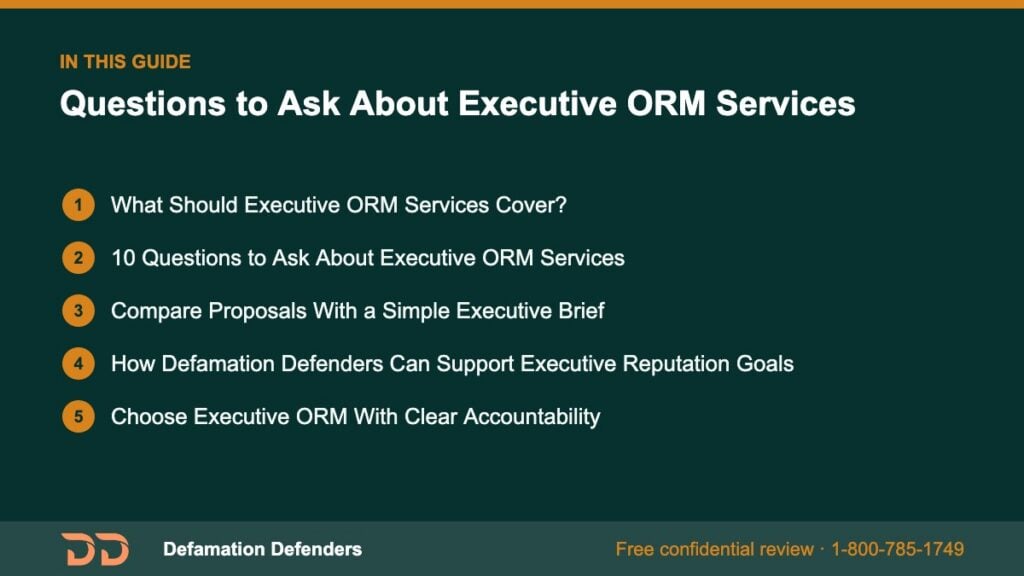
Table Of Content
What Should Executive ORM Services Cover?
Treat executive online reputation management as a coordinated plan for your public identity, not a blanket promise to erase criticism.
Request coverage for the concerns that apply to you: name-based searches, professional profiles, unwanted content, privacy exposure, and ongoing monitoring. Distinguish your personal interests from the company’s communication goals.
For example, a business might want more visibility around a leadership appointment. The incoming executive may also want a home address removed. These goals belong in the same discussion, but they require different actions.
A useful executive ORM plan should explain what changes, who approves it, and how the result will be verified.
Want this content gone? Get a free, confidential quote.
Send us the links. Most removals are done in a few days to a few weeks, with a full refund if we can't complete the agreed removal.
10 Questions to Ask About Executive ORM Services
1. Are You Managing My Reputation, the Company’s, or Both?
Clarify the client relationship before discussing tactics.
Ask whether the scope covers your personal name, company-related searches, previous employers, and board affiliations. Establish who pays, who directs the work, and who receives reports.
These boundaries matter most when interests differ. Suppose you leave a company while a campaign is active. Who decides whether your biography changes? Who can approve outreach about your departure?
Request a named decision-maker for personal matters and another for company-owned content, where appropriate. Include a process for resolving disagreements.
Also define exclusions. Family members and unrelated businesses should not enter the campaign merely because they share a surname or address.
2. Which Searches Will You Audit Before Recommending Services?
Ask for a baseline built around the searches relevant to your role.
Include your full name, common variations, current and former company names, and appropriate location terms. Review web results alongside images, videos, and prominent profile information.
A focused audit should distinguish an outdated title from a mistaken identity, a privacy concern, or criticism that needs no response.
Google explains that search results can vary with time, location, device, and personalization. Ask the provider to record those conditions rather than present one search as everyone’s experience.
Finish with priorities. An exposed private phone number may deserve attention before an unflattering but accurate interview.
3. How Will You Choose Between Removal and Search Result Management?
Require a separate recommendation for each important URL.
| Approach | Intended outcome | What to verify |
|---|---|---|
| Source removal | A publisher deletes targeted material. | The original page or information is gone. |
| Search removal | A search engine excludes an eligible result. | The decision’s scope and remaining source access. |
| Suppression | Relevant pages gain visibility against unwanted results. | Dated changes across agreed searches. |
Google’s personal-information removal policy distinguishes Search removal from deletion at the source and considers public interest.
Ask what supports each request. Legitimate reporting on an executive is not automatically removable because it harms their image.
A credible alternative may be a factual correction or an updated profile, not an unsupported takedown demand.
4. Who Approves Outreach and Public Statements?
Ask for a written approval process that fits your organization.
Identify who reviews facts, who checks sensitive language, and who authorizes publication. Depending on the issue, include the executive, communications lead, security team, and legal counsel.
Set rules for publisher contact too. Do not give broad permission to send demands, offer interviews, or discuss internal matters under your name.
For sensitive announcements, require coordination with the company’s approved release schedule. Keep unreleased information out of drafts shared beyond the authorized team.
Finally, agree on an urgent-response process. Name a backup approver and define what the provider may do while awaiting permission. Speed should not mean losing control.
5. How Will You Protect Executive and Family Privacy?
Separate reducing public exposure from protecting the information collected during the project.
Ask which identity details the provider needs, who can access them, and how long records remain stored. Request secure document sharing and limited account permissions.
The FTC’s business security guidance recommends collecting only necessary information, restricting access, and disposing of records when no longer needed. Use those principles when reviewing the provider’s process.
Require specific consent before involving family members or publishing personal background.
Also ask whether staff use outside contractors or AI tools with case information. Set approval rules for both. A confidentiality clause should support practical safeguards, not stand in for them.
6. What Will You Publish, and Why Is It Worth Publishing?
Ask for an editorial plan, not a quota of flattering articles.
Useful material might include a corrected leadership biography, a substantive industry interview, or an approved explanation of your professional experience.
Google’s people-first content guidance emphasizes helpful, reliable material rather than content made mainly to attract search traffic. Apply that standard to executive profile optimization.
Ask how writers verify credentials, dates, quoted remarks, and accomplishments. Reject invented awards, testimonials, and claims of independent coverage that are actually paid placements.
Make privacy part of editing. A biography can establish expertise without exposing family details or daily routines. Approve every final draft before publication.
7. How Will You Demonstrate Search Result Management Progress?
Request a sample report before committing.
Expect separate reporting for submitted requests, verified source removals, search decisions, profile corrections, and ranking changes. Activity is not the same as an outcome.
Ask the firm to track a stable set of queries. Do not let favorable searches replace difficult ones midway through the campaign.
For a hypothetical leadership transition, useful measures could include corrected company affiliations and improved visibility for the current biography. These are clearer than a reputation score with an unexplained formula.
Require a short explanation of setbacks and next steps. Do not accept claims that an ORM campaign caused a promotion, investment, or contract without evidence connecting those events.
8. What Happens During an Active Reputation Incident?
Walk through a realistic scenario before you need urgent help.
For example: someone creates an impersonation profile shortly before a company announcement. Ask who verifies the account, preserves relevant links, recommends platform reporting, and contacts your internal team.
Set severity levels. A credible safety threat, a factual error, and ordinary criticism should not receive the same response.
Clarify whether urgent support is included, available outside business hours, or separately billed. Request an escalation contact and a backup.
Also ask when the provider recommends pausing scheduled content. A prepared response should include options to investigate or wait, not an automatic public rebuttal.
9. What Do the Fees and Timelines Actually Cover?
Request separate pricing for assessment, removal work, content creation, monitoring, and urgent response.
Confirm minimum terms, renewal rules, approval requirements for extra spending, and the meaning of any outcome-based fee.
Ask for dates the provider controls, such as audit delivery and reporting. Treat publisher decisions and ranking outcomes separately.
Google’s advice on hiring an SEO warns against guaranteed first-place rankings and supposed special access to Google. An executive-level package does not change that limit.
Ask for anonymized examples with comparable issues. Establish a review point for deciding whether stalled work should continue, change direction, or stop.
10. Who Owns the Work When My Role Changes?
Plan the handover before the campaign begins.
Document ownership of domains, websites, biographies, photos, account permissions, and reporting records. Distinguish personally owned profiles from employer-controlled pages.
Ask what happens after resignation, retirement, a business sale, or a move to another organization. Can you retain approved content? Who updates old titles? What requires the former employer’s permission?
Check hosting and renewal obligations. Request an asset inventory and transfer instructions rather than discovering access problems at the end.
Also agree on deleting unnecessary records and revoking contractor access. Executive reputation protection should remain manageable after the original engagement ends.
Compare Proposals With a Simple Executive Brief
Give each prospective provider the same brief:
- Goals and priorities: Define the searches, privacy concerns, and upcoming events that matter.
- Authority and limits: Name approvers, publication boundaries, and matters reserved for counsel.
- Evidence and delivery: Request a scoped plan, itemized fees, baseline report, and review schedule.
Start with priority links rather than a large collection of confidential documents. Ask for the secure submission process before sharing sensitive records.
Reject a proposal that cannot distinguish promised work from uncertain outcomes. A narrow, well-defined first phase is easier to evaluate than an open-ended commitment.
How Defamation Defenders Can Support Executive Reputation Goals
Defamation Defenders’ online reputation management services include content-removal work, search suppression, monitoring, and crisis-related support.
Its executive search cleanup and privacy approach combines assessment, removal efforts, professional profile work, and personal-information cleanup.
Discuss those options against your actual priorities rather than assuming every service belongs in your plan.
Bring the highest-impact URLs and describe the result you need. For example, you may want accurate leadership information more visible while reducing exposure of private contact details.
Request a written scope covering approvals, reporting, privacy safeguards, and unresolved risks. That turns the consultation into a practical decision about next steps.

Frequently Asked Questions About Executive ORM Services
Executive ORM focuses on a named leader’s public identity and personal exposure. Corporate reputation management addresses the organization. Define where they overlap, such as leadership pages and company announcements, while keeping personal privacy concerns and ownership rights separate in the contract.
No. Build clear roles rather than treating the provider as a replacement for every adviser. Ask communications staff to oversee public messaging, security staff to assess safety concerns, and qualified counsel to advise on legal issues. Identify the ORM provider’s responsibilities in that wider process.
Do not accept a universal promise. Ask for the specific factual, policy, or legal basis for each request. Google’s policy considers public interest, including newsworthiness. When deletion is unsupported, discuss corrections, accurate context, and appropriate search visibility work instead.
Ask the provider to separate observed summaries from predictions. Require dated examples, identification of cited sources, and a plan for correcting information where possible. Treat claimed control over every generated answer with skepticism. Keep this work distinct from ordinary ranking reports.
Request a quote based on your targets and required support. Compare the same deliverables, not just monthly totals. Check whether the price includes content production, urgent response, continued monitoring, and handover. Ask what happens financially when a request fails or a new URL appears.
Ask the provider to separate observed summaries from predictions. Require dated examples, identification of cited sources, and a plan for correcting information where possible. Treat claimed control over every generated answer with skepticism. Keep this work distinct from ordinary ranking reports.
Choose Executive ORM With Clear Accountability
Your executive reputation plan should protect more than search positions. It should preserve accurate information, respect private boundaries, and keep the right people in control.
Choose online reputation management services that explain their methods and distinguish verified results from hopeful forecasts. Effective search result management deserves clear scope, measured progress, and a workable handover.
Contact Defamation Defenders to discuss your executive reputation priorities. Bring your key search concerns and approval requirements, and request a focused plan for removal opportunities, privacy protection, and stronger professional visibility.
Works Cited
Chierotti, Joe. “Executive Google Cleanup and Privacy Protection in the US.” Defamation Defenders, 7 May 2026, defamationdefenders.com/executive-google-cleanup-privacy-protection-us/. Accessed 24 Sept. 2026.
Defamation Defenders. “Online Reputation Management Services.” Defamation Defenders, defamationdefenders.com/reputation-management/. Accessed 24 Sept. 2026.
Federal Trade Commission. “Protecting Personal Information: A Guide for Business.” Federal Trade Commission, www.ftc.gov/business-guidance/resources/protecting-personal-information-guide-business. Accessed 24 Sept. 2026.
Google. “Creating Helpful, Reliable, People-First Content.” Google Search Central, developers.google.com/search/docs/fundamentals/creating-helpful-content. Accessed 24 Sept. 2026.
Google. “Do You Need an SEO?” Google Search Central, 5 June 2026, developers.google.com/search/docs/fundamentals/do-i-need-seo. Accessed 24 Sept. 2026.
Google. “Remove My Private Info from Google Search.” Google Search Help, support.google.com/websearch/answer/9673730. Accessed 24 Sept. 2026.
Related Contents:
Want this content gone? Get a free, confidential quote.
Send us the links. We'll reply with a firm quote and timeline. Most removals are done in a few days to a few weeks, with a full refund if we can't complete the agreed removal.
Pay-after-removal options · 4,000+ clients served · 4.9/5 on Google
Prefer to talk? Call 1-800-785-1749
