

A mugshot removal service gets your booking photo taken down from the websites that republish it, then deals with the Google results that point to it. The work has two parts: removal at the source, and cleanup in search. Anyone who promises only one of them leaves the other half of the problem sitting in front of employers, landlords and neighbors. Below we explain how each part works, which laws help, what each step realistically involves, and how to judge a provider before you sign.
Table Of Content
TL;DR
- A mugshot has to be handled in two places: the website that hosts it and the Google results that link to it. Fixing only one leaves the image findable.
- Mugshots do not expire. They stay online until the publisher takes them down or the page is deindexed or suppressed.
- Some states, such as Georgia, give qualifying people a legal right to free removal. Others have little or no protection, so the route depends on where the arrest happened.
- Expungement or sealing helps your case but rarely cleans the internet by itself. Copies on other sites need their own requests.
- We work on a pay-after-removal model for agreed content, with a free evaluation first, so you know the plan before you spend anything.
Want this content gone? Get a free, confidential quote.
Send us the links. Most removals are done in a few days to a few weeks, with a full refund if we can't complete the agreed removal.
Table of Contents
- Why your mugshot is online and why it stays there
- Removing the photo from Google versus from the website
- How a mugshot removal service works, step by step
- What the law can do for you, state by state
- Does expungement or sealing remove a mugshot?
- Can you remove a mugshot yourself for free?
- What to check before you hire a mugshot removal company
- Our perspective
- Getting started with Defamation Defenders
- How long mugshot removal takes
- FAQ
- Sources
Why your mugshot is online and why it stays there
In most of the country, booking photos are created by a sheriff’s office or police department and can be released as public records. Private websites collect them, repost them and, in some cases, charge people to take them down. The National Conference of State Legislatures notes that booking photographs can be copied and redistributed by other websites, which makes life hard for people whose charges were dropped or who were found not guilty.
That copying is why the photo does not simply vanish when your case ends. One arrest can produce a dozen pages: the original posting, scraped copies, aggregator listings and social media shares. If you take no steps, mugshots can remain on the internet indefinitely, even after a dismissal or acquittal.
The business behind some of these sites has drawn enforcement. In 2018, California’s Attorney General announced criminal charges alleging that one operator republished booking information scraped from police and sheriff websites and then charged depublishing fees. The charges alleged more than $2 million taken from approximately 5,703 people nationally over three years. The lesson for you is practical: the party that posts your photo should never be the party you pay to take it down without understanding exactly what you are buying.
Removing the photo from Google versus from the website
This distinction decides whether a project works, so it is worth getting clear.
When a result is removed from Google Search, the page itself is untouched. Google’s own help documentation explains that removing a result from Search does not remove the content from the website: people can still reach it by URL, through social sharing or on other search engines. The same page says that once the site has changed or removed the content, you can send Google a request to update or remove the result.
So the order matters:
- Remove or change the page at the source. This is the permanent fix.
- Ask Google to drop the stale result. This clears the search listing so the old snippet or image no longer shows up for your name.
- Suppress what remains. If a copy stays up somewhere you cannot reach, push it down the results with stronger, accurate content about you.
Google removal alone is cosmetic. Source removal alone leaves cached results for a while. A competent service sequences all three.
How a mugshot removal service works, step by step
Here is the process as we run it, so you can compare it with any provider’s.
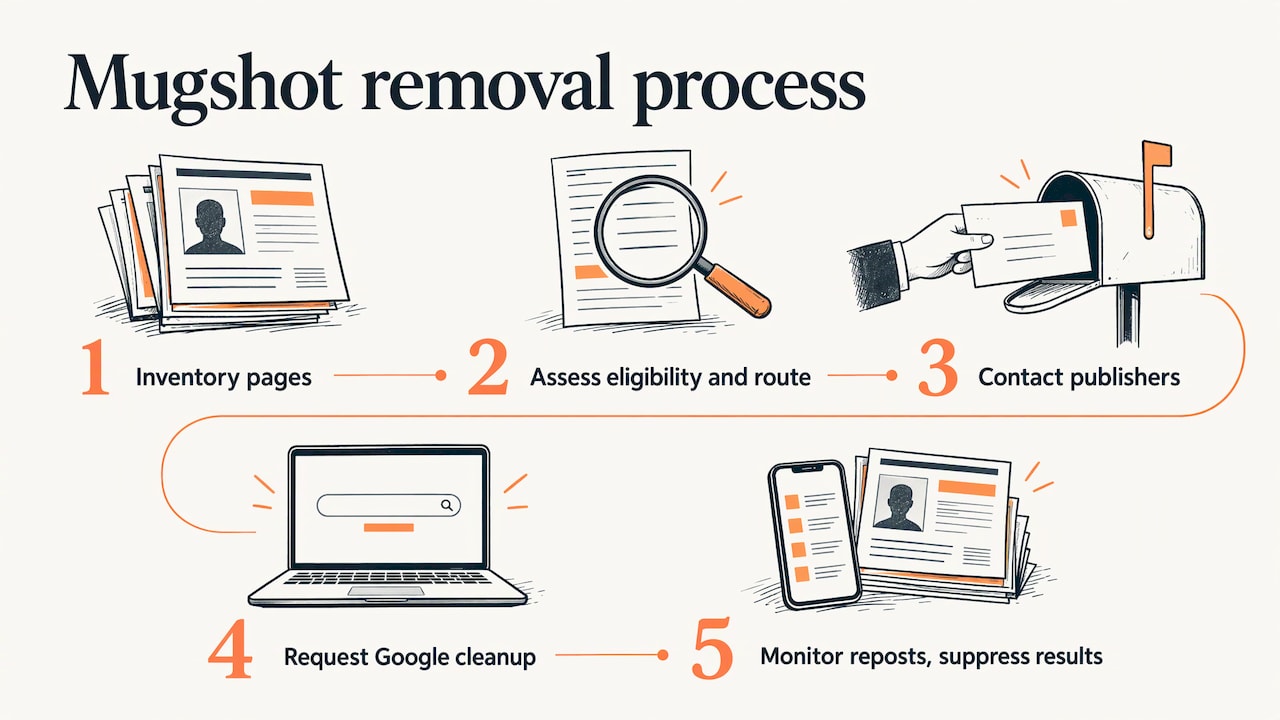
1. Inventory
We search your name, common variations and your arrest details to find every page carrying the photo or the record. People are often surprised by the count. Mugshot pages, court-records aggregators, news posts and forum threads all show up in this sweep.
2. Eligibility and route
For each page we determine the best lever. It may be a state statute, the publisher’s own removal policy, an expungement or sealing order, a privacy or copyright angle, or a search-level request. Different pages in the same case can need different routes.
3. Publisher outreach
We contact the site owner with the documentation the page requires: identification, case outcome and, where relevant, a legal citation. Where a statute dictates the form of the request, we follow it to the letter, because a request sent the wrong way gives a site an easy reason to ignore it.
4. Search cleanup
Once a page is changed or gone, we move on the Google side. For stubborn cases, a Google deindexing service targets the specific URLs that keep appearing for your name.
5. Suppression and monitoring
Copies pop up again. We keep watching for reposts and, where something cannot be removed, use search result suppression to move it off the first page. The suppression service starts from $500 per month.
What the law can do for you, state by state
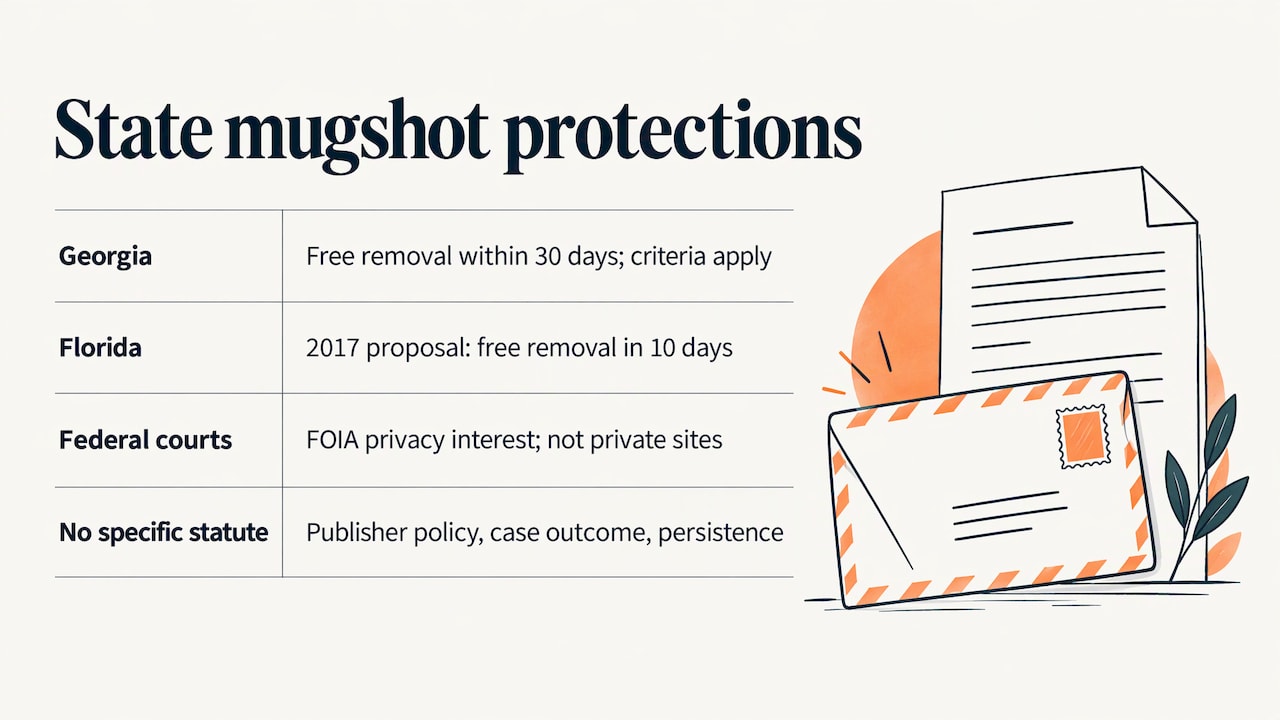
There is no single federal rule that forces private websites to delete booking photos. Protection comes from state law, and it varies a lot.
Georgia is the clearest example. Under O.C.G.A. § 10-1-393.5, commercial websites must remove a mugshot at no charge within 30 days when the person submits a written request and meets criteria such as dismissed charges or an acquittal. The Attorney General’s office says the request should include your name, date of birth, arrest date and arresting agency, and go by certified mail with return receipt or statutory overnight delivery to the publisher’s registered agent, principal business address or primary residence. If the site does not comply in 30 days or tries to charge a fee, you can report it to the Attorney General’s Consumer Protection Division.
Florida has moved in the same direction. A legislative staff analysis from 2017 described a proposal to bar sites from charging for removal and to require removal within 10 calendar days of a written request. Because bills change on their way to becoming law, confirm the current statute text, or let us confirm it for your case, before you rely on those terms.
Federal courts have recognized privacy value in booking photos. The Sixth Circuit held that people have a non-trivial privacy interest in booking photos under FOIA Exemption 7©, balanced case by case against the public interest. That ruling concerns what federal agencies release, not private websites, but it shows the direction of the argument.
In states without a mugshot-specific statute, removal usually depends on the publisher’s policy, your case outcome and persistence. That is where an experienced team earns its fee.
Does expungement or sealing remove a mugshot?
It helps, but it is not a full cleanup. A sealed or expunged record changes what the court and the agency will confirm. It does not order a private website to delete the copy it already scraped. Mugshots often get republished by commercial sites from public arrest records, and they do not disappear automatically after a dismissal or acquittal.
What the order does give you is leverage. Many publishers accept removal requests that attach proof of dismissal, expungement or sealing, and the order is the document that moves a stalled request. If you are eligible, pursue it with a criminal defense or record-clearing attorney in the state where you were arrested, and then bring the paperwork to the removal effort. Eligibility rules differ by state and offense, so an attorney licensed in that state is the right person to ask.
Can you remove a mugshot yourself for free?
Yes, in some situations. If your state has a removal statute, or the site has a free request form, you can write to the publisher yourself, and that costs nothing but time. The trouble is scale and follow-through. A single arrest can sit on many sites, each with its own form, each likely to repost later. Tracking all of them, keeping dated proof of every request, and then handling the Google side takes patience.
People who decide to hire usually do so when one of these is true:
- The photo appears on several sites or keeps reappearing.
- A site demands a fee, or ignores written requests.
- A job search, licensing review, apartment application or business deal is on the line.
- The arrest was in a state with no removal law.
- You would simply rather not read your own booking page repeatedly.
What to check before you hire a mugshot removal company
This industry has real operators and real problems. Use this checklist with anyone, including us.
| Question | What a good answer looks like |
|---|---|
| When do I pay? | Payment tied to results on agreed content, in writing |
| Is there a guarantee? | Clear terms on what is refunded and when |
| Who runs the sites? | The provider does not own or profit from the pages it removes |
| Will I get a quote? | A firm written quote after a free review, before work begins |
| Who is my contact? | A named person who knows your case |
| What happens if it reappears? | Monitoring and a stated response |
| How is Google handled? | Source removal first, then search requests and suppression |
Also ask which pages are in scope. A fair agreement lists the specific URLs or content types, so both sides know what “removed” means.
Be wary of any provider that guarantees removal from every site in every state, because publishers decide for themselves and laws differ. A promise that fits your actual case, with the route explained, is more believable than a blanket one.
Our perspective
Most people come to us after months of trying to handle a booking photo alone. They usually did the hard part right: they found the pages and sent the requests. What they lacked was a system to keep track of it all and a way to deal with Google at the same time.
We built our model around that gap. You get a free evaluation, a firm written quote before any work begins, and a dedicated project advisor who stays with your case. For agreed content, you pay after removal, and eligible projects carry a money-back guarantee. Payment plans are available if you want to spread the cost.
We treat a mugshot as one piece of a name’s search footprint. Taking down the photo, clearing the search result and building accurate profiles that outrank anything left behind belong in one plan, not three separate purchases. That is why our removal, deindexing, suppression and monitoring work together.
The work is confidential. Nobody learns about your project unless you tell them.
the author
Getting started with Defamation Defenders
Our mugshot and arrest record removal service covers booking photos, court records, news articles and other pages that surface when someone searches your name. We begin with a free evaluation, give you a firm written quote and assign a dedicated project advisor. You pay after the agreed content is removed.
If you also want to see what the wider cleanup involves, our guide to cleaning up your online presence walks through it. For pricing context across different removal types, see our page on the cost to remove negative information online. Individuals can also look at online reputation management for individuals. If your concern is keeping home addresses and other details off data sites, our personal information removal and monitoring starts from $49 per month.
How long mugshot removal takes
Timelines depend on the route. A statutory request in a state like Georgia has a defined window: the Attorney General states a 30-day deadline for removal. Voluntary requests to publishers have no fixed clock, and Google updates follow after the page changes. Complex cases with many copies take longer than a single listing.
What speeds things up is preparation. Have these ready:
- Your full legal name and any aliases used at booking
- Date of birth, arrest date and arresting agency
- Case number and the final disposition
- Any dismissal, acquittal, expungement or sealing order
- A list of the URLs where you have seen the photo
With that file, outreach starts the day the project does.
FAQ
Do mugshots stay online forever?
They can. Without action, a booking photo can stay online indefinitely, and a dismissal or acquittal does not remove it automatically because commercial sites keep republishing from arrest records. Removal at the source, plus search cleanup, is what changes that.
How do I remove a mugshot from Google?
Start with the page itself, because Google removal alone leaves the page reachable by URL and on other search engines. Once the site has removed or changed the content, you can send Google a request to update or drop the result. Our team handles both steps together, including deindexing for URLs that persist.
What can I do if a website refuses to remove my mugshot?
Check whether your state has a removal law. In Georgia, a qualifying person can send a written request, and if the site fails to act within 30 days or charges a fee, the Consumer Protection Division of the Attorney General accepts complaints. Elsewhere, an expungement order, a firm follow-up and search suppression are the next tools.
Can sealing or expunging my record clean up my mugshot online?
It strengthens your position but does not by itself delete copies held by private sites. Use the order as proof when you ask publishers to remove the photo. An attorney in your arrest state can tell you whether you qualify.
How much does a mugshot removal service cost?
Content removal is quoted per project after a free evaluation, and we pay-after-removal on agreed content. Search suppression starts from $500 per month. Your written quote states exactly what is included before any work starts.
Sources
- Contact a website owner, Google Search Help
- Mug Shots and Booking Photo Websites, NCSL
- How to Get Your Mugshot Off The Internet, RecordsFinder
- Do Mugshots Go Away? Expungement and Removal Options, Legal Clarity
- Attorney General Becerra Announces Criminal Charges, California Department of Justice
- Mugshot Websites, Georgia Attorney General’s Consumer Protection Division
- House of Representatives Staff Analysis, Florida Bill 857 (2017)
- Detroit Free Press v. DOJ, Office of Information Policy
Recommended
- How to Get Naked Pictures Removed from the Internet | Legal Strategies
- Remove Leaked Private Photos: Take Control and Protect Your Privacy
- What to Do If Someone Posts Your Picture Without Consent
- How to Remove Revenge Porn and Protect Your Online Reputation
Want this content gone? Get a free, confidential quote.
Send us the links. We'll reply with a firm quote and timeline. Most removals are done in a few days to a few weeks, with a full refund if we can't complete the agreed removal.
Pay-after-removal options · 4,000+ clients served · 4.9/5 on Google
Prefer to talk? Call 1-800-785-1749
