
You can get a fake Google review removed, but only if it breaks Google’s content policies. Disliking a review is not enough. Google only removes reviews that violate its policies, so the work is matching what you see to a specific rule, reporting it cleanly, and appealing if the first decision goes against you. This guide covers each step, the evidence to keep, when a legal claim makes sense, and what to do about negative results in Google Search itself.
Table Of Content
TL;DR
- Only reviews that violate Google’s policies are eligible for removal. Fabricated experiences, competitor attacks and incentivized reviews qualify. Harsh but honest opinions generally do not.
- Report from your Business Profile, choose the right violation reason, then track the result in the Reviews Management Tool. If it says no violation, use the one-time appeal.
- Keep screenshots, reviewer profile links, emails and chat logs. Never pay anyone who threatens a review attack.
- A fake review that states verifiable false facts can support a defamation claim. A vague opinion usually cannot.
- Negative pages in Google Search are a separate problem, with different tools: source removal, Google requests, deindexing and suppression.
Want this content gone? Get a free, confidential quote.
Send us the links. Most removals are done in a few days to a few weeks, with a full refund if we can't complete the agreed removal.
Table of Contents
- What counts as a fake review on Google
- How to report a fake Google review, step by step
- Understanding report statuses and the appeal
- Can Google detect fake reviews on its own?
- Evidence to collect before you report
- Is a fake review illegal, and can you sue?
- When the review is real but unfair
- Negative results in Google Search are a different problem
- Our perspective on fake review removal
- Get help with review removal
- FAQ
- Sources
What counts as a fake review on Google
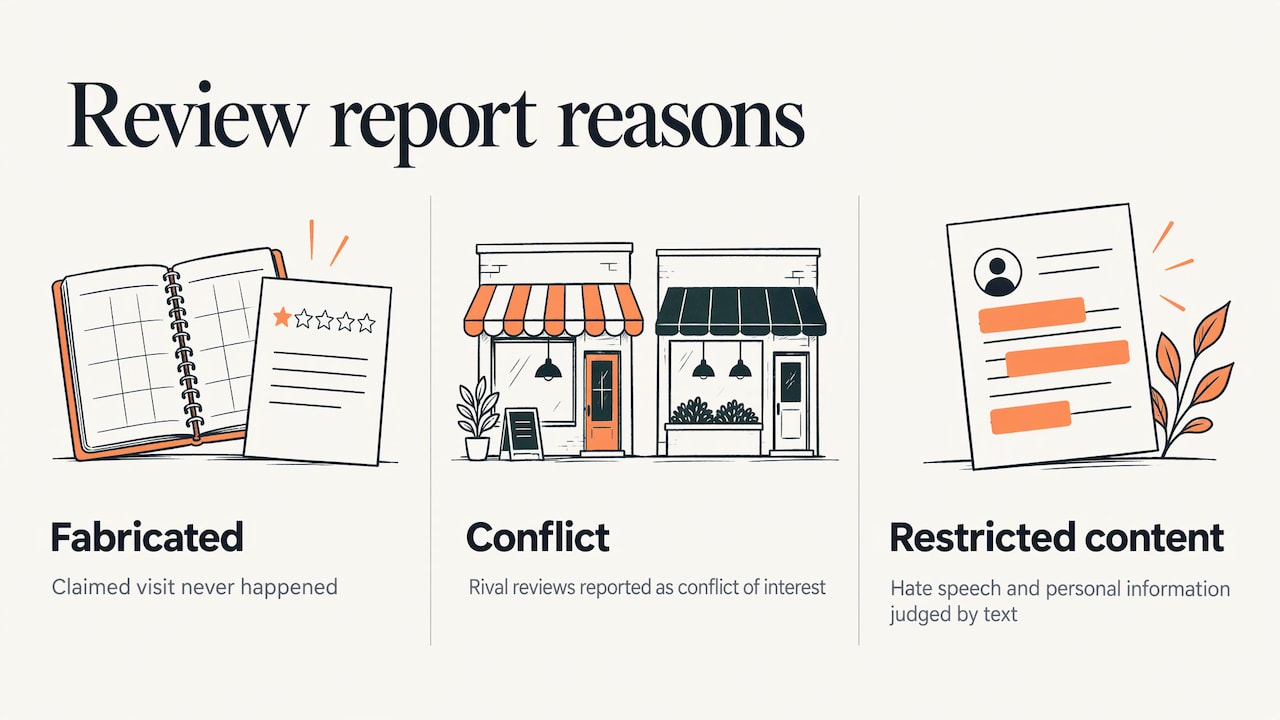
Start here, because it decides everything else. Google’s prohibited content policy describes fake or misleading content as including fabricated experiences, incentivized reviews, requests to revise or remove negative reviews in exchange for an incentive, and competitor reviews meant to undermine a business.
The same policy also covers patterns, not just single posts. Google prohibits unusual review volumes that suggest rating manipulation, conflicts of interest such as competitor or family relationships, and soliciting only positive reviews from customers. Those last two matter for you too: if you quietly ask only happy customers to post, that is a policy problem on your side.
In practice, fake reviews tend to look like one of these:
- A person who was never a customer. The reviewer describes a visit, a call or a purchase that did not happen.
- A competitor or former employee. The reviewer has a conflict of interest and is trying to hurt your rating.
- A burst of one-star reviews. Many reviews from new or unrelated accounts land in a short window.
- Reviews tied to a demand. Someone offers to stop posting, or to delete reviews, if you pay.
A review that is blunt, unfair or exaggerated but written by a real customer about a real experience is a different case. Google tells businesses not to report a review just because they disagree with it, and reports built on that basis tend to be rejected. We cover those reviews further down.
How to report a fake Google review, step by step
Google’s official reporting instructions are short. Here is the process in the order you should do it.
- Sign in to the Google account that manages your Business Profile. Open your profile and select Read reviews.
- Find the review and open its report option. Pick the reason that matches what you saw, such as spam, a conflict of interest or off-topic content. Choose the most specific reason, not the most dramatic one.
- Submit the report. Google evaluates it, and the typical wait is several days.
- Check the status in the Reviews Management Tool. Do not resubmit the same report repeatedly while it is pending.
- Appeal if needed. If the tool says no policy violation was found, use the one-time appeal flow.
If you manage several locations or many reviews, the Reviews Management Tool lets you report and track from one place instead of hunting through each profile.
Choose the right violation reason
The reason you select is the argument you are making. A review claiming a visit that never happened belongs under fake or fabricated experience, not under a generic complaint category. A review from a rival belongs under conflict of interest. If a review contains hate speech, personal information or other restricted content, report it under that content type, because those reasons are judged on the text itself and do not depend on proving the reviewer’s identity.
Understanding report statuses and the appeal
Google lists several statuses for reports, including Decision pending, Report reviewed with no policy violation, and Escalated, where you should check your email for updates. Each tells you something different:
| Status | What it means for you |
|---|---|
| Decision pending | Google is still evaluating. Wait several days before doing anything else. |
| Report reviewed, no policy violation | Google did not find a violation. The one-time appeal is your next step. |
| Escalated | The case is with a further review. Watch your email. |
The one-time appeal can include up to 10 reviews, and Google emails you the result. Since you get one shot, use it well. Group reviews that share a pattern, such as several posts from the same suspicious cluster of accounts, and be factual about why they violate policy. Do not use the appeal to vent.
Can Google detect fake reviews on its own?
Partly, and it helps to know how. Google’s Maps transparency report says its systems analyze account-level connections, paid-review operations, unusual influxes of one-star or five-star reviews, and conflicts of interest. The same page states that 221 million local reviews had been removed for fake engagement as of the period it represents.
That is useful context, but automated detection does not catch everything, and it does not know which review is about a customer who never existed. Your report supplies what the system cannot: the fact that you have no record of this person.
One warning from the same body of guidance. Google can restrict a Business Profile involved in fake engagement by blocking new reviews temporarily, unpublishing existing reviews temporarily, or showing a warning that fake reviews were removed. If you ever bought or incentivized reviews in the past, stop now. A clean profile reports more credibly.
Evidence to collect before you report
Good evidence makes a report easier to act on and keeps your options open if you later need a lawyer. Before the review disappears or the account is deleted, save:
- Full-page screenshots of the review, the date, the star rating and the reviewer’s profile.
- The link to the reviewer’s profile and a list of any other reviews they have posted.
- Your own records showing no matching customer, order, appointment or invoice for that name and date.
- Any emails, texts or chat logs from the reviewer or anyone connected to them, especially threats or demands.
- A simple timeline if a cluster of reviews arrived within days of a dispute, firing or competitor activity.
Do not reply to a suspicious review with accusations. A calm public response, such as stating that you cannot find a record of the visit and inviting the person to contact you directly, protects your image with readers without escalating anything.
If someone demands payment to stop review attacks
Some businesses receive messages offering to stop a wave of one-star reviews for a fee. Reporting on Google’s newer reporting form for review bombing, covered by National Jeweler, says Google advised merchants not to engage or pay, and to preserve screenshots, emails and chat logs for reporting and for law enforcement. Paying rarely ends the problem and may mark you as a target.
Is a fake review illegal, and can you sue?
It can be. Fake reviews can create legal exposure, though what you can actually pursue depends on your state, the facts and the wording of the review. This is a point to take to a licensed attorney in your state, ideally one who handles defamation or business torts.
A 2024 Ohio case shows the line courts draw. In Amaro v. DeMichael, the Ohio Fifth District Court of Appeals held that alleged fake reviews containing objectively verifiable claims, such as fictitious client relationships, communication or follow-up, could proceed as defamation allegations. Generalized subjective judgments were treated as protected opinion at the pleading stage. The American Bar Association Journal reported that the decision allowed claims concerning 62 reviews that described fictitious interactions or experiences.
The practical lesson, not a legal guarantee:
- A review saying you never returned a client’s calls, when that person was never a client, states something checkable and false.
- A review calling you rude or unprofessional is much more likely to be treated as opinion.
An Ohio appellate ruling does not bind courts elsewhere, so treat it as an illustration of how the distinction works. If you are weighing action, our page on legal action against bad reviews explains the options, and our overview of handling online defamation covers the reporting side.
When the review is real but unfair
Not every damaging review is fake. Some come from real customers with real, if one-sided, experiences. Google will not remove those, and arguing otherwise in a report wastes your one appeal.
What works instead is steady, honest work on the profile:
- Reply professionally and specifically. Future customers read your replies as much as the review.
- Ask every satisfied customer for an honest review, to everyone, not just the ones you expect to be positive. Selectively asking only for positive reviews is itself prohibited.
- Keep your profile complete and current so recent, accurate information outweighs one bad moment.
For businesses with several locations, our guide to local reputation management goes deeper on keeping ratings healthy at scale.
Negative results in Google Search are a different problem
Many people searching for review removal actually want a damaging article, forum thread, court record or complaint post gone from the results page. Those are not reviews, and the Business Profile reporting tool does nothing for them.
Start at the source
Google’s Search help says it generally does not remove content from Search except in limited circumstances, including legal removals, violations of Search Essentials, or at the website owner’s request. Google Legal Help advises contacting the content owner first, because removal at the source takes the material off the web. Delisting from Google leaves the page reachable through direct links or other search engines.
If you ask Google to act
For a defamation-based request, Google asks for the exact URLs, a clear explanation of why the statements are false and how they cause harm, and a valid email address. Reliable evidence, including a favorable court ruling, can support the request.
Personal data is handled separately. Google’s private information removal process covers items such as addresses, phone numbers, email addresses, Social Security or tax ID numbers, bank or credit card numbers, signatures, private medical records and confidential credentials. It affects Google Search results only: the source site stays online unless its owner changes it.
If you want to see how those routes fit together, our guide to removing unwanted Google search results walks through them.
What about bankruptcy records?
A bankruptcy appearing in a Google search is not the same as an entry on a credit report. The U.S. Courts explains that bankruptcy courts do not report to consumer reporting agencies, and that bankruptcy filings are generally public records available through clerk offices and PACER, with limited exceptions. So a court record is not something you dispute with a credit bureau.
For credit reports, the CFPB says accurate negative information generally cannot be removed, while inaccurate, duplicated, identity-theft-related or non-consumer information can be disputed. You can dispute with both the credit reporting company and the furnisher, which generally must investigate and correct errors within 30 days at no cost. A bankruptcy court FAQ adds that the court does not verify credit report information and points consumers to the FTC and CFPB processes.
When the record itself is public, the realistic options for search visibility are removal where a third-party site republishes it, deindexing requests where grounds exist, and suppression, which pushes the page down with stronger, accurate content.
Our perspective on fake review removal
Most business owners who come to us have already spent weeks reporting the same review and getting the same automated answer. The pattern is usually the same: the report named the wrong violation, or it argued that the review was unfair instead of showing that it was fake.
We start by sorting. Reviews that clearly break Google’s rules get a clean, evidence-based report. Content that Google will not touch, such as articles, complaint posts, court records or mugshots, needs a different route, whether that is working with the site that hosts it, a deindexing request, or suppression.
We built our model around that honesty. We offer a free evaluation, a firm written quote before any work, and a pay-after-removal structure with a money-back guarantee on eligible projects, so you are not paying for effort that produces nothing. Each client gets a dedicated project advisor, and the work stays confidential.
Reputation damage compounds when it sits. A fake review that stays up for months shapes every first impression, so acting early, with good evidence, is almost always the better path.
the author
Get help with review removal
If you have done the reporting and appeal and the reviews are still live, or the problem is bigger than reviews, we can look at it with you. Our Review Removal Service handles reviews that violate platform policies, and our Content Removal Services cover articles, court records, mugshots, social threads and personal information. The evaluation is free, you get a firm written quote before any work starts, and you pay after removal on the agreed content.

If the issue is a page that keeps ranking, our Search Result Suppression Services start from $500 per month, and personal information removal and monitoring starts from $49 per month. To see what each route involves, read our breakdown of the cost to remove negative information online, or start from our home page.
FAQ
Is it possible to get a fake Google review removed?
Yes, if the review violates Google’s policies. Fabricated experiences, competitor reviews and incentivized reviews are examples. Report it from your Business Profile, track the result, and use the one-time appeal if Google finds no violation.
How long does Google take to remove a fake review?
Google describes the typical evaluation as taking several days. You can follow the report’s status in the Reviews Management Tool. If it is still pending, wait rather than filing duplicates, and check your email if the status shows escalation.
Can Google detect fake reviews?
Google says its systems look at account connections, paid-review operations, sudden surges of one-star or five-star reviews and conflicts of interest. Automated detection is not complete, so reporting a review you know is fake still matters.
Can I sue someone for a fake Google review?
Possibly. Courts distinguish between protected opinion and false statements of fact, and a review describing a nonexistent customer relationship is more likely to be actionable than one that just calls you unprofessional. Outcomes depend on your state and the facts, so speak with a defamation attorney before filing anything.
Can I remove negative results from Google that are not reviews?
Sometimes. The most lasting fix is having the content removed by the site that hosts it. Google itself removes results only in limited cases, such as legal removals, certain private information, or violations of its Search policies. Where removal is not available, suppression can lower the page’s visibility.
Sources
- Report inappropriate reviews on your Business Profile
- Prohibited and restricted content, Maps user generated content
- Google Maps Content Trust and Safety Report
- Business Profile restrictions for policy violations
- Google Has a New Form for Reporting Review Bombing Attacks
- Amaro v. DeMichael, Ohio Court of Appeals, Fifth District, 2024
- ABA Journal: Law firm can sue over alleged fake online reviews
- Google Search consumer information
- Defamation Overview, Google Legal Help
- Remove my private info from Google Search
- Bankruptcy Case Records and Credit Reporting, U.S. Courts
- CFPB: Is it possible to remove accurate negative information from my credit report?
- How do I get a bankruptcy case removed from my credit report? U.S. Bankruptcy Court, Northern District of California
Recommended
- Unwanted Google Search Results: How to Remove Harmful Content and Reclaim Reputation
- Bad Review Examples: What They Look Like and How to Respond Effectively
- Remove Negative Articles from Google: A Comprehensive Guide
Want this content gone? Get a free, confidential quote.
Send us the links. We'll reply with a firm quote and timeline. Most removals are done in a few days to a few weeks, with a full refund if we can't complete the agreed removal.
Pay-after-removal options · 4,000+ clients served · 4.9/5 on Google
Prefer to talk? Call 1-800-785-1749
