
Content Removal › Court Records › JudyRecords
JudyRecords Removal Service
Is a court case on JudyRecords showing up when people search your name? We file the right request with JudyRecords to get the case page out of Google and Bing, or off the site entirely when the record is sealed or expunged, then clean up the court record sites and AI tools that copied it. Pay after removal is available, and if we can’t remove an agreed link, you get your money back.
- ✓ Pay after removal available
- ✓ Money-back guarantee on agreed removals
- ✓ Free, confidential JudyRecords case review
- ✓ Firm quote before any work starts
- ✓ 10+ years, 10,000+ records removed
Reviewed by Joe Chierotti, Defamation Defenders · Updated November 2026
Can you remove a case from JudyRecords?
Yes, in many cases. JudyRecords is a free search engine for U.S. court cases, and it runs two separate request channels: a suppression request that takes a case page out of search engine results, and a removal request that takes the page off JudyRecords itself. Removal is limited to records a court has sealed or expunged. Suppression is broader, and it is where most JudyRecords work happens. Picking the right channel, and writing the request well, is the difference between a quick yes and a request that goes nowhere.
Key facts about JudyRecords case removal
- JudyRecords is huge. It says it indexes more than 770 million U.S. court cases and claims 10x more cases than PACER and 100x more than Google Scholar. Criminal, civil, traffic, family, and probate cases all appear.
- Two channels, two inboxes. Suppression requests go to suppression@judyrecords.com. Removal requests go to removal@judyrecords.com.
- Suppression hides, removal deletes. A suppressed page drops out of Google and other search engines but can still be found by searching JudyRecords directly. A removed page is gone from the site.
- Removal needs a court order. JudyRecords says removal requests are accepted when the record has been sealed or expunged by a court order, with supporting documentation.
- No fee and no published timeline. JudyRecords doesn’t charge for either request, and it doesn’t publish how long they take.
- JudyRecords doesn’t control Google. After a page is suppressed or removed, Google still has to recrawl it or be asked to drop the old result.
- The data travels. JudyRecords sells API access and publishes downloadable datasets, so the same case can show up on other sites.
What JudyRecords will and won’t remove
JudyRecords’ published policy is short and lives on its Info page. Here is what it says, and how it plays out.
Sealed or expunged records: removal from the site
JudyRecords says removal requests are accepted when the record has been sealed or expunged by a court order. You send the case links along with supporting documentation, usually a copy of the order. This is the only ground JudyRecords publishes for deleting a page.
Everything else: suppression from search engines
For other cases, JudyRecords offers suppression. You send the links and a one or two sentence statement of the reason. JudyRecords doesn’t publish which reasons it accepts, so that short statement carries a lot of weight, and every suppression request is case-by-case.
Records that haven’t been sealed
If a record hasn’t been sealed, JudyRecords points people to an expungement service or an attorney instead of removing it. If you may qualify for sealing or expungement, it is often worth pursuing, because the order then unlocks full removal. See expungement vs. nondisclosure.
Outdated or mismatched records
JudyRecords’ terms say a record may not reflect the most accurate information, and that a search result doesn’t mean the record pertains to the person searched. It doesn’t publish a correction process, so a wrong-person or outdated case is usually handled as a suppression request with the reason stated clearly.
What JudyRecords won’t do
It won’t change the underlying court record, and it won’t delete an unsealed case just because it is old, embarrassing, or was resolved in your favor. Those cases go through suppression instead.
Why a JudyRecords listing hurts, even if you won
JudyRecords pages are built to be found. Each case gets its own page with your name, the case number, and the court, and search engines index them.
Employers and landlords
Dismissed doesn’t mean gone
Same name, wrong person
AI answers repeat it
What we remove from JudyRecords
JudyRecords case pages
Google and Bing results
Copies on other sites
How to remove JudyRecords from Google
Find every URL
Search JudyRecords for your name, including middle names and initials. Its search tips explain strict matching (your name followed by three commas) and lenient matching (two commas). Save every case page link.
Ask JudyRecords to act
Email suppression@judyrecords.com with the links and a one or two sentence reason to take the pages out of search engines. If the record is sealed or expunged, email removal@judyrecords.com with the links and the court order instead.
Confirm the change
Check each page before going to Google. A suppressed page should no longer be indexable, and a removed page should no longer load.
Clear the old result
Use Google’s Remove Outdated Content tool for each URL so the stale result and snippet drop out, and use Bing’s content removal tool for Bing. Then search your name again to confirm.
Which JudyRecords cases are easiest to remove
JudyRecords doesn’t publish suppression criteria, so this is how we assess cases at the free review. We tell you up front what is realistic.
| Likelihood | Typical situations |
|---|---|
| Strongest (removal) | Sealed or expunged cases with a court order |
| Strong (suppression) | Dismissed or not-guilty cases, mistaken identity, minor traffic and small civil cases, family and probate matters, and victims, witnesses, or minors named in filings |
| Case-by-case | Older convictions, evictions, collections and small-claims judgments, business disputes |
| Hardest | Recent serious convictions, open criminal cases, and cases with strong public interest, such as officials acting in public roles |
Our JudyRecords removal process
Free confidential audit
Send us your name or the JudyRecords link. We find every JudyRecords URL tied to you, including name variations, plus copies on other court record sites, people-search sites, and AI answers.
Firm quote and plan
You get a per-link price, the channel we’ll use for each case (suppression or removal), and the pay-after-removal option. No work starts until you approve.
We file the requests
We write and send each request to the right JudyRecords inbox, with the reason and documents framed properly. If you look eligible for sealing, we tell you, because it unlocks full removal.
Search engine cleanup
After JudyRecords acts, we get the old results out of Google and Bing and work through copies on other sites.
Monitoring and re-removal
We watch for the case to reappear. If a court record page we removed is re-posted on JudyRecords, we remove it again for free.
How long does JudyRecords removal take?
JudyRecords doesn’t publish processing times, so we won’t invent one. Here is what drives the timing at each stage.
| Stage | What happens | Timing |
|---|---|---|
| Review and quote | We find your URLs and give you a firm per-link quote | Starts as soon as you send your name or link |
| Suppression request | JudyRecords reviews the links and your reason | Not published by JudyRecords; varies by request |
| Removal request (sealed or expunged) | JudyRecords checks the court order against the case | Not published; a complete, legible order avoids back-and-forth |
| Google and Bing cleanup | Search engines drop the old result and snippet | Depends on recrawl; an outdated-content request avoids waiting for it |
| Copies on other sites | Each site follows its own process | Varies by site |
We give you a realistic estimate for your specific case at the free review.
Why JudyRecords requests get denied, and what strengthens a request
Common reasons a request fails
- Wrong channel. Asking for removal without a sealing or expungement order.
- Missing links. JudyRecords asks for the links themselves. A name alone doesn’t identify which pages you mean, and one missed URL leaves the case in search.
- A vague reason. Suppression asks for a one or two sentence reason. “I don’t want this online” gives JudyRecords nothing to weigh.
- Document problems. An order that doesn’t match the case number, missing pages, or an unreadable copy.
- Public interest. Cases involving public officials or serious recent crimes are harder to suppress.
What makes a request stronger
- Every URL tied to the case, including duplicates under name variations
- A short, specific reason tied to a concrete fact, such as a dismissal, mistaken identity, or a minor or victim named in the filing
- A complete copy of the sealing or expungement order with the matching case number
- A clear follow-up instead of repeated duplicate emails
Will my case come back on JudyRecords?
It can. JudyRecords keeps adding cases from court systems; its own case count log shows regular updates. A fresh pull from a court can create a new page for the same case or the same case under a different URL. Copies also spread through JudyRecords’ API and datasets, and Google can pick a page back up if it becomes indexable again.
How we prevent it
- We record every URL we handle, so a new one stands out right away
- We monitor your name on JudyRecords and in Google
- We include copies on other court record and people-search sites in the plan, so one site can’t feed the case back into search
Can you remove yourself from JudyRecords?
Yes. Both JudyRecords requests are free, and plenty of people handle a single case on their own. Here is the do-it-yourself path:
- Search JudyRecords for every version of your name and save each case link.
- Decide on the channel: removal if you have a sealing or expungement order, suppression for everything else.
- Email the right address with the links and either the court order or a one or two sentence reason.
- Follow up if you don’t hear back, then confirm each page is suppressed or gone.
- Submit each URL to Google’s Remove Outdated Content tool and Bing’s content removal tool.
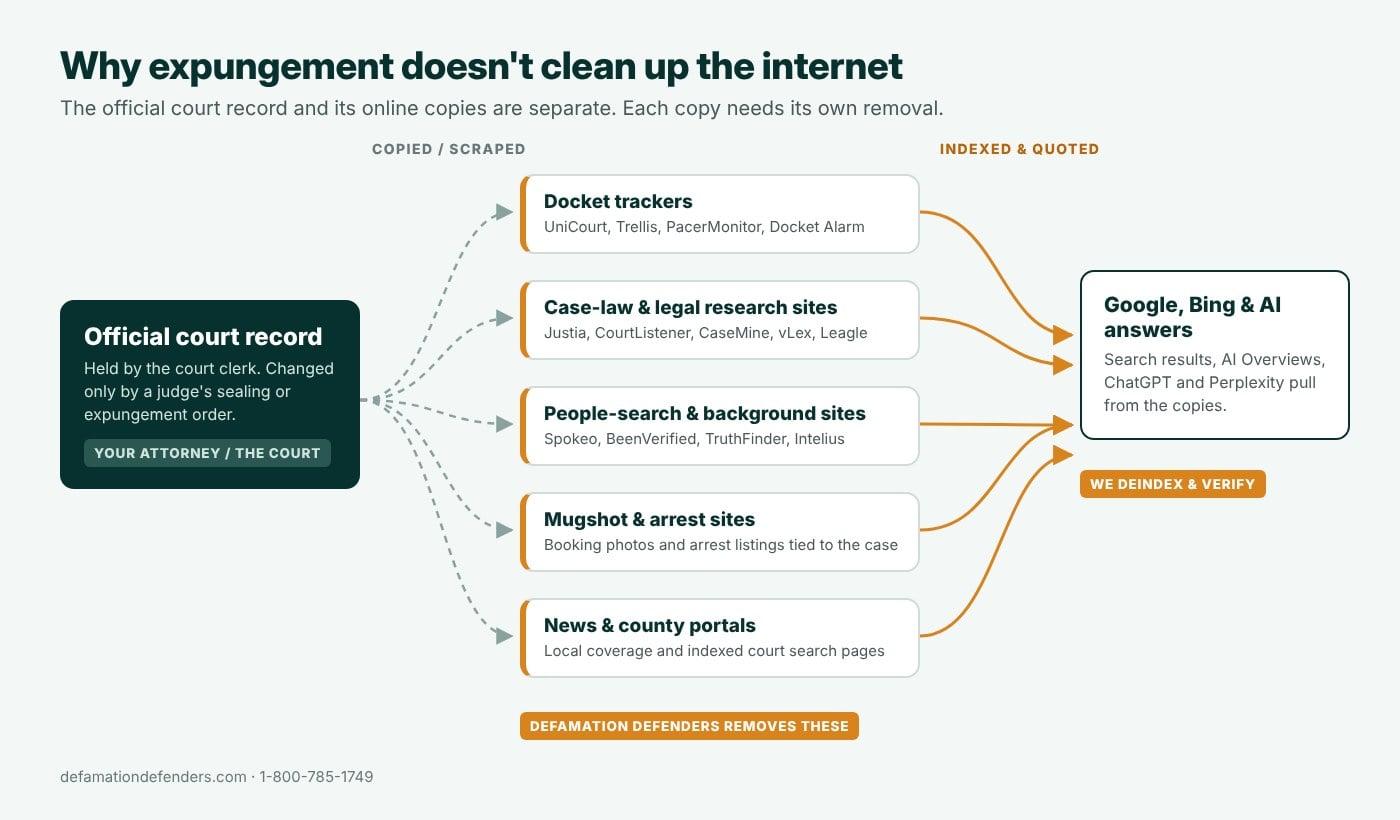
- Check Trellis, Docket Alarm, Justia, UniCourt, and people-search sites for copies.
Where DIY usually goes wrong
- Missing URLs that only appear under a middle name, initial, or misspelling
- Requesting removal without an order, or suppression with a weak reason
- Stopping at JudyRecords while Google still shows the old result
- Not checking the other sites that carry the same case
| Doing it yourself | Defamation Defenders | |
|---|---|---|
| Cost | Free, plus your time | Firm per-link quote; pay after removal available |
| Finding every URL | Manual name searches | Full audit across name variations and other sites |
| Writing the request | Trial and error | Right channel and a clear, specific reason |
| Google and Bing | Separate requests you file | Included |
| Copies and AI answers | Usually missed | Included in the plan |
| If it comes back | Start over | Free re-removal on the same site |
Defamation Defenders vs. other JudyRecords removal services
| Defamation Defenders | Many other services | |
|---|---|---|
| Pay after removal | Available | Rarely offered |
| Money-back guarantee | On every agreed removal | Varies |
| Pricing | Firm per-link quote before work | Often monthly retainers |
| Uses JudyRecords’ own suppression and removal channels | Yes | Some only try to outrank the page |
| Google, Bing, and copies on other sites | Included in the plan | Often extra |
| Free re-removal if re-posted | Yes, same site | Varies |
| Experience | 10+ years, 10,000+ records removed | Varies |
Pay after removal. Money back if we can’t remove it.
Most JudyRecords removal services ask you to pay up front and hope. We put it in writing: pay after removal is available on JudyRecords projects, and every agreed removal is backed by a money-back guarantee and free re-removal.
Pay after removal
Pay after removal is available: you pay once the JudyRecords page is suppressed or removed, instead of paying up front. Payment plans are available for multi-site projects.
Money-back guarantee
If we agree to remove a JudyRecords listing and can’t, you get your money back for that link.
Free re-removal
If a court record or mugshot page we removed is re-posted on the same site, we remove it again at no cost. This does not apply to news articles.
Firm price up front
You get a firm per-link quote before any work starts. We accept all major cards and Zelle.
What our clients say
Defamation Defenders has spent more than 10 years removing records and cleaning up search results for people across the country. Here’s what clients say about working with us.


JudyRecords removal FAQs
How do I remove my case from JudyRecords?
There are two ways. If the record has been sealed or expunged, email removal@judyrecords.com with the case links and the court order. For anything else, email suppression@judyrecords.com with the links and a one or two sentence reason, which takes the page out of search engine results. We handle both, plus Google and Bing.
How do I remove JudyRecords from Google?
Get JudyRecords to suppress or remove the page first, then ask Google to drop the old result with its Remove Outdated Content tool. Google generally won’t drop a live court record page on request alone.
Why am I on JudyRecords?
JudyRecords indexes cases from court systems across the U.S. If your name appears in a filing as a defendant, plaintiff, witness, or other party, it can show up. Its terms also note that a search result doesn’t mean the record pertains to the person searched, so people with common names sometimes see strangers’ cases.
What information does JudyRecords show?
It varies by court, but a case page often shows the party names, case number, court, case type, filing date, and docket details.
Is JudyRecords removal free?
JudyRecords doesn’t charge for suppression or removal requests. Our service is paid, with a firm per-link quote after a free review, and pay after removal is available.
Can you remove a conviction from JudyRecords?
Full removal from the site requires a sealing or expungement order. Without one, a conviction can still be submitted for suppression from search engines, and we’ll tell you honestly how strong that request is. If you may qualify for expungement, we’ll point you in that direction.
What if JudyRecords denies my request?
We look at why: the wrong channel, missing links, a weak reason, or a document problem. Where it makes sense we fix the request and resubmit. Agreed removals are backed by our money-back guarantee.
Can I resubmit a denied JudyRecords request?
JudyRecords’ policy doesn’t limit resubmissions, but a new request works best when something has changed, such as a new court order, a clearer reason, or links that were missing the first time.
How long does JudyRecords removal take?
JudyRecords doesn’t publish processing times. Timing depends on the request type, how complete it is, and how quickly Google and Bing recrawl the page. We give you a realistic estimate at the free review.
How much does JudyRecords removal cost?
It depends on how many case pages and copies are involved. You get a firm per-link quote before any work starts, with pay after removal, payment plans, all major cards, and Zelle available.
If my case is suppressed, can lawyers and courts still see it?
Yes. Suppression only hides the page from search engines; it stays on JudyRecords, and the official court record doesn’t change. Courts, attorneys, and screeners who check official sources can still find it.
Does JudyRecords removal fix AI answers?
It helps. AI tools like ChatGPT, Google AI Overviews, and Perplexity draw on indexed pages, so taking the JudyRecords page out of search removes one source. We also check AI answers for your name and work on the other sources they cite.
Is my case on other sites too?
Often. The same case may appear on Trellis, Docket Alarm, Justia, UniCourt, and people-search sites. Our free audit checks them and includes them in the plan.
Will my case come back on JudyRecords?
It can, because JudyRecords keeps pulling new data from courts. We monitor for it, and if a court record page we removed is re-posted on JudyRecords, we remove it again for free.
Does expungement automatically remove my case from JudyRecords?
No. JudyRecords doesn’t say it tracks sealing or expungement orders. You need to send a removal request with the order and the case links.
Can I sue JudyRecords to remove my case?
JudyRecords says its records were made public by the courts and agencies that hold them, and lawsuits over accurate public records are usually difficult and expensive. Talk to an attorney about your situation. In most cases the suppression and removal channels are faster.
Is JudyRecords removal legal?
Yes. We use JudyRecords’ own suppression and removal channels and the search engines’ own tools. We never falsify documents or try to alter court records.
Do I need a lawyer to remove my case from JudyRecords?
Not for the suppression or removal requests themselves. Getting a record sealed or expunged is a court process, and an attorney often helps with that. We are not a law firm.
Is the process confidential?
Yes. Your review is confidential, and we share only the information each request needs.
Find out if your JudyRecords case can be removed
Send us your name or the JudyRecords link. We’ll find every page tied to you, tell you honestly what can be suppressed or removed, and give you a firm quote. Free and confidential.
Defamation Defenders is an online reputation and content removal company, not a law firm, and nothing on this page is legal advice. We are not affiliated with JudyRecords or its owners. Suppression and removal do not alter, seal, or expunge official court records; only a court can do that. JudyRecords policy details come from its published Info and Terms pages as of November 2026 and may change.
Published · Last updated by the Defamation Defenders team