
Estimated reading time: 10 minutes
A suspicious review appears on your Google Business Profile. You cannot match its claims to a known interaction, yet the rating is visible to prospective customers. Should you report it yourself, hire a specialist, or focus on a response?
The best Google review removal service should help answer that question before asking you to commit. A useful plan identifies the issue, explains the available reporting route, and defines what you are paying for.
Effective negative review removal is not about erasing every unhappy opinion. It is about addressing content that has a supported basis for removal while handling genuine feedback responsibly.
Publisher note: Defamation Defenders publishes this guide. The comparison covers service approaches, with Defamation Defenders featured, rather than an independent company ranking.
Table Of Content
Which Google Reviews Can Be Removed?
Google’s review removal guidance says policy-violating reviews qualify for removal; disagreement or dissatisfaction alone does not. Start by identifying the rule at issue, not just the harm to your rating.
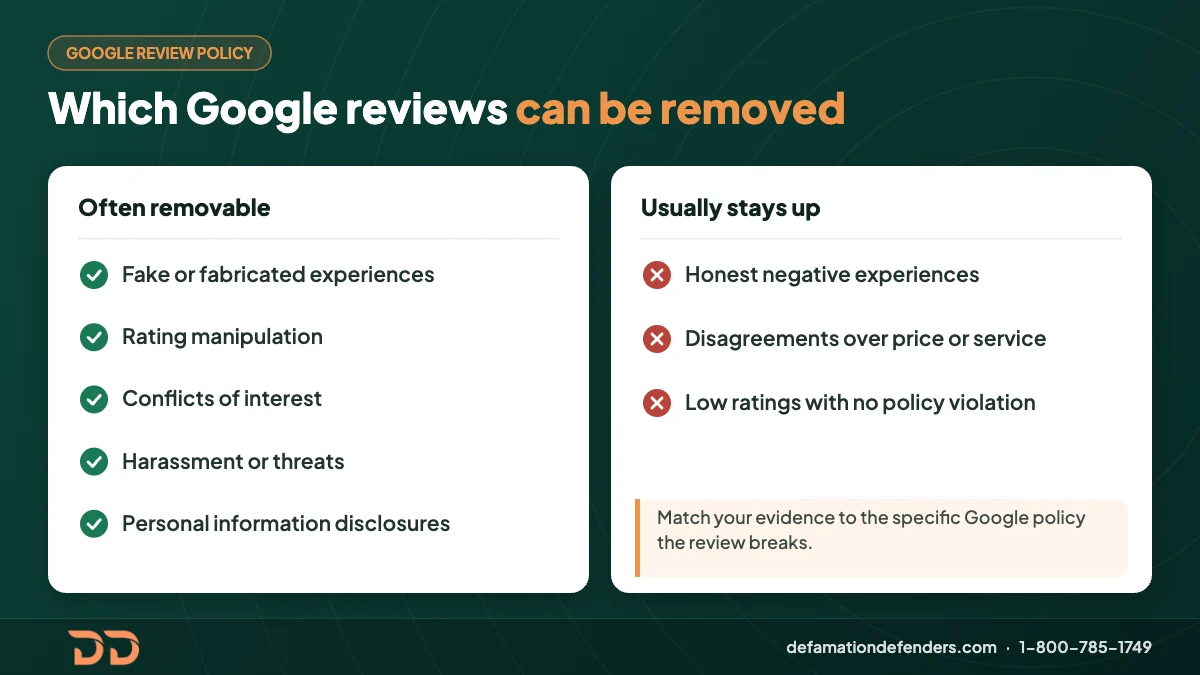
Under Google’s prohibited and restricted content policies, relevant issues can include fabricated experiences, rating manipulation, conflicts of interest, harassment, threats, and certain personal-information disclosures. Match the evidence to the specific requirement.
For example, a reviewer describing an expensive service is different from an account posting unrelated advertising. Likewise, an exposed personal identifier requires a different assessment from criticism of your opening hours.
Treat an unfamiliar reviewer name as a reason to investigate, not proof of fraud. Check the substance of the claim before making accusations.
Buy a documented process, not a promise that every low rating will disappear.
Want this content gone? Get a free, confidential quote.
Send us the links. Most removals are done in a few days to a few weeks, with a full refund if we can't complete the agreed removal.
Google Review Removal Services Compared at a Glance
Use this table to match the service model to your needs. Confirm the actual scope and terms in writing.
| Service approach | Suitable when | Key question before committing |
|---|---|---|
| Defamation Defenders managed support | You want specialist review assessment and related reputation support. | Which reviews, actions, and outcomes does the proposal cover? |
| Self-service reporting | You can assess and document a straightforward issue yourself. | Can your team handle the evidence and follow-up? |
| Individual review project | You need help with one clearly identified review. | What event counts as completion and triggers payment? |
| Review-management software | You need organized tracking and response workflows. | Does the package include human case handling or only tools? |
| Attorney-led assessment | A dispute requires advice about legal rights or action. | What legal work is justified, and what remains uncertain? |
Defamation Defenders: Managed Removal and Reputation Support
Defamation Defenders offers a dedicated Google review removal service. Its service page offers a confidential assessment, a quote before work begins, and a money-back guarantee on agreed removals. Ask for those terms as they apply to your specific reviews, including exclusions and refund conditions.
Its business reputation management services also cover review assessment, response practices, content-removal options, and monitoring. This broader scope is worth discussing when reviews are only part of the problem.
For example, you may need to address a suspicious review while correcting inaccurate business details elsewhere. Request separate deliverables so each task has a clear purpose.
Choose the work that fits your situation. A single disputed review does not automatically justify an ongoing campaign.
Self-Service Reporting: For a Focused, Manageable Case
Consider handling the matter internally when you have a clear policy concern and time to document it.
Assign one person to review the evidence, submit the report, and track the response. Keep a shared record of approved actions so colleagues do not send conflicting explanations.
The key comparison is your team’s available time versus the quoted service scope. Do not assume paying someone creates different eligibility rules.
For a business with several locations, name the affected branch and responsible contact in each case. Keep one location’s records out of another location’s submission. Ask any outside provider to preserve that separation in its reporting, rather than combining all reviews into a single total.
Individual Review Projects: For a Defined Target
A single-review engagement can make sense when you want a narrow assignment rather than ongoing management.
Ask for the exact review URL in the agreement. Clarify whether the work includes assessment, reporting, eligible follow-up, and verification.
An outcome-based fee still needs a precise definition. A changed star average is not proof that the targeted review was removed.
Monitoring Software: For Organization and Consistent Responses
Consider tools when your main need is coordinating reviews across locations or teams.
Ask for a demonstration using your workflow. Who checks flagged items? Who drafts responses? Who handles denied requests?
Do not confuse a dashboard with managed removal. Confirm whether you are buying software access, human support, or both, and identify the work your staff must still perform.
Attorney-Led Assessment: For Legal Questions
Seek qualified counsel when you need advice about a disputed allegation, legal demand, or possible proceedings.
Keep that assessment distinct from routine platform reporting. A provider preparing screenshots or organizing links is not necessarily providing legal representation.
Before authorizing outreach, clarify who approves statements, handles responses, and pays any separate legal fees. Request a reasoned assessment, not an automatic threat letter.
What a Reliable Negative Review Removal Process Looks Like
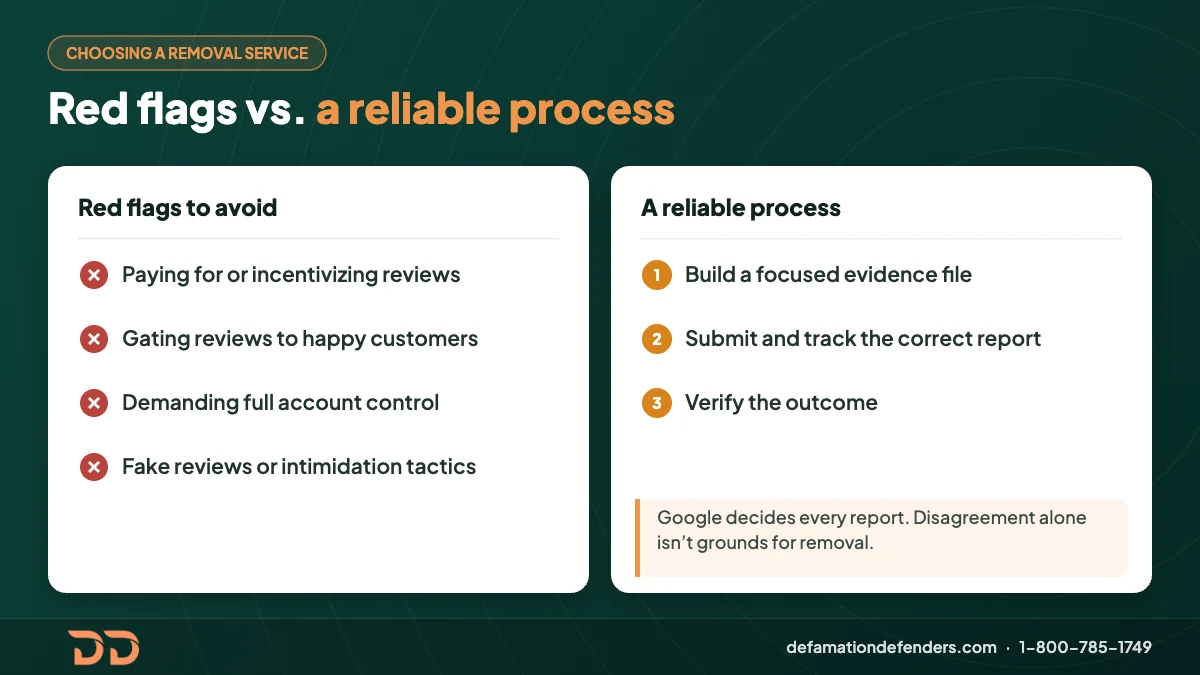
1. Build a Focused Evidence File
Save the review link, displayed text, date, reviewer profile link, and relevant correspondence. Keep sensitive customer records private and share only what the process requires. Set an approval step before anyone contacts a reviewer or posts under your business name.
Explain the issue plainly. Identify which statement or behavior appears to violate a rule and what supports that assessment.
Separate confirmed facts from suspicions. Avoid presenting a missing booking record as decisive proof.
2. Submit and Track the Correct Report
Google lets businesses report reviews through their Business Profile or the Reviews Management Tool. Its help page explains status checks and a one-time appeal for eligible denied reports. Keep the case reference and the reasoning used, so follow-up addresses the actual decision.
Ask any paid provider to show what was submitted and what response came back. Reporting volume should not substitute for relevant evidence.
3. Verify the Outcome
Check the targeted review on the relevant listing. Record whether it remains, changed, or disappeared. Keep submitted, pending, denied, and removed items separate.
Also distinguish review removal from search suppression. Publishing useful pages may support broader visibility goals, but a different search position is not evidence that the review was deleted.
For example, a hypothetical report might show six targeted reviews: two removed, two pending, and two denied. That is useful information, even without a perfect result. A report saying only “six reviews handled” would hide the distinction.
Use a simple private tracker:
Review URL:
Policy concern:
Supporting evidence:
Report date and case reference:
Decision or appeal status:
Verified outcome and next review date:
What Should Google Review Removal Cost?
Compare written quotes against the same assignment rather than looking for a universal price.
Ask whether the fee covers assessment, one review, several reviews, or recurring support. Identify any setup charge, minimum term, renewal rule, and additional cost for follow-up.
For outcome-based pricing, define what triggers payment. Does the agreement require the exact review to disappear? What happens if it returns? Is the refund process straightforward?
Request a sample report before signing. It should show the target, action, decision, and remaining work without exposing another client’s private details.
Before accepting a success-rate claim, ask what was counted. Were ineligible cases excluded? Were pending requests included? Did the figures cover comparable reviews and a defined time period? Request anonymized evidence that connects the service delivered to the outcome claimed.
A narrow project may be enough for one issue. Choose ongoing review management only when its reporting and support solve a continuing need.
Red Flags That Deserve a Closer Look
Incentives, Fake Reviews, and Review Gating
Google prohibits incentives for posting, revising, or removing reviews. It also prohibits discouraging negative feedback or selectively soliciting positive reviews. Do not approve a campaign that routes only happy customers to Google.
The FTC’s review-rule guidance addresses fake reviews and prohibited intimidation, including unfounded legal threats intended to prevent or remove reviews. Require truthful reporting and responsible outreach from anyone acting for your business.
Unnecessary Account Control
Google supports separate Business Profile owner and manager access, so collaboration does not require sharing your password. Grant only the access needed, retain control of your profile, and remove permissions after the engagement.
Ask how the provider protects screenshots, customer information, and case records. Avoid sending complete customer files merely to support a basic review assessment.
What to Do About Review Extortion
A sudden cluster of low ratings followed by a payment demand needs a different response from an ordinary complaint.
Google provides a dedicated review extortion reporting process. It advises businesses not to pay or engage with the people making demands and to preserve communications and relevant review links. Use that route when the facts fit, rather than labeling every disputed review extortion.
Keep the timeline, messages, and contact details together. Share relevant evidence through verified reporting channels, not public arguments.
What If the Review Stays Online?
Plan for this possibility before hiring anyone.

For genuine feedback, address the underlying issue and use a calm response where appropriate. Keep private customer details out of public replies. In a regulated profession, obtain the necessary review before discussing a client interaction.
A measured reply might say:
Thank you for sharing your concerns. Please contact our team through our usual support channel so we can review the matter privately.
Adapt that wording to the facts; do not imply a relationship you have not verified.
Ask for honest feedback through a consistent, non-incentivized process. Also review repeated themes in complaints. A service improvement may do more for customer trust than another unsupported removal request.
Frequently Asked Questions About Google Review Removal
No provider’s contract changes Google’s eligibility rules. A refund guarantee describes your remedy if agreed work fails; it does not establish that every negative review qualifies. Read the scope and exclusions before relying on the word “guaranteed.”
Google says review evaluation typically takes several days. That is not a guaranteed deletion date. Ask the provider to separate preparation, submission, Google review, and any appeal, and to explain how it reports delays.
The absence of written feedback does not establish a violation by itself. Google’s policies apply to ratings as well as reviews. Assess genuine policy concerns and supporting evidence rather than treating a low score alone as grounds for removal.
Evaluate the actual work offered: policy assessment, evidence organization, case tracking, eligible follow-up, and outcome checks. Ask which tasks your team retains. Paid support is worth considering when those deliverables justify the fee, not merely because reporting feels frustrating.
Treat the mismatch as an investigative clue. Review the content and relevant records carefully before making an accusation. Ask a provider to distinguish verified facts from assumptions and explain what additional evidence would support its proposed action.
No. Improving other pages’ visibility is a different objective from deleting the review. Require separate reporting and pricing for those tasks. A review-management proposal should never count a stronger website ranking as a completed review removal.
The best Google review removal approach is the one suited to your evidence, priorities, and resources. Compare eligibility assessment, scope, pricing, privacy safeguards, and verified results rather than sweeping promises.
Responsible negative review removal protects your business without silencing legitimate customer experiences.
Contact Defamation Defenders to request an assessment of the reviews concerning you. Bring the review links and any prior responses, then ask for clear next steps, written terms, and a plan for remaining issues.
Works Cited
Defamation Defenders. “Business Reputation Management.” Defamation Defenders, defamationdefenders.com/business-reputation-management/. Accessed 13 Oct. 2026.
Defamation Defenders. “Google Review Removal Service.” Defamation Defenders, defamationdefenders.com/google-review-removal-service/. Accessed 13 Oct. 2026.
Federal Trade Commission. “The Consumer Reviews and Testimonials Rule: Questions and Answers.” Federal Trade Commission, Nov. 2024, www.ftc.gov/business-guidance/resources/consumer-reviews-testimonials-rule-questions-answers. Accessed 13 Oct. 2026.
Google. “Manage Your Business Profile Owners & Managers.” Google Business Profile Help, support.google.com/business/answer/3403100. Accessed 13 Oct. 2026.
Google. “Manage Your Google Business Reviews.” Google Business Profile Help, support.google.com/business/workflow/9945796. Accessed 13 Oct. 2026.
Google. “Prohibited & Restricted Content.” Maps User Generated Content Policy Help, support.google.com/contributionpolicy/answer/7400114. Accessed 13 Oct. 2026.
Google. “Report Inappropriate Reviews on Your Business Profile.” Google Business Profile Help, support.google.com/business/answer/4596773. Accessed 13 Oct. 2026.
Related Contents:
Want this content gone? Get a free, confidential quote.
Send us the links. We'll reply with a firm quote and timeline. Most removals are done in a few days to a few weeks, with a full refund if we can't complete the agreed removal.
Pay-after-removal options · 4,000+ clients served · 4.9/5 on Google
Prefer to talk? Call 1-800-785-1749
