

What parents can do to report abuse and seek removal
Need help with this? Our leaked content removal service can handle it for you, starting with a free, confidential review and a firm quote before any work begins.
If someone has created or shared an explicit AI deepfake of your child, start with their safety, then report it through child-protection and platform channels. Do not download, forward or screenshot the image to prove what happened. Record known URLs and report details without creating another copy.
An ordinary school photograph or social media picture can be manipulated into an explicit deepfake. Your child does not need to have taken or shared an intimate image to be targeted.
Table Of Content
What the new IWF findings show
On October 5, 2026, the Internet Watch Foundation reported new AI child abuse imagery findings. Its analysts assessed 6,310 AI-generated images meeting the legal definition of child sexual abuse between January 1 and June 30, 2026. That was approximately 40 percent more than the 4,512 images identified during all of 2026. Images depicting children ages seven through thirteen accounted for 79 percent of the first-half total.
These are images identified and assessed by the IWF, not a count of every image circulating online or the number of children affected. The findings show why families need reporting routes that address synthetic content as well as real photographs.
Want this content gone? Get a free, confidential quote.
Send us the links. Most removals are done in a few days to a few weeks, with a full refund if we can't complete the agreed removal.
An AI-generated image can still be reportable abuse
A fake image can expose an identifiable child to harassment, blackmail or repeated humiliation. Do not wait to establish exactly how it was made before asking for help. NCMEC’s generative AI guidance describes exploitation involving manipulated images, including incidents among classmates, and directs families to reporting and support services.
Whether an image meets a particular legal definition depends on the content and applicable law. Families do not need to resolve that question themselves before reporting suspected exploitation.
Google’s child sexual abuse imagery policy also addresses prohibited modified imagery of identifiable minors and computer-generated imagery that is indistinguishable from actual children engaged in sexually explicit conduct.
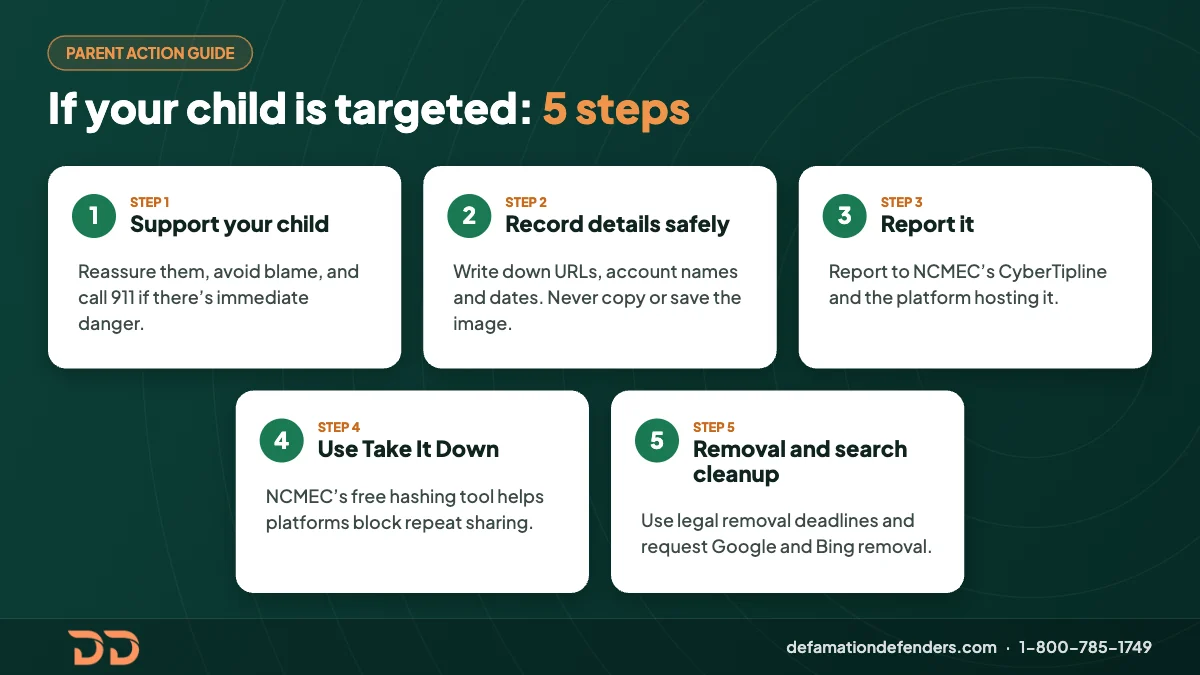
What to do if your child is targeted: five steps
1. Support your child and address threats
Tell your child they did the right thing by coming to you. Avoid blame or making them repeatedly view the image. If there is immediate danger, contact local emergency services.
If someone demands money, more images or sexual activity, treat the situation as suspected sextortion. Seek help before paying or complying. Report and block the account, but do not delete the profile or existing messages. Ask NCMEC or law enforcement how to preserve the original conversation safely without making new copies of abusive imagery.
2. Record locations and report details safely
Keep a written record of information you already have:
- The page or post URL and available account identifiers.
- When you discovered the content and when you reported it.
- Threats or demands described in text without copying explicit imagery.
- Platform report numbers, confirmation emails and decisions.
Do not ask friends, classmates or school staff to send you the image. Do not repost it to explain the situation. Google instructs users not to take or share explicit screenshots involving minors. If material is already on a device, seek professional instructions about handling it rather than making additional copies.
3. Report to NCMEC and the platform
In the United States, submit a report through the CyberTipline. Include known URLs, account information and the circumstances. Follow the reporting form’s instructions; do not acquire an image you do not already have.
Also use the platform’s child-safety or sexual-exploitation reporting channel. Identify that the content concerns a minor and explain that it is AI-generated or manipulated if you know that. Keep the report confirmation. If classmates are involved, contact the school’s safeguarding or administration team without forwarding the image.
4. Ask about tools that can limit repeat sharing
NCMEC’s Take It Down service is free. It creates a digital fingerprint, called a hash, on the user’s device. The image stays on that device; participating platforms receive the hash to help detect matching content on public or unencrypted services.
NCMEC says victims of AI-generated explicit images can use the service. For a manipulated image of a child, ask NCMEC for guidance on the appropriate route. The tool does not cover every website or encrypted conversation, and a hash is not a guarantee that every altered copy will be blocked.
Do not download an image or ask someone to send it so you can use the tool. If you do not have the material on the original device, the Take It Down FAQ directs you to the CyberTipline or 1-800-THE-LOST for assistance. Take It Down is a service; the TAKE IT DOWN Act is a separate federal law.
5. Use applicable removal deadlines and search reporting routes
The FTC’s TAKE IT DOWN Act guidance explains that covered platforms must remove qualifying nonconsensual intimate images within 48 hours of a valid request, including reasonable efforts to find and remove known identical copies. Qualifying AI-generated depictions can fall within the law. Platform coverage and notice requirements matter; the deadline does not apply to every website or every report.
Keep the submission time and confirmation number. If a covered platform fails to provide a working process or does not act on a valid request within the required period, report that failure at TakeItDown.ftc.gov. An FTC complaint supports enforcement; it does not guarantee immediate removal in an individual case.
If the content appears in Google Search, use Google’s child sexual abuse imagery reporting route. Search removal and source removal are separate: a result can disappear from Google while the underlying content remains on the hosting site. Do not upload explicit screenshots as supporting evidence.
How Defamation Defenders can help assess removal options
Families dealing with multiple URLs, reposts or lingering search results may want help organizing removal requests. Our online content removal services provide a starting point for discussing which source-removal and search-removal options may apply.
Start with a description of the issue and known URLs. Do not send or upload explicit images of a minor through our general contact form or email. Use NCMEC, law enforcement and qualified child-protection professionals for exploitation reports and evidence-handling guidance.
Additional removal work should complement those channels, with clear boundaries about platform coverage, deadlines and what can be verified. Availability and outcomes depend on the content and the publisher.
Request a free discussion of removal options or call Defamation Defenders at 1-800-785-1749. Our consultation is not an emergency reporting service.
Talk before an incident happens
Ask your child what they have heard about AI image tools. Explain that creating, saving or forwarding sexualized images of classmates is harmful, even when the image is fabricated. Encourage them to tell a trusted adult if they encounter one, and ask the school how it handles reports and supports affected students.

A child should know they can ask for help without being punished for someone else’s abuse. The IWF and National Crime Agency parent guide offers additional advice about family conversations and photo-sharing privacy settings.
Frequently asked questions about child AI deepfake removal
Can I report an explicit deepfake if the image is fake?
Yes. Report suspected child sexual exploitation even if the image was generated or manipulated by AI. Let the reporting organization assess the content; you do not need to prove how it was made first.
Should I save a screenshot as evidence?
Do not create or share explicit screenshots involving a minor. Record known URLs, account identifiers and report numbers instead. Ask NCMEC or law enforcement how to handle material already on a device.
Does Take It Down remove an image from the whole internet?
No. It helps participating platforms detect matching content using hashes. Coverage is limited, and altered copies may require further action. Do not download content just to submit it.
Will removing a Google result delete the original image?
No. Google Search removal changes search visibility. The source website and other copies need separate reporting or removal requests.
For terminology used in removal discussions, see our online reputation management glossary.
This article provides general information. Laws, reporting processes and platform policies vary by location and can change. Sources checked October 7, 2026.
Want this content gone? Get a free, confidential quote.
Send us the links. We'll reply with a firm quote and timeline. Most removals are done in a few days to a few weeks, with a full refund if we can't complete the agreed removal.
Pay-after-removal options · 4,000+ clients served · 4.9/5 on Google
Prefer to talk? Call 1-800-785-1749
