
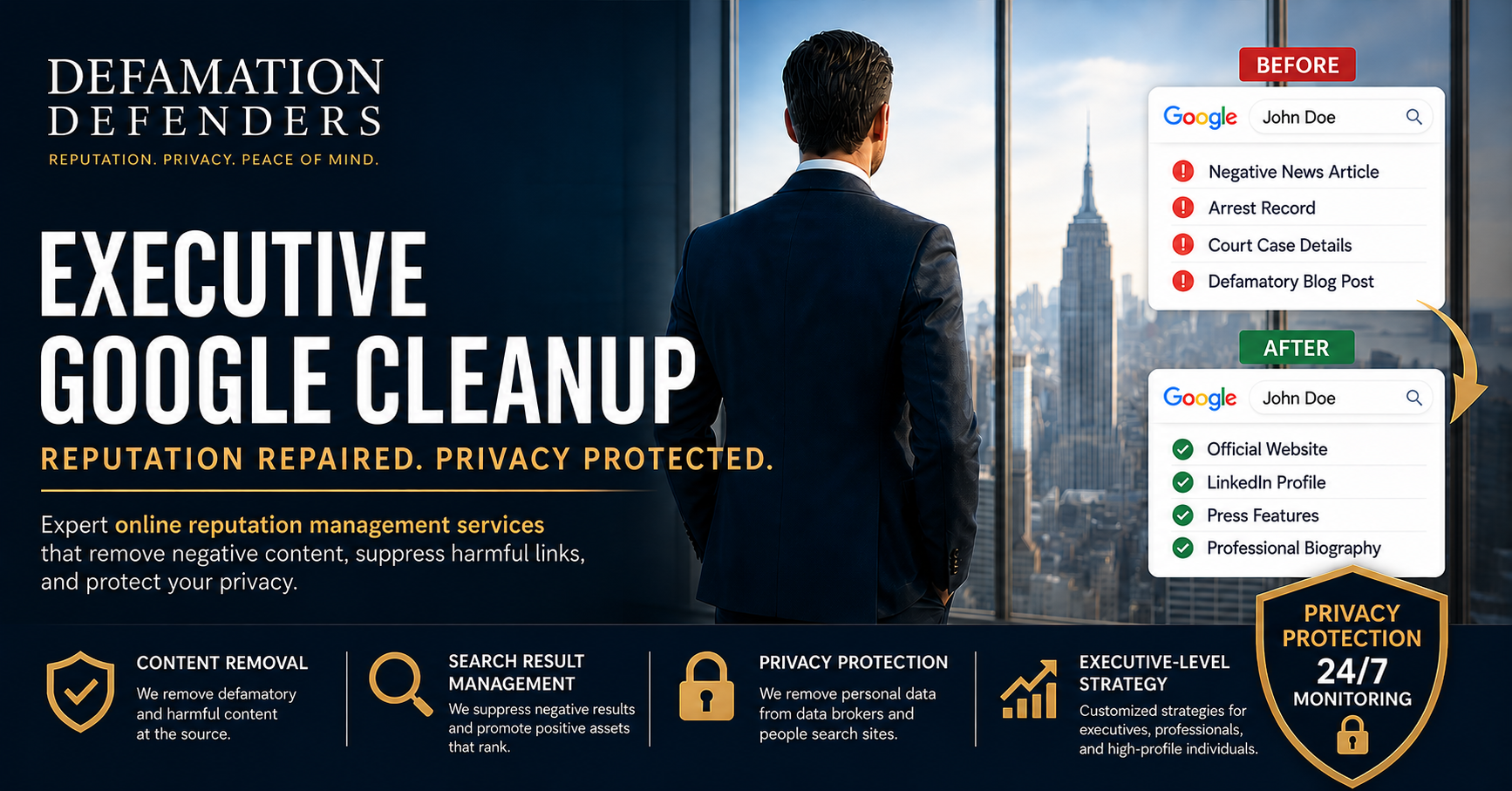
When your name is searched, the first page of results becomes your digital résumé. For executives, attorneys, founders, and high-income professionals, that search result page often influences hiring decisions, investor confidence, media perception, and even personal relationships. Negative or outdated content—whether it’s a news article, court listing, Reddit thread, or social media post—can create disproportionate damage.
Need help with this? Our personal information removal service can handle it for you, starting with a free, confidential review and a firm quote before any work begins.
This page breaks down exactly how Defamation Defenders approaches Google search results cleanup, combining online reputation management services, defamatory content removal, and privacy protection strategies into a structured, results-driven system.
Table Of Content
Why Executive-Level Google Cleanup Requires a Different Approach
Most reputation issues aren’t just about “bad press.” They’re about search architecture.
Looking for hands-on help? See our executive and CEO reputation management service: removal, search suppression, family privacy, and AI answers in one confidential plan.
Executives typically face:
- High-authority domains ranking for their name (news sites, legal databases)
- Persistent indexing in Google Search
- Syndicated or scraped content that multiplies visibility
- Data broker exposure (addresses, family members, assets)
A basic takedown request isn’t enough. You need a multi-layered system combining:
- Removal
- Deindexing
- Suppression
- Privacy hardening
The Defamation Defenders Framework
Our process is built around three pillars:
1. Content Removal (Highest Impact, Highest Priority)
The fastest way to improve search results is to remove the source content entirely.
We target:
- Defamatory articles
- Mugshots and arrest records
- Court listings and legal databases
- Social media posts
- Reddit threads and forum discussions
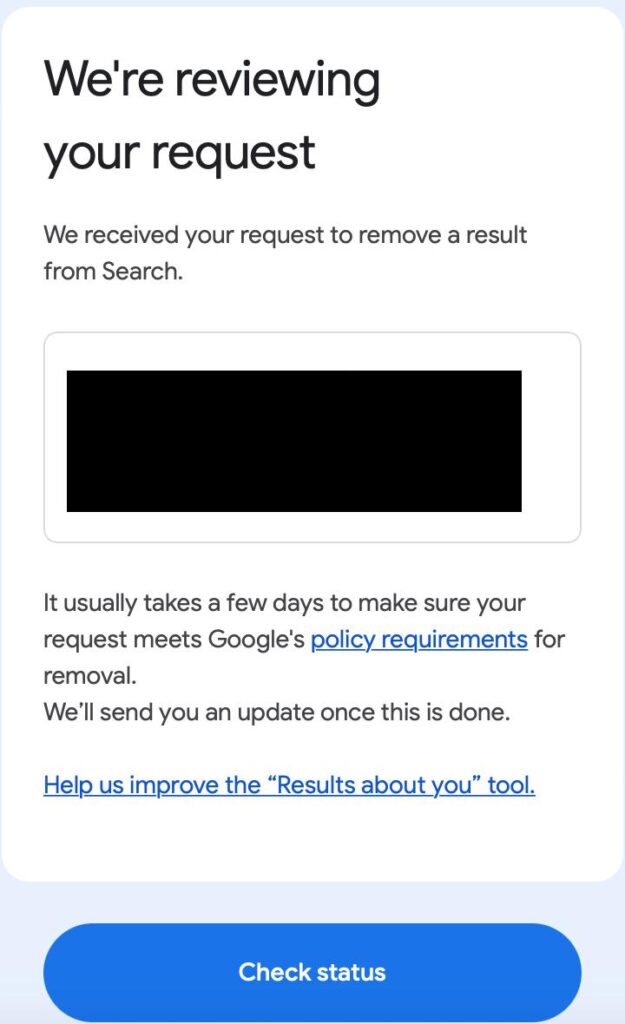
Methods Used:
- Platform policy enforcement (terms of service violations)
- Copyright (DMCA) claims where applicable
- Privacy violations (PII exposure)
- Negotiated removals with publishers
- Strategic escalation pathways
Key insight: Most firms rely heavily on legal threats. Defamation Defenders uses policy-based removal strategies first, which are often faster and more scalable.
2. Deindexing from Google
Even if content can’t be removed, it can often be removed from search visibility.
Deindexing ensures that:
- The content still exists (in some cases)
- But it no longer appears in Google search results
Techniques include:
- Google URL removal requests
- Outdated content removal tools
- Legal-based deindexing when applicable
- Index suppression signals
This is especially effective for:
- Outdated or inaccurate content
- Pages with weak authority
- Cached or archived versions
3. SEO Suppression & Search Result Management
When removal isn’t possible, we shift to search result management.
This involves:
- Publishing high-authority, positive content
- Building branded web properties
- Optimizing LinkedIn, press features, and professional profiles
- Creating controlled assets that rank above negative content
The goal:
Push harmful results off page 1—and ideally page 2—of Google.
This is where most “cheap ORM services” fail. They create low-quality content that doesn’t rank. Our approach focuses on:
- Domain authority
- Entity optimization
- AI citation readiness (AEO)
- Structured data and semantic relevance
Privacy Protection: The Missing Layer in Most ORM Campaigns
Executives aren’t just dealing with reputation—they’re dealing with exposure.
We proactively remove:
- Home addresses
- Phone numbers
- Family member data
- Employment history leaks
From:
- Data broker sites
- People search engines
- Public aggregation platforms
This reduces:
- Harassment risk
- Doxxing exposure
- Future reputation attacks
It also strengthens removal cases by limiting how widely your data is distributed.
Step-by-Step Process
Step 1: Audit & Threat Mapping
We analyze:
- Your full Google search landscape
- Risk-level scoring of each result
- Source authority and removal feasibility
Deliverable:
- A prioritized action plan
Step 2: Removal & Deindexing Execution
We begin with:
- High-impact targets (page 1 results)
- Fast-win removals
- Parallel deindexing efforts
Timeline:
- Initial removals often occur within 7–21 days
Step 3: Suppression Campaign Launch
Simultaneously:
- Build and optimize positive assets
- Strengthen your digital footprint
- Deploy SEO strategies to outrank harmful content
Timeline:
- Noticeable movement in 30–60 days
- Full page 1 restructuring in 60–120 days
Step 4: Privacy Hardening
We:
- Remove personal data at scale
- Monitor reappearances
- Maintain ongoing protection
Realistic Timelines
| Phase | Expected Timeline |
|---|---|
| Initial removals | 1–3 weeks |
| Deindexing impact | 2–6 weeks |
| SEO suppression | 1–4 months |
| Full cleanup (complex cases) | 3–6 months |
No legitimate provider can guarantee instant results. What matters is execution quality and strategy sequencing.
Proof Points That Matter
When evaluating online reputation management services, focus on:
✔ Removal Rate
What percentage of targeted URLs are actually removed?
✔ Page 1 Control
How many positive/neutral results replace negative ones?
✔ Speed to Impact
How quickly do results begin improving?
✔ Transparency
Are you seeing real URLs removed or just “activity reports”?
What Makes Defamation Defenders Different
Unlike many ORM companies, Defamation Defenders:
- Prioritizes removal over suppression
- Uses non-legal pathways first (faster, less expensive)
- Specializes in executive-level cases
- Combines privacy + reputation strategy
- Builds assets that actually rank
Many competitors rely heavily on templated outreach or low-quality SEO content. That approach no longer works in 2026, especially with AI-driven search.
Common Types of Content We Handle
- Negative news articles
- Lawsuit and court database listings
- Mugshots and arrest records
- Reddit and forum posts
- Blog posts and complaint sites
- Social media defamation
- Data broker listings
Risks of Doing Nothing
Leaving negative content unchecked can lead to:
- Lost business opportunities
- Failed background checks
- Reduced deal flow or investor trust
- Personal safety risks (via exposed data)
Search results don’t fade naturally. In many cases, they become more entrenched over time.
How to Get Started
If you’re dealing with harmful or outdated search results, the first step is clarity.
A proper audit will tell you:
- What can be removed
- What needs suppression
- What risks still exist
Defamation Defenders provides confidential, executive-level online reputation repair tailored to your situation.
If your name is returning results that don’t reflect who you are today, now is the time to act.
👉 Start with a private consultation and get a clear roadmap for your Google search results cleanup, including removal opportunities, suppression strategy, and privacy protection plan.
FAQs
Online reputation management services are strategies used to improve how a person or company appears in search results. This includes content removal, SEO suppression, and privacy protection.
Yes, in many cases. Content can be removed at the source or deindexed from Google using policy, legal, or technical methods.
Most campaigns show initial improvement within 30 days, with full results typically achieved in 3–6 months depending on complexity.
Removal is always preferred. Suppression is used when removal isn’t possible and focuses on pushing negative content lower in search results.
This includes removing personal data from broker sites, monitoring exposure, and reducing the likelihood of future reputation damage.
Final Takeaway
Executive reputation repair isn’t a single tactic—it’s a coordinated system. The combination of defamatory content removal, search result management, and privacy protection is what produces lasting results.
If your search results are working against you, a structured, professional approach is the only way to take control. Contact us today to get started!
