
Estimated reading time: 13 minutes
If a client asks you to remove a defamatory article, your first instinct might be to contact the publisher and demand a takedown. In practice, the process is far more complex than a single phone call or email. Online content removal involves navigating platform policies, legal frameworks, web archives, and search engine indexing rules that all work independently of one another.
This guide walks you through the specific technical, legal, and practical reasons why unwanted online content is so hard to remove permanently. You will also learn actionable strategies for removal, suppression, and monitoring that can protect your clients’ reputations over the long term.
Table Of Content
Key Takeaways: Why Online Content Is Hard to Remove Permanently
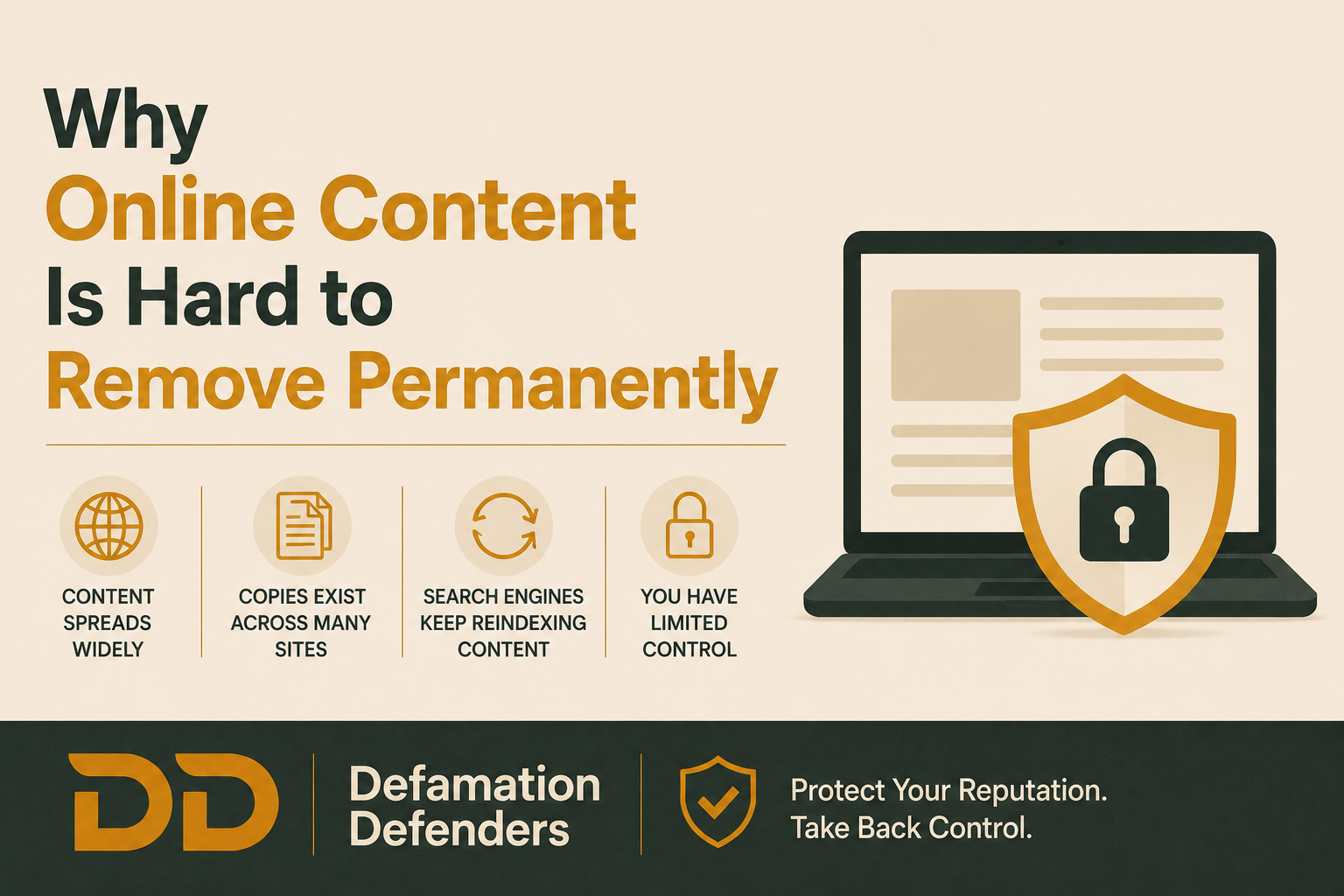
- Removing online content permanently is difficult because the internet was built to replicate and distribute information across multiple servers and platforms.
- Web archives, cached pages, screenshots, and content scraping create copies that persist long after the original is deleted.
- Legal pathways like DMCA notices, court orders, and privacy laws can remove some content, but each has strict eligibility requirements.
- Defamation Defenders combines legal, technical, and SEO-driven strategies to address unwanted content across search engines and source sites.
- When removal is not possible, content suppression and ongoing monitoring offer a realistic path to regaining control of your online reputation.
How the Internet’s Architecture Makes Permanent Deletion Nearly Impossible
The internet was designed for redundancy. Every piece of content you publish is copied, cached, and indexed across servers worldwide. Deleting the original source does not automatically remove those copies.
Search engines like Google index pages independently of the source website. Even after a webmaster takes down an article, the indexed version can appear in search results for days or weeks.
Content delivery networks (CDNs) compound the issue. These systems store copies of web pages on servers in multiple geographic locations to speed up load times. A single blog post might exist on dozens of servers simultaneously.
DNS propagation adds another delay. When a page is removed, it can take time for that change to register across the global network of servers that direct internet traffic. During this window, users may still reach cached or mirrored versions.
Why Web Archives and Cached Pages Preserve Content Indefinitely
The Wayback Machine, operated by the Internet Archive, has cataloged hundreds of billions of web pages since 1996. Once a page is archived, it becomes part of a public digital record that is independent of the original publisher.
Requesting removal from the Internet Archive is possible, but the process is slow and not always successful. The archive considers public interest, copyright, and legal grounds before acting on takedown requests.
Google’s cache presents a similar challenge. When you search for a page, Google may display a stored version even if the live page has been removed. This cached copy typically refreshes on its own timeline, which can take weeks.
Other search engines, including Bing and Yahoo, maintain their own caches independently. Removing content from Google does not remove it from these platforms. Each search engine requires a separate removal request.
How Screenshots, Reposts, and Scraping Multiply Unwanted Content
Before you even notice harmful content about you or your client, other users may have already taken screenshots, shared the post on social media, or reposted it on forums.
Content scraping bots automatically copy articles, reviews, and posts from one site and republish them on others. A single defamatory article can appear on dozens of scraper sites hours after its original publication.
Social media amplification adds another layer. A negative review or news story can be shared thousands of times across platforms like Facebook, X, and Reddit, making it nearly impossible to track every copy.
Even private messages and group chats can spread content outside of public view. Once information enters these channels, there is no reliable way to retract it or even confirm its existence.
What Legal Options Exist for Online Content Removal?
DMCA Takedown Notices
If someone publishes your copyrighted material without permission, a DMCA takedown notice is one of the most direct removal tools available. The Digital Millennium Copyright Act requires hosting platforms to remove infringing content once they receive a valid notice.
This approach works well for stolen images, copied text, and unauthorized use of creative work. It does not apply to factual reporting, opinion pieces, or reviews, even if they are unflattering.
Filing a DMCA notice requires specific information, including identification of the copyrighted work, the infringing URL, and a statement under penalty of perjury. Errors in the filing can lead to delays or outright rejection.
Court Orders and Defamation Claims
When content is demonstrably false and damaging, a court order can compel a publisher or platform to remove it. Defamation lawsuits can also lead to injunctions requiring the takedown of specific content.
The challenge is that litigation takes time and money. Courts must balance free speech protections with individual harm, which means not every defamatory statement qualifies for removal.
In the United States, Section 230 of the Communications Decency Act shields platforms from liability for user-generated content. This means a platform hosting defamatory posts often has no legal obligation to remove them unless a court specifically orders it.
Privacy-Based Removal Requests
Google accepts removal requests for content that exposes personally identifiable information (PII) such as Social Security numbers, bank account details, or non-consensual intimate images.
In some jurisdictions, the “Right to Be Forgotten” allows individuals to request de-indexing of outdated or irrelevant personal information from search results.
The TAKE IT DOWN Act, signed into law in May 2025 and now enforced by the FTC, requires platforms to remove non-consensual intimate images, including deepfakes, in 48 hours of receiving a valid request. Platforms that fail to comply face civil penalties of up to $53,088 per violation.
Why Platform Policies Create Barriers to Content Removal
Every platform has its own terms of service, content policies, and removal procedures. What violates policy on one platform may be perfectly acceptable on another.
Social media companies like Facebook, X, and Reddit generally protect user-generated content under free expression principles. Unless a post contains threats, harassment, or illegal material, these platforms often decline removal requests.
Review platforms like Google Business Profile and Yelp will remove reviews that violate their guidelines, but negative opinions and subjective experiences are usually protected. Even if a review contains inaccuracies, proving that to a platform’s moderation team can be difficult.
Each platform also has different response times and escalation procedures. A takedown request on one platform might be resolved in days, while the same request on another could take weeks or months with no resolution.
How Search Engines Handle Content Removal Requests
Search engines do not create the content they index. Google, for example, simply crawls and catalogs web pages. Removing a result from Google does not delete the content from its original source.
Google’s content removal process applies to specific categories: personally identifiable information, non-consensual intimate imagery, content that violates copyright, and material subject to legal orders.
For content that does not fit these categories, Google typically denies removal requests. In these cases, addressing the source website directly or using suppression strategies becomes the practical path forward.
Google receives hundreds of thousands of removal requests annually. According to Google’s transparency reports, only a portion of these requests result in removal. The rest are denied because the content does not meet the criteria for takedown.
The Role of Data Brokers and People-Search Sites
Your personal information, including phone numbers, home addresses, and public records, is often collected and sold by data broker websites. These sites aggregate data from public sources and make it searchable by anyone.
Removing your information from one data broker does not prevent others from listing it. Many of these sites have opt-out processes, but they vary widely in complexity. Some require written requests, others demand identity verification, and a few simply re-list your data after a period of time.
Defamation Defenders offers personal information removal as part of its reputation management services, handling the opt-out process across multiple data brokers on your behalf.
For attorneys representing clients with exposed personal data, data broker removal is often an essential first step. Reducing the availability of personal information across these sites limits the risk of doxxing, identity theft, and further reputational harm.
How AI-Generated Content Complicates Online Removal
AI tools can now generate realistic text, images, and videos in seconds. Deepfakes and AI-generated misinformation are increasingly appearing in search results, social media feeds, and news aggregators.
The speed at which AI content can be produced and distributed outpaces traditional takedown processes. By the time you identify and report a deepfake, it may have already been viewed, shared, and re-uploaded across multiple platforms.
Detecting AI-generated content is also becoming more difficult as the technology improves. Platforms are investing in detection tools, but false negatives remain common, allowing convincing fakes to stay online undetected.
The TAKE IT DOWN Act addresses deepfake intimate images specifically, but AI-generated defamatory text and manipulated non-intimate images currently fall into a legal gray area with fewer enforcement options.
When Removal Fails: How Content Suppression Works
In many cases, complete removal is not possible. The content may be legally protected, the publisher may refuse to cooperate, or the material may exist on too many sites to address individually.
Content suppression is the practical alternative. This strategy involves creating and optimizing positive, authoritative content so it ranks higher than the unwanted material in search results. Over time, the negative content gets pushed to page two or beyond, where very few people look.
Effective suppression requires a coordinated effort. It typically includes publishing articles on high-authority sites, optimizing LinkedIn and other professional profiles, creating press releases, and building backlinks to positive content.
Defamation Defenders uses a combination of SEO, strategic content publishing, and reputation suppression techniques to reshape what appears when someone searches your name or your client’s name.
Why Ongoing Monitoring Is Essential After Content Removal
Even after you successfully remove content from a website or search engine, there is no assurance it will stay gone. Content can resurface when scraper sites republish it, when cached versions refresh, or when someone shares an old screenshot.
Setting up Google Alerts for your name, your client’s name, and relevant keywords is a basic first step. These alerts notify you when new content matching your search terms appears online.
For more thorough protection, Defamation Defenders offers 24/7 monitoring services that track mentions across search engines, social media, forums, and data broker sites. Early detection of new harmful content allows for faster response and better outcomes.
Monitoring also helps you measure the effectiveness of suppression efforts over time. Tracking changes in search rankings for specific queries gives you data to evaluate whether your strategy is working or needs adjustment.
How Attorneys Can Build a Multi-Pronged Content Removal Strategy
If you represent clients dealing with harmful online content, a single tactic rarely solves the problem. The most effective approach combines legal action, platform-level requests, search engine de-indexing, and ongoing suppression.
Start by auditing the full scope of the problem. Identify every URL, screenshot, and repost. Determine which content is legally actionable and which falls outside the reach of takedown tools.
Next, prioritize your actions. Pursue DMCA notices and legal removals for the most damaging content first. Simultaneously, begin building positive digital assets, including professional profiles, published articles, and press coverage, to support a suppression strategy.
Partnering with a reputation management firm like Defamation Defenders gives you access to the technical and strategic resources needed to address content across multiple channels. The team at Defamation Defenders handles everything from negative content removal to long-term search engine reputation management.
Common Mistakes to Avoid When Trying to Remove Online Content
One of the most frequent errors is contacting a publisher with an emotional or aggressive message. Hostile communication almost never results in content removal and can sometimes lead to additional negative coverage.
Another mistake is relying solely on one method. Sending a single DMCA notice and waiting for results ignores the complexity of how content spreads online. A multi-channel approach is almost always necessary.
Some individuals turn to questionable “instant removal” services that use aggressive or deceptive tactics. These services can backfire, triggering the Streisand effect, where attempts to suppress information actually increase its visibility.
Working with a reputable firm matters. Defamation Defenders uses only ethical, white-hat methods to protect your reputation, ensuring that every action taken is legally sound and strategically effective.
What the Future Holds for Online Content Removal
New legislation is slowly expanding the tools available for content removal. The TAKE IT DOWN Act marks a significant step forward by requiring platforms to remove non-consensual intimate images and deepfakes. Similar laws targeting AI-generated misinformation are being proposed at both state and federal levels.
At the same time, the proliferation of decentralized platforms and blockchain-based storage systems introduces new challenges. Content stored on decentralized networks cannot be removed by a single authority, which means traditional takedown methods may not apply.
For now, the most effective approach remains a combination of legal expertise, technical knowledge, and proactive reputation management. Staying ahead of emerging threats requires ongoing monitoring and a willingness to adapt your strategy as the digital landscape changes.
In Conclusion: A Realistic Approach to Removing Unwanted Online Content
Permanent removal of online content is rarely straightforward. The internet’s architecture, platform policies, legal protections, and the sheer volume of content copies make full deletion difficult for even the most determined individuals and legal teams.
What you can do is take a realistic, multi-step approach. Pursue legal removals where the law supports your case. Use suppression to push harmful content out of sight. Monitor your digital footprint on an ongoing basis to catch new threats early.
Defamation Defenders helps individuals, businesses, and attorneys navigate every stage of this process. From legal content takedowns to ongoing reputation defense, the team brings the expertise and persistence needed to protect what matters most: your name and your reputation.
FAQs About Why Online Content Is Hard to Remove Permanently
In some cases, yes. Content that violates copyright, contains PII, or is subject to a court order can often be removed from source sites and search engines. However, copies on archives, scraper sites, and social media may persist.
Defamation Defenders helps you address content across multiple platforms to maximize removal coverage.
Content removal eliminates the material from its source and from search engine results. Content suppression pushes negative results lower in search rankings by building stronger positive content above them.
Defamation Defenders uses both strategies to give you the outcome that fits your situation.
Google typically responds to removal requests in 7 to 14 business days. If the request is denied, suppression efforts can begin immediately.
Defamation Defenders accelerates this process by filing properly documented requests and pursuing suppression in parallel.
Common legal grounds include copyright infringement (DMCA), defamation, invasion of privacy, and violations of platform terms of service. The TAKE IT DOWN Act also requires platforms to remove non-consensual intimate images in 48 hours.
Defamation Defenders evaluates each case to determine the strongest available legal pathway.
No company can control third-party publishers, platform policies, or free speech protections. Firms that promise removal of all negative content often over-promise and under-deliver.
Defamation Defenders sets realistic expectations and focuses on outcomes you can actually achieve, combining removal, suppression, and monitoring for lasting results.
An attorney can pursue legal takedowns through DMCA notices, defamation claims, and court orders. For content that is not legally actionable, partnering with Defamation Defenders adds technical capabilities like search engine de-indexing, content suppression, and ongoing reputation monitoring.
