
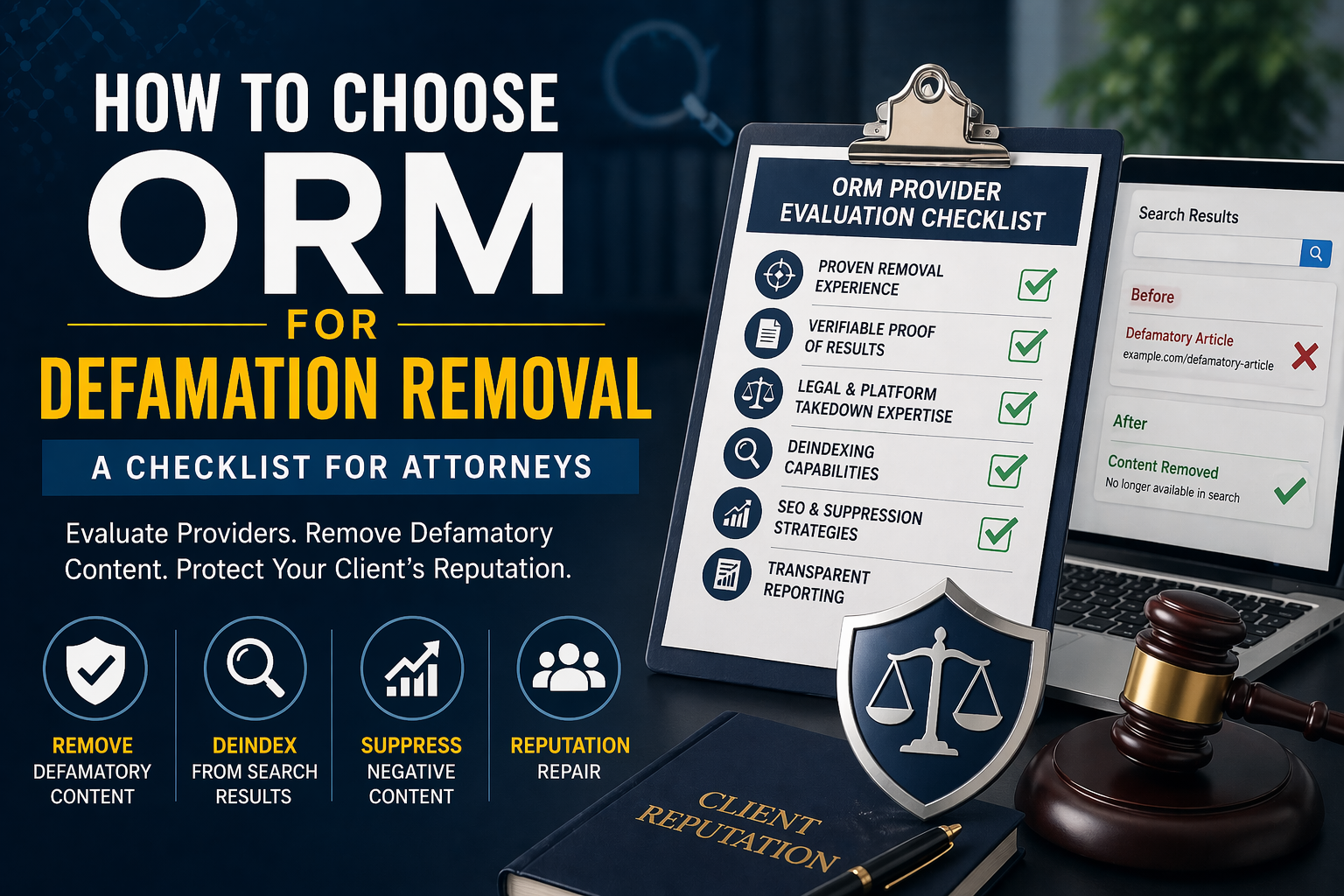
A step-by-step checklist for attorneys evaluating online reputation management providers
Selecting the right online reputation management (ORM) provider for defamation removal requires more than comparing pricing or promises. Attorneys need a structured evaluation process to separate legitimate content takedown services from vendors relying on vague “suppression” tactics.
Below is a practical, step-by-step checklist to vet providers, request the right proof, avoid common pitfalls, and compare removal vs. deindexing vs. negative content suppression strategies.
Table Of Content
Step 1: Define the Objective (Removal vs. Suppression)
Why this matters: Not all ORM strategies achieve the same outcome. Removal eliminates the content; suppression only buries it.
Checklist:
- Identify URLs and platforms involved
- Determine if content is defamatory, outdated, or policy-violating
- Prioritize removal first, suppression second
When to push for removal:
- False statements of fact
- Legal exposure for the publisher
- Content violates platform or privacy policies
Step 2: Evaluate Core Capabilities (Three Pillars)
A. Removal (Highest Value)
What to look for:
- Direct publisher negotiation experience
- Platform-specific takedown expertise
- Legal coordination (without over-reliance on lawsuits)
Ask for proof:
- Before/after case studies showing full URL removal
- Examples of successful takedowns on major platforms
B. Deindexing (Search-Level Removal)
What to look for:
- Experience with search engine policies and legal requests
- Ability to remove or suppress URLs in Google results
Ask for proof:
- Screenshots showing URLs removed from search
- Documentation of successful legal or policy-based requests
C. Suppression (SEO-Based Reputation Repair)
What to look for:
- Proven SEO expertise (not generic content spam)
- Ability to rank authoritative assets (press, profiles, domains)
Ask for proof:
- Ranking reports showing negative results pushed off page one
- Examples of branded search improvements over time
Step 3: Request Verifiable Proof
Minimum evidence to require:
- Real case studies with identifiable outcomes
- Timeline estimates based on past results
- Specific URLs (anonymized if necessary)
What credible providers show:
- Removal success rates by content type
- Platform-specific expertise (e.g., Reddit, Meta, forums, news sites)
- Clear methodology (not “proprietary” black boxes)
Step 4: Analyze Their Strategy (Not Just the Pitch)
Ask directly:
- “How will you remove this specific URL?”
- “What happens if removal fails?”
- “What percentage of cases require suppression instead?”
Strong answers include:
- Multi-layered approach (legal + technical + SEO)
- Platform-specific tactics
- Contingency plans
Weak answers include:
- Vague promises like “we’ll handle it”
- Overemphasis on backlinks or blog posts
- No discussion of removal pathways
Step 5: Identify Red Flags
Avoid providers that:
- Guarantee removal of all content (unrealistic)
- Rely exclusively on SEO suppression
- Cannot explain how they achieve removals
- Use fake news sites or low-quality blog networks
- Require long-term contracts without clear deliverables
Critical warning sign:
If a provider avoids discussing removal and jumps straight to “reputation repair,” they likely lack real defamation removal capabilities.
Step 6: Compare Removal vs. Deindexing vs. Suppression
| Strategy | Outcome | Speed | Longevity | Best Use Case |
|---|---|---|---|---|
| Removal | Content deleted at source | Medium | Permanent | Defamatory, policy-violating content |
| Deindexing | Removed from search results | Fast–Medium | Strong | Sensitive or legal-based removals |
| Suppression | Content buried in rankings | Slow | Ongoing | When removal isn’t possible |
Key insight:
- Removal = highest impact
- Deindexing = fastest visibility reduction
- Suppression = fallback strategy
Step 7: Evaluate Legal Integration
What matters:
The best ORM providers complement—not replace—legal strategy.
Ask:
- Do they coordinate with attorneys?
- Can they support court orders or legal takedowns?
- Do they understand defamation standards?
Look for:
- Experience working with law firms
- Ability to escalate cases legally when needed
Step 8: Review Reporting & Transparency
You should receive:
- Clear progress updates (weekly or biweekly)
- URL-level tracking
- Ranking reports for suppression campaigns
Avoid:
- Generic “activity reports” without outcomes
- Lack of measurable KPIs
Step 9: Assess Speed & Responsiveness
Why it matters:
Defamatory content gains authority and visibility over time.
Checklist:
- Response time to inquiries
- Time to initiate takedowns
- Escalation speed for urgent cases
Step 10: Compare Pricing vs. Outcomes
What to evaluate:
- Cost per URL removal vs. monthly retainers
- Scope of services included (removal, deindexing, suppression)
- Expected timelines and success rates
Important:
The cheapest provider often relies on low-quality suppression tactics that fail to deliver meaningful reputation repair.
Final Decision Framework
Before selecting an ORM provider, confirm:
- They prioritize removing defamatory content, not just hiding it
- They provide verifiable proof of past success
- They use a multi-strategy approach (removal + deindexing + suppression)
- They communicate clearly and transparently
Take Action: Vet the Right Partner
Choosing the wrong provider can waste time—and allow reputational damage to spread further. A qualified ORM partner should deliver measurable results across defamation removal, content takedown services, and negative content suppression.
👉 Request a Free Case Review:
https://defamationdefenders.com/
👉 Learn About Defamation Removal Services:
https://defamationdefenders.com/content-removal/
👉 Explore Reputation Repair & Suppression:
https://defamationdefenders.com/reputation-management/
Defamation Defenders works directly with attorneys and professionals to remove defamatory content, execute targeted takedowns, and implement long-term online reputation management strategies that protect clients at scale.
Frequently Asked Questions About Online Reputation Management for Defamation Removal
The most effective online reputation management strategy prioritizes removing defamatory content at the source first, followed by search engine deindexing and, if necessary, negative content suppression. A multi-layered approach combining legal, technical, and SEO tactics produces the strongest results.
Yes, in many cases defamatory content can be fully removed, especially when it violates platform policies, contains false statements, or creates legal liability. However, if removal is not possible, ORM professionals use deindexing and suppression to significantly reduce visibility.
Defamation removal timelines vary depending on the platform and strategy used.
Platform takedowns: a few days to several weeks
Search engine deindexing: days to a few weeks
SEO suppression: typically 2–6 months for meaningful results
Attorneys should prioritize providers that:
Focus on removing defamatory content, not just suppression
Provide verifiable case studies and proof of results
Use a combination of takedown, deindexing, and SEO strategies
Offer transparent reporting and realistic timelines
Common red flags include:
Guarantees to remove all content
No explanation of removal methods
Over-reliance on SEO suppression
Lack of real case studies or proof
Long-term contracts with vague deliverables
No. Suppression does not remove defamatory content—it pushes it lower in search results. True defamation removal eliminates the content entirely, which is always the preferred outcome when possible.
Yes, the most effective ORM providers collaborate with attorneys to support legal strategies, including evidence gathering, court orders, and platform compliance processes.
Related Content You Might Like:
