
Estimated reading time: 9 minutes
Trust is one of the most valuable currencies in today’s business climate. Every year, millions of individuals interact with companies online, hire service providers, purchase products, or engage in partnerships—only to later discover that the business was never real, never compliant, or never authorized to operate. Scams escalate rapidly, and fraudulent entities are becoming harder to identify without structured investigation.
Need help with this? Our business reputation management service can handle it for you, starting with a free, confidential review and a firm quote before any work begins.
If you’ve ever wondered how to check if a company is legitimate in the USA, you’re not alone. Whether you’re a consumer evaluating a contractor, an entrepreneur exploring partnerships, or a professional researching vendors, verification is the most effective way to protect yourself before a transaction occurs.
This step-by-step guide walks you through reliable methods to confirm whether a company is real, licensed, compliant, and trustworthy, while providing advanced tools, authoritative links, and protective strategies for 2026.
Why Company Verification Matters More Than Ever
Fraudulent entities can cause far-reaching harm. Financial losses are only one part of the equation. Fake or non-compliant companies may expose you to legal liabilities, data theft, reputation damage, and extended disputes that take months or years to resolve.
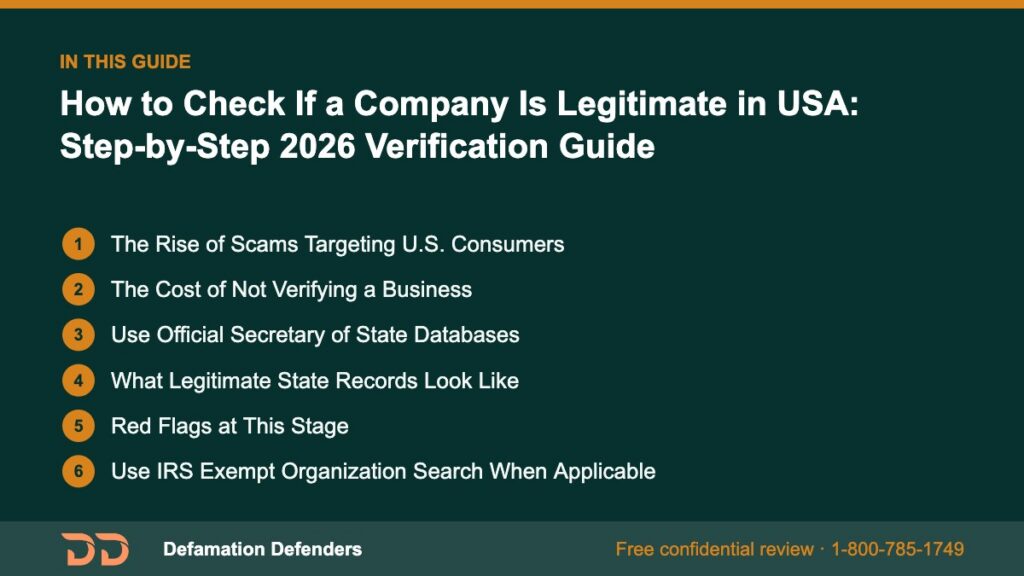
Table Of Content
The Rise of Scams Targeting U.S. Consumers
Recent reports from the Federal Trade Commission show a sharp increase in business-related fraud. Scammers pose as:
- Service providers
- Online stores
- Hiring agencies
- Investment firms
- Contractors
- Government-affiliated companies
- Charitable organizations
They may use official-looking names, logos, websites, and email addresses to appear legitimate.
Want this content gone? Get a free, confidential quote.
Send us the links. Most removals are done in a few days to a few weeks, with a full refund if we can't complete the agreed removal.
The Cost of Not Verifying a Business
Failing to check legitimacy can result in:
- Identity theft
- Lost deposits or payments
- Fake invoices
- Unlicensed work
- Poor-quality results
- Legal disputes
- Jeopardized reputation
- Personal or business exposure
Understanding how to verify a company prevents both financial loss and reputational harm.
Step-by-Step Guide to Check If a Company Is Legitimate in the USA
Below is a structured walkthrough of how to determine whether a company is real, compliant, and safe to engage with.
Step 1 — Check Basic Business Registration Information
Every legal business operating within the United States must register at the state level. This is your first and most reliable verification step.
Use Official Secretary of State Databases
Each state has a public business entity search tool. It allows you to confirm:
- Registration status
- Formation date
- Registered agent
- Entity type
- Corporate standing
- Annual report history
- Whether the company is active, inactive, or dissolved
These searches are free. You can access state directories from the National Association of Secretaries of State:
https://www.nass.org/business-services/corporations
What Legitimate State Records Look Like
A real company will appear with:
- An active status
- A valid registration date
- A named registered agent
- A business address
- Document filings
If no record exists, this is a red flag.
Red Flags at This Stage
- No matching business name in state records
- Recently formed entities claiming decades of experience
- Frequent changes in ownership
- Suspended or dissolved status
- No listed registered agent
If a company fails this verification, avoid further interaction until clarified.
Step 2 — Verify Federal Employer Identification (EIN) and IRS Records
Though you cannot directly access a company’s EIN, you can confirm whether a company should have one.
Use IRS Exempt Organization Search When Applicable
If the company claims to be a nonprofit, verify with the IRS tool:
https://apps.irs.gov/app/eos/
Red flags include:
- Nonprofits not appearing in the IRS database
- Claims of tax deduction status that don’t match IRS listings
Why EIN Details Matter
Registered U.S. businesses require an EIN to:
- Hire employees
- Speak with financial institutions
- File taxes
- Operate legally
If a company avoids providing basic tax identification when appropriate, caution is warranted.
Step 3 — Check Business Licensing and Industry Credentials
Not all companies need a license, but many do—especially in regulated sectors.
Professions That Require Licensing
Examples include:
- Real estate
- Insurance
- Contracting
- Finance
- Healthcare
- Automotive sales
- Legal services
- Transportation
- Home improvement trades
Use State and Federal Licensing Databases
A few authoritative sources:
- Department of Labor License Finder
https://www.dol.gov/agencies/whd/state/licenses - Contractor Licensing Boards (varies by state)
- FINRA BrokerCheck for investment professionals
https://brokercheck.finra.org/ - NMLS Consumer Access for mortgage companies
https://nmlsconsumeraccess.org/ - FMCSA for transportation companies
https://safer.fmcsa.dot.gov/CompanySnapshot.aspx
What Licensing Results Tell You
Licensing records show:
- Authorization status
- Required credentials
- Disciplinary actions
- Revocations
- Abuse complaints
If a company claims licensing but does not appear in these records, proceed cautiously.
Step 4 — Examine the Company’s Website and Online Identity
Websites reveal a company’s professionalism, age, and legitimacy.
Look for These Trust Markers
- About page with real names
- Verified business address
- Professional contact information
- Policies: returns, warranties, privacy
- Consistent branding
- Secure checkout (HTTPS)
Confirm Website Age With WHOIS Lookup
Use tools such as ICANN Lookup:
https://lookup.icann.org/en
A company claiming to be decades old but using a domain registered last month is a red flag.
Check for Plagiarized Content
Fraudulent websites often steal text from other businesses.
Use Copyscape or Google Search Operators to test sections of text.
Example operator:
"Exact sentence from the site" plagiarism check
Evaluate Website Transparency
A legitimate business is never vague about:
- Ownership
- Location
- Contact information
- Service processes
- Disclosures
If you cannot identify who owns the company, reconsider working with them.
Step 5 — Verify Their Physical Address
A real company should have a verifiable address.
Ways to Validate a Business Address
- Search the address on Google Maps
- Check property ownership through county assessor records
- Validate whether the address matches a PO box, UPS store, or virtual mailbox
If a company claims it operates from a “corporate office,” but the address is a mail drop box, that’s a warning sign.
Step 6 — Check Official Review Platforms and Complaint Databases
Reviews can reveal patterns of fraud or misconduct.

Trusted Places to Check Complaints
- Better Business Bureau (BBB)
https://www.bbb.org/ - FTC Complaint Assistant database
https://reportfraud.ftc.gov/ - Consumer Financial Protection Bureau
https://www.consumerfinance.gov/data-research/consumer-complaints/ - State attorney general consumer portals
- ScamTracker by BBB
https://www.bbb.org/scamtracker
How to Interpret Reviews
Look for:
- Consistency of complaints
- Company responses
- Verification of the reviewer
- Patterns (billing fraud, poor service, no refunds, impersonation)
- “Too positive” reviews that may be fake
Red Flags in Reviews
- Hundreds of reviews posted within days
- Identical wording
- Fake reviewer names
- No negative reviews at all
Authentic companies usually have a mix of positive and neutral experiences.
Step 7 — Research the Company’s Leadership and Team
Fraudulent companies often use fake names or anonymous leadership.
How to Investigate Leadership
- Search founders on LinkedIn
- Look for press releases or interviews mentioning leadership
- Check for real business history
- Confirm expertise aligns with industry claims
Warning Signs to Notice
- No leadership listed
- Fake profile photos
- Generic names with no history
- Founders using stock images
- No professional footprint online
Authentic companies typically have traceable professional backgrounds.
Step 8 — Evaluate Their Business Practices and Customer Communication
Company behavior often reveals legitimacy.
Communication Red Flags
- Refusing to provide contract copies
- High-pressure sales tactics
- Demanding payment before documentation
- Requests for untraceable payments
- Frequent changes in contact information
- Vague or evasive responses
Safe Payment Practices
A legitimate business will offer:
- Verified payment gateways
- Contracts before payment
- Itemized invoices
- Clear refund policies
Avoid companies that require:
- Gift cards
- Wire transfers
- Cryptocurrency (unless industry appropriate)
- Non-refundable deposits
Step 9 — Check Legal Standing Through Court and Corporate Records
Court filings can reveal whether a company has faced lawsuits or sanctions.
Where to Search
- PACER (Federal cases)
https://pacer.uscourts.gov/ - State court search portals
- County clerk sites
- Business litigation databases
Look for:
- Fraud claims
- Bankruptcy filings
- Civil suits
- Regulatory actions
Step 10 — Perform a Full Reputation Audit
A reputation audit reveals whether the company has a history of misconduct online.
How to Conduct a Reputation Audit
Perform these searches:
[Company name] scam
[Company name] fraud
[Company name] complaints
[Company name] lawsuit
[Company name] reviews
[Company name] problems
Also search leadership names plus the above terms.
What to Include in Your Audit Notes
- Nature of complaints
- Frequency of issues
- Patterns of suspicious activity
- Whether complaints are recent
- Whether the company responds professionally
Document your findings in a log to track inconsistencies.
Step 11 — Confirm That the Company Is Not Using Stolen Branding
Some scammers impersonate real businesses.
How to Detect Impersonation
- Compare logos with the real brand
- Verify phone numbers
- Check domain spelling carefully
- Look for website cloning
This is common in:
- Real estate scams
- Investment schemes
- Hiring scams
- Insurance fraud
- E-commerce copycat sites
If impersonation is suspected, discontinue contact immediately.
Step 12 — Verify Through Third-Party Media Mentions
Legitimate companies often appear in:
- News articles
- Industry journals
- Press releases
- Local business listings
- Chamber of commerce pages
Search for:
[Company name] news
[Company name] press
[Company name] award
Lack of third-party mention may require further verification.
How Defamation Defenders Helps When a Company Is Fake or Harmful
Verifying a company protects your reputation and safety—but what if someone impersonates you, uses your name in a scam, or spreads misinformation about your business?
Defamation Defenders supports victims facing:
- Business impersonation
- Scam accusations targeting innocent individuals
- Fake company pages misusing personal information
- False reviews
- Online attacks
- Fraudulent listings
- Reputation damage
We provide:
- Content removal
- Search result suppression
- Reputation recovery
- Identity protection
- Fraud-related misinformation cleanup
Explore solutions:
If you discover a fraudulent entity using your identity or harming your name, our team can intervene swiftly and effectively.
FAQ — How to Check If a Company Is Legitimate in the USA
Use state business registries, licensing databases, government portals, address verification, complaint records, website analysis, and reputation checks.
Yes. All legally formed companies must register in at least one U.S. state.
No. Reviews can be manipulated. Always confirm state filings, licensing, and official records.
Verify registration on the Secretary of State business search.
Use industry-specific licensing databases such as state contractor boards, FINRA BrokerCheck, or federal transportation registries.
Most legitimate businesses require an EIN.
Not always, but a brand-new website claiming a long history is suspicious.
Contact Defamation Defenders for impersonation and fraud removal assistance.
Protecting yourself—and your reputation—starts with proper verification. If you believe a company is impersonating you, misusing your information, or publishing false claims that harm your name, Defamation Defenders is here to help.
➡️ Take control today:
Request a Free Reputation Analysis
Our specialists will guide you through restoring your credibility, removing harmful content, and securing your online identity.
MLA Citations
Federal Trade Commission. “Report Fraud.” FTC.gov, https://reportfraud.ftc.gov/.
National Association of Secretaries of State. “Business Services.” NASS.org, https://www.nass.org/business-services/corporations.
Internal Revenue Service. “Exempt Organizations Select Check.” IRS.gov, https://apps.irs.gov/app/eos/.
Consumer Financial Protection Bureau. “Consumer Complaint Database.” CFPB.gov, https://www.consumerfinance.gov/data-research/consumer-complaints/.
BBB. “Scam Tracker.” Better Business Bureau, https://www.bbb.org/scamtracker.
BrokerCheck. “FINRA BrokerCheck.” FINRA.org, https://brokercheck.finra.org/.
Related Content:
Want this content gone? Get a free, confidential quote.
Send us the links. We'll reply with a firm quote and timeline. Most removals are done in a few days to a few weeks, with a full refund if we can't complete the agreed removal.
Pay-after-removal options · 4,000+ clients served · 4.9/5 on Google
Prefer to talk? Call 1-800-785-1749
