
Estimated reading time: 7 minutes
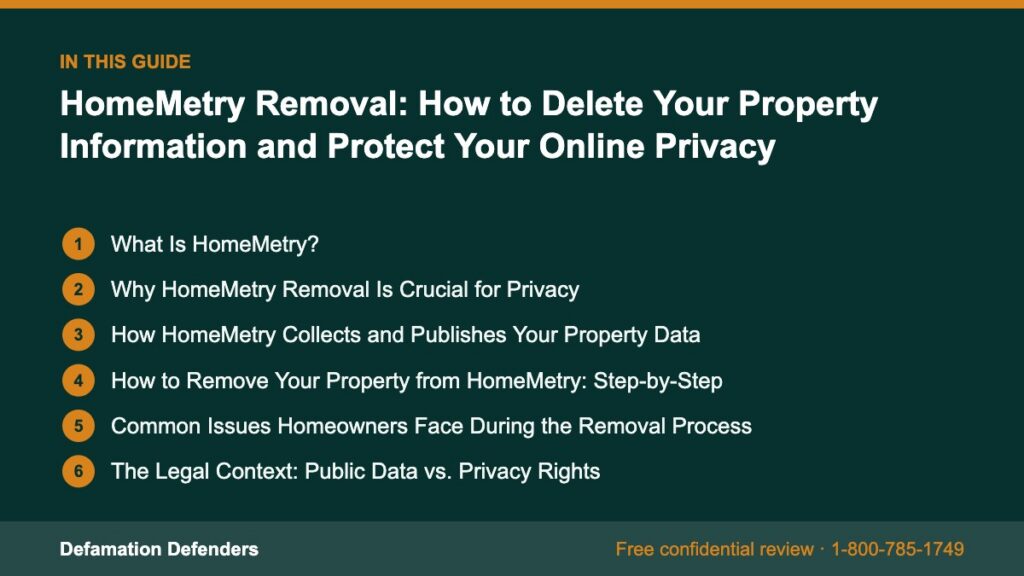
Table Of Content
What Is HomeMetry?
HomeMetry.com is a real estate data aggregation site that publishes detailed property information, including ownership details, purchase history, home value, and even structural data.
Need help with this? Our personal information removal service can handle it for you, starting with a free, confidential review and a firm quote before any work begins.
The platform compiles information from public records and real estate data feeds, providing searchable profiles for:
- Homeowners’ names and addresses
- Property sale prices and transaction dates
- Lot size and home dimensions
- Property tax information
- Neighborhood demographic statistics
While HomeMetry presents itself as a valuable research tool for realtors, investors, and buyers, it can expose personal information that homeowners never consented to share publicly.
Why HomeMetry Removal Is Crucial for Privacy
Having your name, address, and property information on HomeMetry can lead to serious privacy and security concerns.
The Hidden Dangers of Online Property Listings
- Identity Theft: Criminals can use your address and ownership data to build detailed personal profiles.
- Stalking or Harassment: Public visibility of your residence increases the risk of unwanted contact.
- Financial Exploitation: Scammers target high-value properties for fraudulent activities.
- Professional Risks: Homeowners in sensitive industries may face reputational harm or unwanted exposure.
- Data Brokerage: HomeMetry may share or sell your property details to third-party data brokers.
“The more property data you share online, the easier it becomes for others to track your life offline.” — Defamation Defenders Privacy Expert
How HomeMetry Collects and Publishes Your Property Data
HomeMetry pulls its information from government and public data sources, including:
- County tax assessors and property appraiser databases
- Real estate multiple listing services (MLS)
- Deed and mortgage filings
- Public zoning and building permit records
- Data broker networks and commercial property APIs
While the data may be public by law, HomeMetry republishes it in a way that makes personal property information easily searchable, creating privacy risks for millions of homeowners.
How to Remove Your Property from HomeMetry: Step-by-Step
If you’ve discovered your name or property details listed on HomeMetry, follow these steps to remove them effectively.
Step 1: Locate Your Listing
- Visit https://www.homemetry.com/.
- Enter your name or property address in the search bar.
- Identify your listing and copy its full URL.
- Note any additional associated pages that display personal details.
Step 2: Find the Opt-Out Page
Scroll to the footer of HomeMetry’s homepage and look for links titled:
- “Privacy Policy”
- “Opt-Out”
- “Do Not Sell My Personal Information”
- “Contact Us”
If an opt-out form isn’t listed, you can still submit a request through their privacy contact email found in the Privacy Policy section.
Step 3: Submit Your Removal Request
You can use the following template to email HomeMetry directly.
Subject: Request for Data Removal - HomeMetry.com

To Whom It May Concern,

I am requesting the removal of my personal information and property details from HomeMetry.com. My property appears under the following URL: [Insert URL].

This request is made under the provisions of applicable privacy laws, including the California Consumer Privacy Act (CCPA). Please confirm once my information has been deleted and ensure that it will not be republished or shared with any third-party partners.

Thank you,
[Your Full Name]
[Your Email Address]
[Your City, State]
After submitting, save a copy of your request and confirmation email for documentation.
Step 4: Verify Removal
HomeMetry typically processes opt-out requests within 7–14 business days. To confirm, revisit the site after two weeks and search your name or address again.
If the listing still appears, follow up by referencing your initial request and providing the date it was submitted.
Step 5: Remove Cached Versions from Search Engines
Even after successful removal from HomeMetry, cached pages may remain visible on Google or Bing.
- Visit the Google Remove Outdated Content Tool.
- Paste the deleted HomeMetry URL.
- Select “This content no longer exists.”
- Submit and wait for confirmation.
Repeat this process for any duplicate links.
Common Issues Homeowners Face During the Removal Process
While HomeMetry provides an opt-out pathway, the process isn’t always straightforward.
Frequent Challenges Include:
- Duplicate listings showing slight variations in property data.
- Slow response times from support.
- Data reappearance after updates or syndication.
- Incomplete removals where tax details remain online.
If these issues persist, Defamation Defenders can help coordinate comprehensive data removal and suppression, ensuring that deleted information stays offline.
The Legal Context: Public Data vs. Privacy Rights
HomeMetry operates within the bounds of U.S. public records law, but evolving privacy legislation provides individuals with stronger data control options.
Privacy Laws Supporting Your Right to Removal:
- California Consumer Privacy Act (CCPA): Grants the right to request deletion and opt out of data sales.
- General Data Protection Regulation (GDPR): Applies to any EU citizens whose data may appear on U.S.-based platforms.
- Virginia Consumer Data Protection Act (VCDPA): Allows individuals to request correction or deletion of personal information.
- Colorado Privacy Act (CPA): Provides residents with similar data access and deletion rights.
You can learn more about your rights on the Federal Trade Commission’s Privacy Protection page.
“Privacy laws are closing the gap between public access and personal consent—HomeMetry removals are your first line of defense.” — FTC Report on Data Privacy
The Broader Impact of Property Data Exposure
Having property records available online may seem harmless, but the aggregation of home data contributes to a growing surveillance economy.
Risks of Widespread Real Estate Data Exposure:
- Targeted Scams: Criminals can use property valuations to target specific homeowners.
- Social Engineering Attacks: Scammers pose as service providers or government officials.
- Discrimination and Profiling: Automated systems may use your property data to infer financial status.
- Erosion of Personal Safety: Public maps linked to addresses make location tracking easier.
HomeMetry’s model amplifies these risks, highlighting why prompt removal is crucial.

How Defamation Defenders Handles HomeMetry Removal
Defamation Defenders specializes in personal data and property information removal from high-risk data brokers, including HomeMetry and similar property search platforms.
Our Comprehensive Process:
- Audit: Identify every instance of your name and property appearing online.
- Removal Requests: Submit and verify opt-out submissions across all data brokers.
- De-Indexing: Remove cached search results from Google and Bing.
- Monitoring: Detect reappearances through automated privacy scans.
- Reputation Restoration: Replace outdated or harmful data with verified, positive content.
“Our mission at Defamation Defenders is to give homeowners peace of mind by removing sensitive property information from public access.”
📞 Contact Defamation Defenders today for professional assistance with HomeMetry removals and full-scale online privacy protection.
Maintaining Privacy After Removal
Even after deleting your property listing, protecting your personal information online requires continuous action.
Best Practices for Long-Term Privacy:
- Opt out regularly from data brokers such as Whitepages, PeopleFinders, and Spokeo.
- Use a P.O. Box or business address for registrations and public forms.
- Limit property data disclosure on real estate websites.
- Create Google Alerts for your name and address.
- Secure your social media privacy settings to prevent data scraping.
Case Study: HomeMetry Removal Success
A homeowner in California discovered their full address and property valuation listed on HomeMetry, leading to privacy concerns and targeted mail scams.
Defamation Defenders’ Approach:
- Conducted a full property data audit.
- Submitted verified removal requests to HomeMetry and associated brokers.
- Requested de-indexing from Google’s search cache.
- Set up long-term monitoring to prevent reappearance.
Outcome: Within three weeks, all listings were removed, and the client’s private details were no longer searchable online.
Tools and Resources for Homeowners
| Resource | Purpose | Link |
|---|---|---|
| HomeMetry.com | Locate your property listing | https://www.homemetry.com/ |
| Google Remove Outdated Content Tool | Request cache removal | Google Tool |
| Federal Trade Commission | Learn about U.S. privacy rights | FTC Privacy Page |
| Privacy Rights Clearinghouse | Data protection education | PrivacyRights.org |
FAQ: HomeMetry Removal
HomeMetry gathers data from county property records and real estate databases.
Yes, unless you opt out, your address and property details are publicly viewable.
Yes, but privacy laws like the CCPA give you the right to request deletion.
It can, but under law, you can file a privacy complaint if they fail to comply.
No, only the online display is removed, not the official county record.
Yes, we provide full-spectrum property data removal services across all brokers.
Submit proactive opt-out requests to property data platforms shortly after purchase.
Your home is your sanctuary—but public data websites like HomeMetry can turn it into a target for unwanted exposure. Taking action to remove your property listing is more than a privacy step—it’s an investment in safety.
Defamation Defenders provides professional support to ensure that your personal and property information stays private, secure, and permanently removed from online directories.
👉 Start your HomeMetry removal process today and reclaim control over your personal privacy and peace of mind.
Works Cited
- Federal Trade Commission. Protecting Personal Information. www.ftc.gov.
- California Consumer Privacy Act (CCPA). State of California. oag.ca.gov/privacy/ccpa.
- Electronic Frontier Foundation. Data Brokers and Privacy Risks. www.eff.org.
- Solove, Daniel J. Understanding Privacy. Harvard University Press, 2008.
- Privacy Rights Clearinghouse. Your Personal Data and Real Estate Privacy. www.privacyrights.org.
