
Estimated reading time: 6 minutes
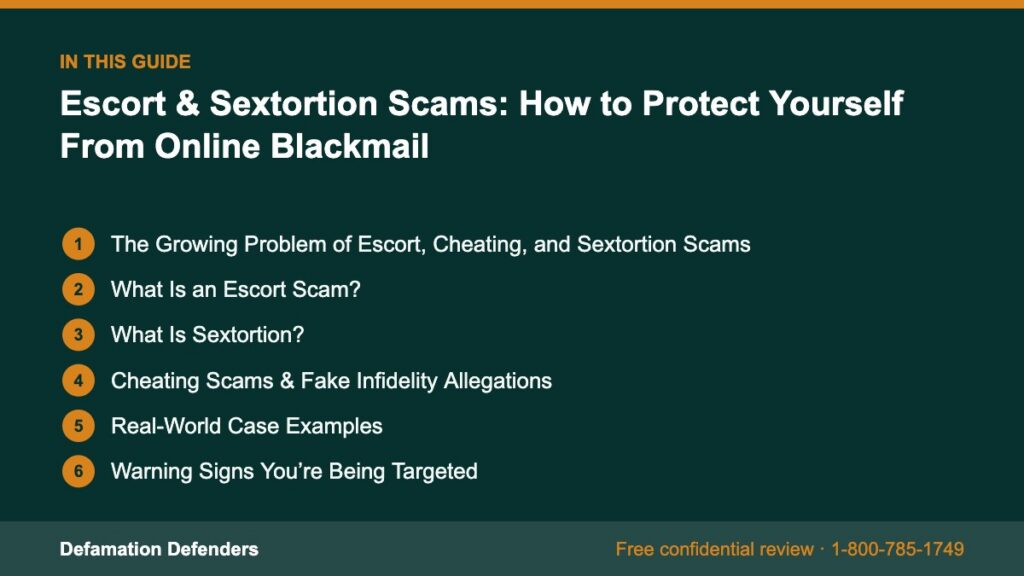
Table Of Content
The Growing Problem of Escort, Cheating, and Sextortion Scams
The internet has made it easier than ever for scammers to exploit human relationships, intimacy, and reputation. One of the most disturbing trends in online fraud today is the rise of escort scams, cheating scams, and sextortion blackmail schemes.
Need help with this? Our leaked content removal service can handle it for you, starting with a free, confidential review and a firm quote before any work begins.
Victims are often lured in through dating apps, escort websites, or social media. Once trust is gained, scammers use threats of exposure to demand money or favors. The result can be devastating—emotionally, financially, and reputationally. Our guide on what to do when private content is leaked explains how to report threats and get images taken down.
At Defamation Defenders, we work with victims across the U.S. to remove harmful content, restore reputations, and prevent scams from escalating. This guide explains how these scams operate, how to protect yourself, and what steps to take if you’ve been targeted.
What Is an Escort Scam?
Escort scams typically start with an online listing, classified ad, or social media post offering companionship. While some ads are legitimate, many are bait for fraud.
Common Escort Scam Tactics:
- Bait-and-Switch: The person in the photos is not the one who arrives.
- Upfront Payment Fraud: Scammers demand wire transfers, crypto, or prepaid cards, then disappear.
- Hidden Fees: Victims are pressured into paying for “extra services,” “travel costs,” or “safety deposits.”
- Blackmail: Once private communications or explicit images are exchanged, scammers threaten exposure.
These scams often intertwine with sextortion schemes, making the victim feel trapped and powerless.
What Is Sextortion?
Sextortion is a form of online blackmail where a scammer threatens to release sexual content (real or fabricated) unless demands are met. According to the FBI’s IC3, sextortion cases have skyrocketed in the past five years, with losses in the tens of millions【FBI.gov†source】.
Sextortion Methods Include:
- Fake Romantic Profiles: Scammers pose as attractive strangers and quickly request intimate content.
- Video Call Recording: A “flirtatious” chat is secretly recorded and later used as blackmail.
- Hacked Accounts: Criminals gain access to private images stored in cloud accounts or messaging apps.
- Fabricated Evidence: Some scammers create fake screenshots or doctored conversations alleging infidelity.
The psychological impact can be severe—victims often feel fear, shame, and helplessness, which makes them more likely to comply.
Cheating Scams & Fake Infidelity Allegations
Cheating scams exploit the fear of infidelity. The scammer may email or message you, claiming to have proof of an affair. They may threaten to expose alleged cheating to your partner, friends, or employer unless you pay.
Even if completely false, the accusation itself can damage reputations. These scams often target professionals, public figures, and anyone with a reputation to protect.
Real-World Case Examples
- Case 1: Social Media Sextortion
A college student was tricked into sharing explicit photos with someone posing as a peer. Within hours, the scammer demanded $5,000 in Bitcoin or threatened to send the photos to the victim’s family and university contacts. - Case 2: Escort Blackmail
A business executive arranged a meeting with someone from an escort site. After exchanging messages and a deposit, he received threats that the conversation would be forwarded to his employer unless he paid thousands more. - Case 3: Fabricated Cheating Evidence
A married professional received an email claiming the sender had screenshots of an affair. The images were photoshopped, but the stress nearly ruined his marriage. Defamation Defenders helped suppress the content before it spread.
Warning Signs You’re Being Targeted
- A stranger pressures you to share intimate photos quickly.
- Someone demands payment in Bitcoin, gift cards, or prepaid debit cards.
- You’re threatened with exposure to family, employer, or social circles.
- You receive unexpected messages with claims of “evidence” of cheating.
- Your private accounts show signs of hacking or unauthorized logins.

What To Do If You’re a Victim
1. Do Not Pay
Paying scammers almost never resolves the problem. Instead, it signals that you’re vulnerable to repeat exploitation.
2. Document Everything
Take screenshots of conversations, payment demands, and threats. Save emails and messages. This evidence may be crucial if law enforcement or attorneys get involved.
3. Report the Crime
- File a complaint with the FBI IC3.
- Contact your local police department or cybercrime unit.
- If minors are involved, report immediately to NCMEC CyberTipline.
4. Lock Down Your Accounts
- Change passwords immediately.
- Enable two-factor authentication.
- Review privacy settings on all platforms.
5. Seek Professional Help
A specialized reputation management and content removal team can help get extortion content deleted and mitigate reputational damage.
State-by-State Legal Remedies
Laws against sextortion and online blackmail vary by state, but most fall under extortion, harassment, or cybercrime statutes. Here’s a quick overview:
- California: Penal Code §518 covers extortion, including online blackmail.
- Texas: Penal Code §21.16 criminalizes unlawful disclosure of intimate material (“revenge porn”).
- New York: Penal Law §155 covers coercion and blackmail.
- Florida: Statute §836.05 makes written threats to extort a felony.
In many states, sextortion can also be prosecuted under federal law, particularly if it involves interstate communication.
How Defamation Defenders Can Help
Victims of escort scams, cheating scams, and sextortion often fear permanent damage to their reputation. Our services include:
- Content Removal: We work to remove sextortion and blackmail content from escort sites, forums, and social media.
- Search Result Suppression: If content cannot be removed, we bury it with positive content.
- Crisis Management: Immediate action plans to minimize exposure.
- Ongoing Monitoring: Alerts for new threats or mentions of your name online.
👉 Explore our full content removal services
Frequently Asked Questions (FAQs)
No. Paying typically leads to repeated demands and more threats.
In many cases, yes. Defamation Defenders helps remove content from websites, forums, and search results.
Having a response plan in place is critical. Our team helps victims control the narrative and minimize reputational fallout.
Yes. Sextortion is a form of blackmail and is illegal under state and federal laws.
Immediately. The faster you involve professionals, the higher the chance of removing harmful content before it spreads.
Escort scams, cheating scams, and sextortion are designed to exploit your fear and shame. But you don’t have to face them alone. By acting quickly—preserving evidence, reporting the crime, and working with professionals—you can protect your reputation and stop the extortion cycle.
Contact Defamation Defenders today for a confidential consultation and regain control of your online image.
Naked URLs List
- https://www.ic3.gov/
- https://report.cybertip.org/
- https://defamationdefenders.com/content-removal-service/
- https://defamationdefenders.com/how-to-get-court-order-to-remove-website/
Related Contents:
